Background and career
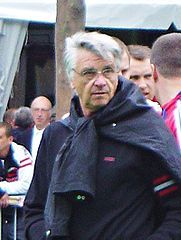
Aimé Étienne Jacquet (French pronunciation: [eme ʒakɛ]; born 27 November 1941) is a French former professional football player and manager. He was the manager of the France national team from 1993 until 1998. He managed France to victory in the 1998 FIFA World Cup as the host nation, stepping down from his position immediately after the tournament.
Jacquet was born in Sail-sous-Couzan, Loire. He began his career as an amateur player for his local club, US Couzan, while working in a factory.
Scouted by Saint-Étienne, he joined Les Verts in 1960. One of the most successful clubs of the time, Saint-Étienne, won an impressive five league titles and three French Cups in his 11 years with the club. He also played for the French national team, playing two games in 1968. In 1973, he left Saint-Étienne for regional rivals Olympique Lyonnais, where he ended his career as a player.
Jacquet pursued a solid managerial career for several clubs in France and gained an impressive list of accolades, most notably for Bordeaux during the 1980s, leading them to three league titles, two French Cups, two European semi-finals and one-quarter-final. Dismissed by President Claude Bez in 1989, he left Bordeaux to hone his managerial skills with more modest teams like Montpellier, and Nancy. In 1991, he accepted a position with the National Technical Department (DTN, Direction Technique Nationale). In 1992, he was appointed the assistant to then national team manager Gérard Houllier.
After the France national team was knocked out of qualifying for the 1994 FIFA World Cup, finishing third of the group behind Sweden and Bulgaria, Jacquet was made the manager of the national team, but only provisionally. After a promising series of friendly matches including a victory over Italy, his provisional status was upgraded to permanent. Jacquet initially selected Eric Cantona as captain and made him the team's playmaker. Cantona was successfully establishing his career in the FA Premier League and was playing some of the best football of his career, but notoriously kicked a Crystal Palace fan in January 1995, which earned him a year-long suspension from all international matches. As Cantona was the key playmaker, Jacquet was forced to make major changes to the team in the wake of his suspension. Jacquet revamped the squad with some new blood and built it around Zinedine Zidane and other younger players while dropping Cantona, Jean-Pierre Papin, and David Ginola. Jacquet succeeded in helping France qualify for the Euro 96. Making it all the way to the semi-finals, Les Bleus managed to show they could survive without veterans such as Papin, Cantona, or Ginola. Jacquet himself stated that the team had done well without Cantona, and that he wanted to keep faith with the players who had taken them this far.
In the months that followed the Euro 96, Jacquet honed his team's skills in a series of friendly matches. He adopted a very defensive strategy. The press began to criticize the team manager, calling his methods "paleolithic". In June 1997 at Le Tournoi, cries of "Resign!" could be heard from the crowd as the French team finished third behind England and Brazil, only coming out ahead of Italy by virtue of goal difference. The media also continued to criticize Jacquet. The media's distrust of Jacquet reached fever pitch in May 1998 when, instead of a list of 22 players meant to play in the World Cup, Jacquet gave a list of 28 players, causing the sports daily L'Équipe to write an editorial arguing that Jacquet was not the right man to lead the French team to victory.
Sources
Net-worth figure: Celebrity Net Worth (October 2026), in USD. Biography and career facts: the person's Wikipedia article and linked reporting. Snapshot date for all StarWorth figures: 28 October 2026.


