Background and career
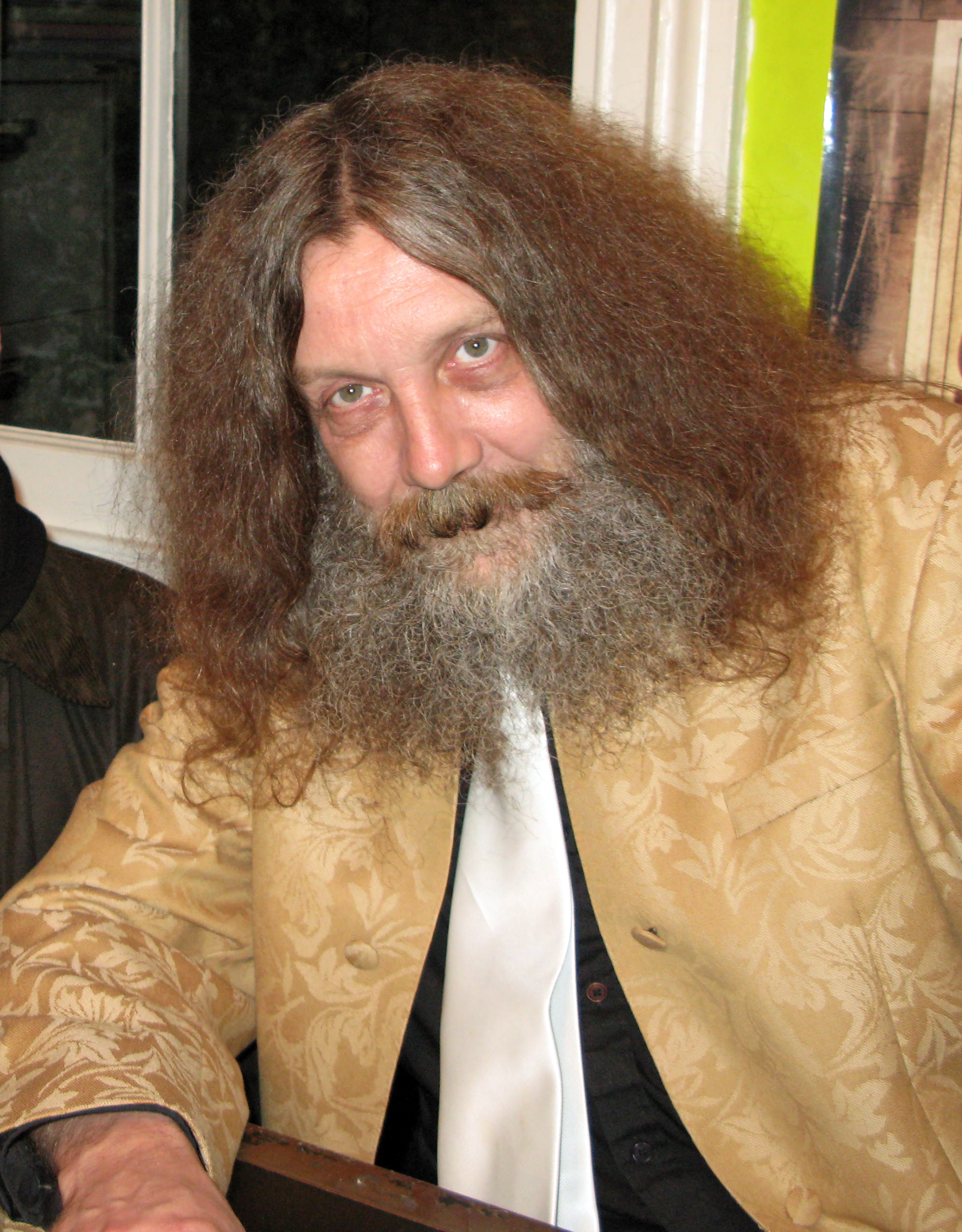
Alan Moore (born 18 November 1953) is an English author known primarily for his work in comics including Watchmen, V for Vendetta, The Ballad of Halo Jones, Swamp Thing, Batman: The Killing Joke, Superman: Whatever Happened to the Man of Tomorrow? and From Hell. He is widely recognised among his peers and critics as one of the best comic book writers in the English language. Moore has occasionally used such pseudonyms as Curt Vile, Jill de Ray, Brilburn Logue and Translucia Baboon; also, reprints of some of his work have been credited to The Original Writer when Moore requested that his name be removed. Moore started writing for British underground and alternative fanzines in the late 1970s before achieving success publishing comic strips in such magazines as 2000 AD and Warrior. He was subsequently picked up by DC Comics as "the first comics writer living in Britain to do prominent work in America", where he worked on major characters such as Batman (Batman: The Killing Joke) and Superman ("Whatever Happened to the Man of Tomorrow?"), substantially developed the character Swamp Thing, and penned original titles such as Watchmen. During that decade, Moore helped to bring about greater social respectability for comics in the United States and United Kingdom. He prefers the term "comic" to "graphic novel". In the late 1980s and early 1990s he left the comic industry mainstream and went independent for a while, working on experimental work such as the epic From Hell and the prose novel Voice of the Fire. He subsequently returned to the mainstream later in the 1990s, working for Image Comics, before developing America's Best Comics, an imprint through which he published works such as The League of Extraordinary Gentlemen and the occult-based Promethea. In 2016, he published Jerusalem: a 1,266-page experimental novel set in his hometown of Northampton, UK. Moore is an occultist, ceremonial magician, and anarchist, and has featured such themes in works including Promethea, From Hell and V for Vendetta, as well as performing avant-garde spoken-word occult "workings" with The Moon and Serpent Grand Egyptian Theatre of Marvels, some of which have been released on CD. Despite his objections, Moore's works have provided the basis for several Hollywood films, including From Hell (2001), The League of Extraordinary Gentlemen (2003), V for Vendetta (2005) and Watchmen (2009). Moore has also been referenced in popular culture and has been recognised as an influence on a variety of literary and television figures including Neil Gaiman and Damon Lindelof. He has lived a significant portion of his life in Northampton, England, and he has said in various interviews that his stories draw heavily from his experiences living there.
Moore was born on 18 November 1953, at St Edmund's Hospital in Northampton to a working-class family who he believed had lived in the town for several generations. He grew up in a part of Northampton known as The Boroughs, a poverty-stricken area with a lack of facilities and high levels of illiteracy, but he nonetheless "loved it. I loved the people. I loved the community and ... I didn't know that there was anything else." He lived in a house with his parents, brewery worker Ernest Moore and printer Sylvia Doreen, with his younger brother Mike, and with his maternal grandmother. He "read omnivorously" from the age of five, getting books out of the local library, and subsequently attended Spring Lane Primary School. At the same time, he began reading comic strips, initially in British comics, such as Topper and The Beezer, but eventually also American imports such as The Flash, Detective Comics, Fantastic Four and Blackhawk. He later passed his 11-plus exam and was, therefore, eligible to go to Northampton Grammar School, where he first came into contact with people who were middle class and better educated, and he was shocked at how he went from being one of the top pupils at his primary school to one of the lowest in the class at secondary. Subsequently, disliking school and having "no interest in academic study", he believed that there was a "covert curriculum" being taught that was designed to indoctrinate children with "punctuality, obedience and the acceptance of monotony". In the late 1960s, Moore began publishing his poetry and essays in fanzines, eventually setting up his fanzine, Embryo. Through Embryo, Moore became involved in a group known as the Northampton Arts Lab. The Arts Lab subsequently made significant contributions to the magazine. He began dealing the hallucinogenic LSD at school, being expelled for doing so in 1970—he later described himself as "one of the world's most inept LSD dealers". The headmaster of the school subsequently "got in touch with various other academic establishments that I'd applied to and told them not to accept me because I was a danger to the moral well-being of the rest of the students there, which was possibly true."
LSD was an incredible experience. Not that I'm recommending it for anybody else; but for me it kind of—it hammered home to me that reality was not a fixed thing. That the reality that we saw about us every day was one reality, and a valid one—but that there were others, different perspectives where different things have meaning that were just as valid. That had a profound effect on me. While continuing to live in his parents' home for a few more years, he moved through various jobs, including cleaning toilets and working in a tannery. In late 1973, he met and began a relationship with Northampton-born Phyllis Dixon, with whom he moved into "a little one-room flat in the Barrack Road area in Northampton". Soon marrying, they moved into a new council estate in the town's eastern district while he worked in an office for a sub-contractor of the local gas board. Moore felt that he was not being fulfilled by this job, and so decided to try to earn a living doing something more artistic.
Abandoning his office job, he decided to instead take up both writing and illustrating his own comics. He had already produced a couple of strips for several alternative fanzines and magazines, such as Anon E. Mouse for the local paper Anon, and St. Pancras Panda, a parody of Paddington Bear, for the Oxford-based Back Street Bugle. His first paid work was for a few drawings that were printed in NME. In late 1979/early 1980, he and his friend, comic-book writer Steve Moore (whom he had known since he was fourteen) co-created the violent cyborg character Axel Pressbutton for some comics in Dark Star, a British music magazine. (Steve Moore wrote the strip under the name "Pedro Henry", while Alan Moore drew them using the pseudonym of Curt Vile, a pun on the name of composer Kurt Weill.) Not long afterward, Alan Moore succeeded in getting an underground comix-type series about a private detective known as Roscoe Moscow (who is investigating the "death of Rock N' Roll") published (under the Curt Vile name) in the weekly music magazine Sounds, earning £35 a week. Alongside this, he and Phyllis, with their newborn daughter Leah, began claiming unemployment benefit to supplement this income. After the conclusion of Roscoe Moscow, Moore started a new strip for Sounds—the serialised comic "The Stars My Degradation" (a reference to Alfred Bester's The Stars My Destination), featuring Axel Pressbutton. Moore wrote most of the episodes of "The Stars My Degradation" and drew all of them, which appeared in Sounds from 12 July 1980, to 19 March 1983. Beginning in 1979 Moore created a new comic strip known as Maxwell the Magic Cat in the Northants Post (based in Moore's hometown), under the pseudonym of Jill de Ray (a pun on the Medieval child murderer Gilles de Rais, something he found to be a "sardonic joke"). Earning a further £10 a week from this, he decided to sign off of social security and to continue writing and drawing Maxwell the Magic Cat until 1986. Moore has stated that he would have been happy to continue Maxwell's adventures almost indefinitely but ended the strip after the newspaper ran a negative editorial on the place of homosexuals in the community. Meanwhile, Moore decided to focus more fully on writing comics rather than both writing and drawing them, stating that "After I'd been doing [it] for a couple of years, I realised that I would never be able to draw well enough and/or quickly enough to actually make any kind of decent living as an artist." To learn more about how to write a successful comic-book script, he asked for advice from his friend Steve Moore. Interested in writing for 2000 AD, one of Britain's most prominent comic magazines, Alan Moore then submitted a script for their long-running and successful series Judge Dredd. While having no need for another writer on Judge Dredd, which was already being written by John Wagner, fellow writer Alan Grant saw promise in Moore's work—later remarking that "this guy's a really fucking good writer"—and instead asked him to write some short stories for the publication's Future Shocks series. While the first few were rejected, Grant advised Moore on improvements, and eventually accepted the first of many. Meanwhile, Moore had also begun writing minor stories for Doctor Who Weekly and later commented that "I really, really wanted a regular strip. I didn't want to do short stories ... But that wasn't what was being offered. I was being offered short four or five-page stories where everything had to be done in those five pages. And, looking back, it was the best possible education that I could have had in how to construct a story."
From 1980 until 1986, Moore maintained his status as a freelance writer and was offered a spate of work by a variety of comic book companies in Britain, mainly Marvel UK, and the publishers of 2000 AD and Warrior. He later remarked that "I remember that what was generally happening was that everybody wanted to give me work, for fear that I would just be given other work by their rivals. So everybody was offering me things." It was an era when comic books were increasing in popularity in Britain, and according to Lance Parkin, "the British comics scene was cohering as never before, and it was clear that the audience was sticking with the title as they grew up. Comics were no longer just for very small boys: teenagers—even A-level and university students—were reading them now." During this period, 2000 AD accepted and published over fifty of Moore's one-off stories for their Future Shocks and Time Twisters science fiction series. The editors at the magazine were impressed by Moore's work and decided to offer him a more permanent strip, starting with a story that they wanted to be vaguely based upon the hit film E.T. the Extra-Terrestrial. The result, Skizz, which was illustrated by Jim Baikie, told the story of the titular alien who crashes to Earth and is cared for by a teenager named Roxy, and Moore later noted that in his opinion, this work "owes far too much to Alan Bleasdale." Another series he produced for 2000 AD was D.R. and Quinch, which was illustrated by Alan Davis. The story, which Moore described as "continuing the tradition of Dennis the Menace, but giving him a thermonuclear capacity", revolved around two delinquent aliens, and was a science-fiction take on National Lampoon's characters O.C. and Stiggs. The work widely considered to be the highlight of his 2000 AD career, and that which he described as "the one that worked best for me", was The Ballad of Halo Jones. Co-created with artist Ian Gibson, the series was about a young woman in the 50th century. The series was discontinued after three books due to a dispute between Moore and Fleetway, the magazine's publishers, over the intellectual property rights of the characters Moore and Gibson had co-created. Another comic company to employ Moore was Marvel UK, who had formerly purchased a few of his one-off stories for Doctor Who Weekly and Star Wars Weekly. Aiming to get an older audience than 2000 AD, their main rival, they employed Moore to write for the regular strip Captain Britain, "halfway through a storyline that he's neither inaugurated nor completely understood." He replaced the former writer Dave Thorpe but maintained the original artist, Alan Davis, whom Moore described as "an artist whose love for the medium and whose sheer exultation upon finding himself gainfully employed within it shine from every line, every new costume design, each nuance of expression."
The third comic company that Moore worked for in this period was Quality Communications, publishers of a new monthly magazine called Warrior. The magazine was founded by Dez Skinn, a former editor of both IPC (publishers of 2000 AD) and Marvel UK, and was designed to offer writers a greater degree of freedom over their artistic creations than was allowed by pre-existing companies. It was at Warrior that Moore "would start to reach his potential". Moore was given two ongoing strips in Warrior: Marvelman and V for Vendetta, both of which debuted in Warrior's first issue in March 1982. V for Vendetta was a dystopian thriller set in a future 1997 where a fascist government controlled Britain, opposed only by a lone anarchist dressed in a Guy Fawkes costume who turns to terrorism to topple the government. Illustrated by David Lloyd, Moore was influenced by his pessimistic feelings about the Thatcherite Conservative government, which he projected forward as a fascist state in which all ethnic and sexual minorities had been eliminated. It has been regarded as "among Moore's best work" and has maintained a cult following throughout subsequent decades. Marvelman (later retitled Miracleman for legal reasons) was a series that originally had been published in Britain from 1954 through to 1963, based largely upon the American comic Captain Marvel. Upon resurrecting Marvelman, Moore "took a kitsch children's character and placed him within the real world of 1982". The work was drawn primarily by Garry Leach and Alan Davis. The third series that Moore produced for Warrior was The Bojeffries Saga, a comedy about a working-class English family of vampires and werewolves, drawn by Steve Parkhouse. Warrior closed before these stories were completed, but under new publishers both Miracleman and V for Vendetta were resumed by Moore, who finished both stories by 1989. Moore's biographer Lance Parkin remarked that "reading them through together throws up some interesting contrasts—in one the hero fights a fascist dictatorship based in London, in the other an Aryan superman imposes one." Although Moore's work numbered amongst the most popular strips to appear in 2000 AD, Moore himself became increasingly concerned at the lack of creator's rights in British comics. In 1985, he talked to fanzine Arkensword, noting that he had stopped working for all British publishers bar IPC, "purely for the reason that IPC so far have avoided lying to me, cheating me or generally treating me like shit." He did join other creators in decrying the wholesale relinquishing of all rights, and in 1986 stopped writing for 2000 AD, leaving mooted future volumes of the Halo Jones story unstarted. Moore's outspoken opinions and principles, particularly on the subject of creator's rights and ownership, would see him burn bridges with a number of other publishers over the course of his career. Meanwhile, during this same period, he—using the pseudonym of Translucia Baboon—became involved in the music scene, founding his own band, The Sinister Ducks, with David J (of goth band Bauhaus) and Alex Green, and in 1983 released a single, March of the Sinister Ducks, with sleeve art by illustrator Kevin O'Neill. In 1984, Moore and David J released a 12-inch single featuring a recording of "This Vicious Cabaret", a song featured in V for Vendetta, which was released on the Glass Records label. Moore wrote the song "Leopardman at C&A" for David J, and it was set to music by Mick Collins for the album We Have You Surrounded by Collins' group The Dirtbombs.


