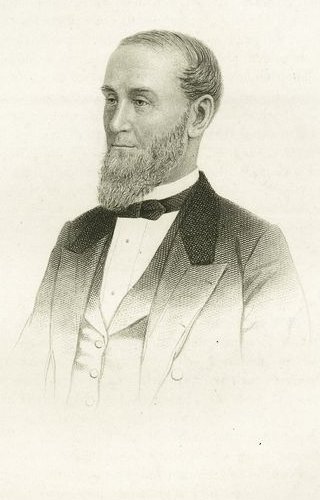
Background and career
Alexander Turney Stewart (October 12, 1803 – April 10, 1876) was an Irish-American entrepreneur who moved to New York and made his multimillion-dollar fortune in the most extensive and lucrative dry goods store in the world. Stewart was born in Lisburn, Ulster, Ireland, and abandoned his original aspirations of joining the clergy to go to New York City in 1823. He spent a short time teaching before returning to Ireland to receive the money his grandfather had left him, purchase some Belfast linens and laces, and return to New York to open a store. Stewart had extraordinary skill in business, and by 1846 he had built a large marble-fronted store on Broadway between Chambers Street and Reade Street, which was devoted to the wholesale branch of his business. In 1862 he built a new store covering an entire city block between Broadway and Fourth Avenue and between 9th and 10th streets. It was eight stories tall and attracted the wonder and business of upscale New York. Trainloads of wealthy customers from outlying cities came to shop. Stewart made most of his money through wholesaling and especially New York City real estate. He opened branches of the company in other parts of the world and owned several mills and factories. He had an annual income of US$1,843,637 in 1863 (equivalent to $37.8 million in 2025). His business success is estimated to have made him one of the twenty wealthiest people in history as of 2007, with a fortune equivalent to approximately US$90 billion in 2012.
Alexander Turney Stewart was born in Lisburn, Ireland, to Scottish Protestant parents on October 12, 1803. Three weeks after his birth, Stewart's farmer father died of tuberculosis. About two years later Stewart's mother remarried and followed her new husband to America, leaving Stewart behind to be raised by his grandfather, John Torney. Torney wanted his only grandson to become a minister in the Church of Ireland. At age seven Stewart was sent to a village school, and in 1814 entered Mr. Neely's English Academy. When Stewart's grandfather died in 1816 he was brought into the home of Thomas Lamb, an Irish Quaker. Upon completing his formal education at Belfast Academical Institution he wrote to his mother in New York City. While incubating a desire to move there, the fifteen-year-old Stewart was prevailed upon by Lamb to gain some business experience by earning money as a grocer in Belfast. Quickly wearying of the work, Stewart packed his bags in the spring of 1818 and left for New York with the $500 he had earned as a bag boy. After six weeks at sea, Stewart arrived at his mother's home. He became a $300-a-year tutor at Isaac N. Bragg's Academy, a school for wealthy youths on Roosevelt Street, and joined an Episcopal church run by Reverend Edward Mitchell. There he met his future wife, Cornelia Mitchell Clinch, the daughter of Susannah Banker and James Clinch, a wealthy ship chandler. Cornelia's brother Charles P. Clinch (1797–1880) was Acting Collector of the Port of New York.
Historians know little about Stewart's life between 1818 and 1822, except that he returned to Ireland upon receiving his grandfather's inheritance of value between US$5,000 and $10,000. The will pertaining to Stewart stated:
I bequeath to my dear grandson ALEXANDER all the rest of my property, houses, and land, with the appurtenances thereto, stock, crop, and chattels of every kind. The money arising from the sale of the property devised to him to be subject to the payment by my said grandson ALEXANDER T. STEWART of an annuity to his grandmother, MARTHA STEWART, of three guineas a year during her life. Upon returning to New York City in 1823, Stewart married Cornelia on October 16. Before marrying, Stewart opened his first store, located at 283 Broadway, which sold Irish fabrics and domestic calicos purchased with funds from his inheritance and earnings as a tutor.
The store opened on September 1, 1823, just across from City Hall Park, north of Chambers Street on the opposite side of Broadway from where his later Marble Palace was to stand. Rented for $375 a year, it measured 12.5 feet wide by 30 feet deep, rather small by today's standards but average during the 19th century. A larger front section used for the business was divided by a thin wall from a smaller back section which served as Stewart's residence. Unlike other dry goods competitors located along Pearl Street, Stewart placed his store several blocks west on Broadway. He believed customers would travel to buy goods where they could most easily find the best prices, stating that the key to success was not where the store was placed, but rather where "to obtain wholesale trade to undersell competitors". When first opening the store, Stewart placed cases full of merchandise along the sidewalk in front of the store as a way of advertising his establishment. Stewart claimed that "the messy clutter in front of the store and pushing crowds advertised the business." As he rose to the top of the retail developers, Stewart included no signs on any place of his store and did not use any advertisements until May 13, 1831. He felt that anyone who wanted to shop in his store would "know where it was located." A natural salesman, Stewart realized that "you will deal with ignorant, opinionated and innocent people. You will often have an opportunity to cheat them. If they could, they would cheat you, or force you to sell at less than cost. You must be wise, but not too wise. You must never actually cheat the customer, even if you can.... You must make her happy and satisfied, so she will come back." Stewart held that the key to establishing a great business was to make friends with the customers and encourage their return, i.e., to focus on customer service.
Between 1845 and 1846, the construction and finishing details of one of Stewart's most famous buildings, the "Marble Palace" at 280 Broadway, were completed. This establishment, "the cradle of the department store", sent A. T. Stewart & Company to the top of America's most successful retailers. The building, originally four stories over a ground floor supported on cast-iron Corinthian columns, survives at 280 Broadway at the corner of Chambers Street, just across from his first store. It offered imported European women's clothing. In addition to its merchandise, the second floor offered the first women's "fashion shows" as full-length mirrors enabled women to view themselves from different angles. The Italianate design, faced with Tuckahoe marble, featured four floors of pedimented windows, the first commercial building in the United States to display an extravagant exterior. Inside, Stewart wanted not only to display his merchandise, but to emphasize natural light from the structure's central rotunda and high ceilings. "The Marble Palace" was the first "big store" that sold merchandise and was a huge financial success. In 1855 Stewart's personal fortune was estimated to be $2.25 million. In 1856 Stewart expanded his merchandise to include furs, "the best and most natural skins", as customers were told. In the 1850s, he also followed other retailers such as Macy's, Lord and Taylor and B. Altman and Company to the area which was to be called "Ladies' Mile", on Broadway and Sixth Avenue between 9th Street and 23rd Street.
Sources
Net-worth figure: Celebrity Net Worth (October 2026), in USD. Biography and career facts: the person's Wikipedia article and linked reporting. Snapshot date for all StarWorth figures: 28 October 2026.


