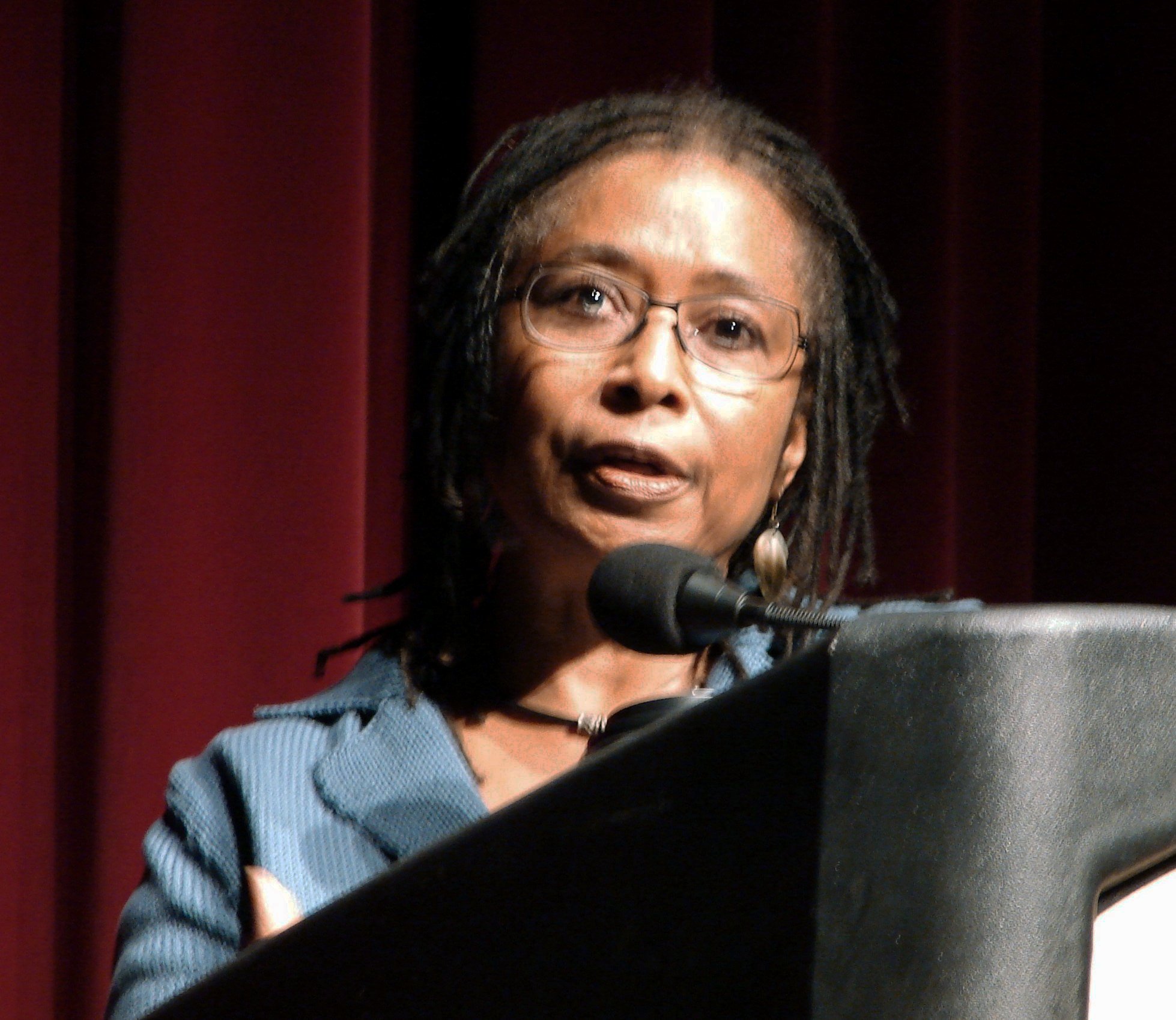
Background and career
Alice Malsenior Tallulah-Kate Walker (born February 9, 1944) is an American novelist, short story writer, poet, and social activist. In 1982, she became the first African-American woman to win the Pulitzer Prize for Fiction, which she was awarded for her novel The Color Purple. Over the span of her career, Walker has published seventeen novels and short story collections, twelve non-fiction works, and collections of essays and poetry. Walker, born in rural Georgia, overcame challenges such as childhood injury and segregation to become high school valedictorian and graduate from Sarah Lawrence College. She began her writing career with her first book of poetry, Once, and later wrote novels, including her best-known work, The Color Purple. As an activist, Walker participated in the Civil Rights Movement, advocated for women of color through the term "womanism," and has been involved in animal advocacy and pacifism. Additionally, she has taken a strong stance on the Israeli–Palestinian conflict, supporting the Boycott, Divestment and Sanctions campaign against Israel. Walker has faced multiple accusations of antisemitism due to her praise for British conspiracy theorist David Icke and his works, which contain antisemitic conspiracy theories, along with criticisms of her own writings.
Alice Malsenior Walker was born in Eatonton, Georgia, a rural farming town, to Willie Lee Walker and Minnie Tallulah Grant. Both of Walker's parents were sharecroppers, though her mother also worked as a seamstress to earn extra money. Walker, the youngest of eight children, was first enrolled in school when she was just four years old at East Putnam Consolidated. As an eight-year-old, Walker sustained an injury to her right eye after one of her brothers fired a BB gun. Since her family did not have access to a car, Walker could not receive immediate medical attention, causing her to become permanently blind in that eye. It was after the injury to her eye that Walker began to take up reading and writing. The scar tissue was removed when Walker was 14, but a mark still remains. It is described in her essay "Beauty: When the Other Dancer is the Self". As the schools in Eatonton were segregated, Walker attended the only high school available to Black students: Butler Baker High School. There, she went on to become valedictorian, and enrolled in Spelman College in 1961 after being granted a full scholarship by the state of Georgia for having the highest academic achievements of her class. She found two of her professors, Howard Zinn and Staughton Lynd, to be great mentors during her time at Spelman, but both were transferred two years later. Walker was offered another scholarship, this time from Sarah Lawrence College in Yonkers, New York, and after the firing of her Spelman professor, Howard Zinn, Walker accepted the offer. Walker became pregnant at the start of her senior year and had an abortion; this experience, as well as the bout of suicidal thoughts that followed, inspired much of the poetry found in Once, Walker's first collection of poetry. Walker graduated from Sarah Lawrence College in 1965.
Walker wrote the poems that would culminate in her first book of poetry, entitled Once, while she was a student in East Africa and during her senior year at Sarah Lawrence College. Walker would slip her poetry under the office door of her professor and mentor, Muriel Rukeyser, when she was a student at Sarah Lawrence. Rukeyser then showed the poems to her literary agent. Once was published four years later by Harcourt Brace Jovanovich. Following graduation, Walker briefly worked for the New York City Department of Welfare, before returning to the South. She took a job working for the Legal Defense Fund of the National Association for the Advancement of Colored People in Jackson, Mississippi. Walker also worked as a consultant in Black history to the Friends of the Children of Mississippi Head Start program. She later returned to writing as writer-in-residence at Jackson State University (1968–69) and Tougaloo College (1970–71). In addition to her work at Tougaloo College, Walker published her first novel, The Third Life of Grange Copeland, in 1970. The novel explores the life of Grange Copeland, an abusive, irresponsible sharecropper, husband and father. During this period, Walker published her work in small feminist and lesbian publications in the South associated with the women in print movement, including Sinister Wisdom and Feminary. The women in print movement was an effort by second-wave feminists to establish alternative communications networks of feminists publications, presses, and bookstores created by and for women. Later, at the inaugural National Feminist Bookstore Week in 1995, Walker signed a "feminist writer's pledge" proclaiming the significance of feminist and lesbian presses, along with Jewelle Gomez, Tee Corinne, Dorothy Allison, and Blanche McCrary Boyd. In 1973, before becoming editor of Ms. magazine, Walker and literary scholar Charlotte D. Hunt discovered an unmarked grave they believed to be that of Zora Neale Hurston in Ft. Pierce, Florida. Walker had it marked with a gray marker stating ZORA NEALE HURSTON / A GENIUS OF THE SOUTH / NOVELIST FOLKLORIST / ANTHROPOLOGIST / 1901–1960. The line "a genius of the south" is from Jean Toomer's poem Georgia Dusk, which appears in his book Cane. Hurston was actually born in 1891, not 1901. Walker's 1975 article "In Search of Zora Neale Hurston", published in Ms. magazine and later retitled "Looking for Zora", helped revive interest in the work of this Afro-American writer and anthropologist. In 1976, Walker's second novel, Meridian, was published. Meridian is a novel about activist workers in the South, during the civil rights movement, with events that closely parallel some of Walker's own experiences. In 1982, she published what has become her best-known work, The Color Purple. The novel follows a young, troubled Black woman who is not just fighting her way through a racist white culture, she is also fighting her way through a patriarchal Black culture. The book became a bestseller, and it was subsequently adapted into a critically acclaimed 1985 movie which was directed by Steven Spielberg, starring Oprah Winfrey and Whoopi Goldberg, as well as a 2005 Broadway musical totaling 910 performances. Walker has written several other novels, including The Temple of My Familiar (1989) and Possessing the Secret of Joy (1992) (which featured several characters and descendants of characters from The Color Purple). She has published a number of collections of short stories, poetry, and other writings. Her work is focused on the struggles of Black people, particularly women, and their lives in a racist, sexist, and violent society. In 1993, Alice Walker coauthored a novel, Warrior Marks, alongside feminist activist Pratibha Parmar. The novel was based on the topic of Female Genital Mutilation (FGM) and the Sexual Blinding of Women. The novel takes place in Africa, where the two of them collectively interview several survivors of FGM. The novel seeks to unearth the sociocultural rationale behind the practice by providing a platform to activists who stand in opposition to this issue. In 2000, Walker released a collection of short fiction, based on her own life, called The Way Forward Is With a Broken Heart, exploring love and race relations. In this book, Walker details her interracial relationship with Melvyn Rosenman Leventhal, a civil rights attorney who was also working in Mississippi. The couple married on March 17, 1967, in New York City, since interracial marriage was then illegal in the South, and divorced in 1976. They had a daughter, Rebecca, together in 1969. Rebecca Walker, Alice Walker's only child, is an American novelist, editor, artist, and activist. The Third Wave Foundation, an activist fund, was co-founded by Rebecca and Shannon Liss-Riordan. Her godmother is Alice Walker's mentor and co-founder of Ms. magazine, Gloria Steinem. In 2007, Walker donated her papers, consisting of 122 boxes of manuscripts and archive material, to Emory University's Manuscript, Archives, and Rare Book Library. In addition to drafts of novels such as The Color Purple, unpublished poems and manuscripts, and correspondence with editors, the collection includes extensive correspondence with family members, friends and colleagues, early treatment of the film script for The Color Purple, syllabi from courses she taught, and fan mail. The collection also contains a scrapbook of poetry compiled when Walker was 15, entitled "Poems of a Childhood Poetess". In 2013, Alice Walker published two new books, one of them entitled The Cushion in the Road: Meditation and Wandering as the Whole World Awakens to Being in Harm's Way. The other was a book of poems entitled The World Will Follow Joy: Turning Madness into Flowers (New Poems).
Walker met Martin Luther King Jr. when she was a student at Spelman College in the early 1960s. She credits King for her decision to return to the American South as an activist in the Civil Rights Movement. She took part in the 1963 March on Washington with hundreds of thousands of people. Later, she volunteered to register Black voters in Georgia and Mississippi. On March 8, 2003, International Women's Day, on the eve of the Iraq War, Walker was arrested with 26 others, including fellow authors Maxine Hong Kingston and Terry Tempest Williams, at a protest outside the White House, for crossing a police line during an anti-war rally. Walker wrote about the experience in her essay "We Are the Ones We Have Been Waiting For".
Walker's specific brand of feminism included advocacy on behalf of women of color. In 1983, Walker coined the term womanist in her collection In Search of Our Mothers' Gardens, to mean "a Black feminist or feminist of color". The term was made to unite women of color and the feminist movement at "the intersection of race, class, and gender oppression". Walker states that "'Womanism' gives us a word of our own". because it is a discourse of Black women and the issues they confront in society. Womanism as a movement came into fruition in 1985 at the American Academy of Religion and the Society of Biblical Literature to address Black women's concerns from their own intellectual, physical, and spiritual perspectives." Today, her womanist ideology still persists within several movements including the Black Lives Matter Movement that was formed by Black women in response to police brutality against Black males. The philosophy of womanism also served as the fundamental basis for the #MeToo Movement in which women publicly expressed their experiences of sexual abuse and harassment.
Walker's idea of feminist advocacy emerged in her work, In Search of Our Mothers' Gardens, specifically in the essay, If the Present Looked Like the Past, what would the future Look Like?. In her piece, she reflects on the modern injustices and historical oppression of the feminist movement. She also touches upon the need for compassion, empathy and awareness on behalf of Black women to overcome the past atrocities such as slavery and colonialism. In the end, the essay provides both a critique on the Black feminist movement and a call to action for readers to liberate themselves from discrimination.


