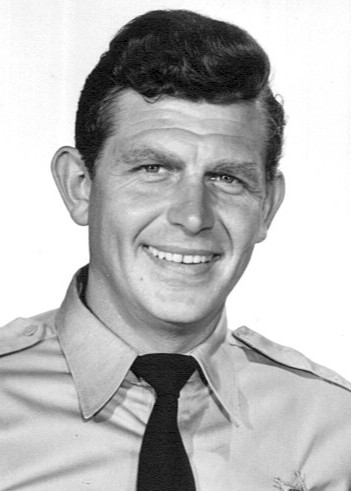
Background and career
Andy Samuel Griffith (June 1, 1926 – July 3, 2012) was an American actor, comedian, television producer, singer, and writer whose career spanned more than six decades. Known for his Southern drawl, Griffith received two Tony Award nominations for his Broadway performances in No Time for Sergeants (1956) and Destry Rides Again (1960). He made his film debut in Elia Kazan's A Face in the Crowd (1957), a role that helped establish his Hollywood career. He became best known for portraying the Sheriff Andy Taylor in the sitcom The Andy Griffith Show (1960–1968) and defence lawyer Ben Matlock in the legal drama Matlock (1986–1995).
Griffith was born on June 1, 1926, in Mount Airy, North Carolina, the only child of Carl Lee Griffith and his wife, Geneva (née Nunn). During his early childhood, Griffith lived with his maternal grandmother while his parents sought work in Ohio. His family could not initially afford a crib or a bed, and he reportedly slept in dresser drawers during infancy. In 1932, Griffith's parents purchased a home in Mount Airy's "blue-collar" south side, where his father worked as a carpenter. By the time he entered school, he faced ridicule because of his family's poverty. He was a shy student, but once he found a way to make his peers laugh, he began to come out of his shell. As a student at Mount Airy High School, Griffith developed an interest in acting and participated in school plays. As a teenager, he developed an interest in swing music. Griffith was raised Baptist and was taught to sing and play the trombone by Edward Mickey, a minister at Grace Moravian Church, who led the brass band. Griffith graduated from high school in 1944. He attended the University of North Carolina (UNC) in Chapel Hill, North Carolina, and graduated with a Bachelor of Arts degree in music in 1949. He began college intending to become a Moravian minister, but changed his major to music and joined the Carolina Playmakers. While attending university, Griffith began performing in The Lost Colony in 1946, a play by Paul Green about the failed 16th-century attempt to establish an English colony on North Carolina's Roanoke Island. He continued performing in the production for seven summers, eventually taking on the role of Sir Walter Raleigh.
At UNC, Griffith was a member of the Phi Mu Alpha Sinfonia music fraternity's Alpha Rho chapter. He also played roles in several student operettas, including The Chimes of Normandy (1946), and Gilbert and Sullivan's The Gondoliers (1945), The Mikado (1948) and H.M.S. Pinafore (1949). After graduation, he taught music and served as an assistant drama coach for several years at Goldsboro High School in Goldsboro, North Carolina, where his students included future radio broadcaster Carl Kasell.
Griffith's early career was as a monologist. Assuming the character of an affable country parson, "Deacon Andy Griffith" delivered comic monologues such as "What It Was, Was Football", in which he described a football game from the perspective of someone unfamiliar with the sport. The monologue was released as a single in 1953 on the Colonial Records label. Capitol Records acquired the master recording and reissued the record in December 1953. It became a hit, reaching number nine on Billboard's Best Sellers in Stores chart in 1954. The B-side of the original Colonial single featured the deacon explaining Shakespeare's Romeo and Juliet in the same rural dialect. Griffith made appearances on television variety shows, including The Ed Sullivan Show in 1954, where he performed his comic monologues. Griffith made his television acting debut in March 1955 as Will Stockdale, a country boy drafted into the United States Air Force, in Ira Levin's television adaptation of No Time for Sergeants, broadcast on the anthology series The United States Steel Hour. He later made a second appearance on the series in Never Know the End (1958). Griffith reprised the role in Ira Levin's full-length stage adaptation of the same name, which opened on Broadway on October 20, 1955. The role earned him a Tony Award nomination for "Distinguished Supporting or Featured Dramatic Actor" at the 1956 Tony Awards, losing to Ed Begley. He also received the 1956 Theatre World Award for his Broadway debut in No Time for Sergeants. Griffith's performance also received positive reviews, including praise from theatre critic Brooks Atkinson of The New York Times.In 1957, Griffith made his feature-film debut starring in A Face in the Crowd. He portrayed Larry "Lonesome" Rhodes, a manipulative and power-hungry drifter who becomes a television personality and gains political influence. The film was directed by Elia Kazan, written by Budd Schulberg and co-starred Patricia Neal, Walter Matthau, Tony Franciosa, and Lee Remick (in her film debut). Griffith also sang as part of his role in A Face in the Crowd. Griffith reprised his role as Will Stockdale in Warner Bros.' 1958 film adaptation of No Time for Sergeants, alongside Don Knotts, who also appeared in the Broadway production. The film influenced the later television sitcom Gomer Pyle, U.S.M.C., a spin-off of The Andy Griffith Show. Following the success of No Time for Sergeants, Warner Bros. cast Griffith in another military comedy, Onionhead (1958), in which he portrayed a US Coast Guard sailor. Griffith's only other Broadway appearance was in the title role of the 1959 musical Destry Rides Again, co-starring Dolores Gray. The show, with a score by Harold Rome, ran for 472 performances between April 1959 and June 1960. Griffith was nominated for the Tony Award for Best Actor in a Musical at the 1960 Tony Awards, losing to Jackie Gleason.
In February 1960, Griffith appeared as Sheriff Andy Taylor, who served as a justice of the peace officer and editor of the local newspaper, in an episode of Make Room for Daddy starring Danny Thomas. The episode, titled "Danny Meets Andy Griffith", featured Thomas's character being stopped for running a stop sign in Mayberry and served as a backdoor pilot for The Andy Griffith Show. Both shows were produced by Sheldon Leonard. Following the backdoor pilot, Griffith began starring as Sheriff Andy Taylor in The Andy Griffith Show, which premiered on CBS in September 1960. Set in the fictional town of Mayberry, North Carolina, the series followed Taylor, a widowed sheriff and town sage. The show was filmed at Desilu Studios, with exteriors filmed at Forty Acres in Culver City, California. From 1960 to 1965, the show co-starred Griffith's longtime friend Don Knotts as Deputy Barney Fife, Taylor's best friend and comedy partner. The show also starred child actor Ron Howard (then known as Ronny Howard), who played Taylor's son, Opie Taylor. Griffith never received a writing credit for the show, but contributed to the development of its scripts. Knotts won five Primetime Emmy Awards, while Frances Bavier won one in 1967. Griffith was never nominate for an Emmy Award during the show's run. Griffith sang in several episodes of The Andy Griffith Show, and during the show's run, he also recorded country and gospel music, including a vocal version of the show's theme song titled "The Fishin' Hole".
In 1967, Griffith announced that he would leave The Andy Griffith Show after its eigth season to pursue a movie career and other projects. During the final season of the show, Ken Berry was introduced as widowed farmer Sam Jones, whose character gradually became the focus of the series in preparation for Griffith's departure. The series was succeeded by Mayberry R.F.D., which premiered on CBS on 23 September 1968, with Berry in the lead role and several cast members from The Andy Griffith Show returning. Griffith served as executive producer, reviewing scripts and providing input on a weekly basis. He also made guest appearances as Andy Taylor, including in the premiere episode, in which Taylor married Helen Crump. Griffith reprised his role alongside Knotts in the 1986 television film, Return to Mayberry. He later participated in reunion specials for The Andy Griffith Show in 1993 and 2003, the latter attracting more than 21 million viewers.


