Background and career
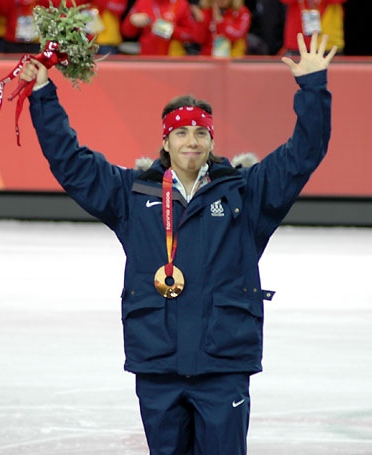
Apolo Anton Ohno (; born May 22, 1982) is an American retired short-track speed skating competitor and an eight-time medalist (two gold, two silver, four bronze) in the Winter Olympics. Ohno was inducted into the International Sports Hall of Fame in 2017 and the U.S. Olympic Hall of Fame in 2019. Raised by his father, Ohno began training full-time in 1996. At the age of 14, he became the youngest U.S. national champion in 1997 and was the reigning champion from 2001 to 2009, winning the title a total of 12 times. In December 1999, he became the youngest skater to win a World Cup event title, and became the first American to win a World Cup overall title in 2001, which he won again in 2003 and 2005. Ohno has been the face of short track in the United States since winning his medals at the 2002 Winter Olympics. He won his first overall World Championship title at the 2008 championships. Ohno's accolades and accomplishments include the United States Olympic Committee's Male Athlete of the Month in October 2003 and March 2008, U.S. Speedskating's Athlete of the Year for 2003, and a finalist for the 2002, 2003, and 2006 Sullivan Award, which recognizes the best amateur athlete in the United States. Since gaining recognition through his sport, Ohno has worked as a motivational speaker, philanthropist, started a nutritional supplement business, and won the 2007 season of Dancing with the Stars. Ohno later became host of a revival of Minute to Win It on Game Show Network and served as a commentator for NBC's coverage of the 2014 Winter Games in Sochi and the 2018 Winter Games in Pyeongchang. Outside of competing, he has been an entrepreneur in the health, wellness, and technology industries.
Ohno was born in Seattle, Washington, to a Japanese-born father, Yuki Ohno (大野 幸, Ōno Yuki) and a European-American mother, Jerrie Lee. Ohno's parents divorced when he was an infant, and he was raised in Seattle by his father. He has had little contact with his biological mother; as of 2002, he had expressed no interest in knowing her or his older half-brother. Ohno's father, a hair stylist and owner of the salon Yuki's Diffusion, often worked 12-hour shifts, and, with no extended family in the United States, found it hard to balance his career with raising a child. His father chose to name his son Apolo not after the Olympian deity Apollo but rather after the Greek words apo, which means to "steer away from", and lo, which means "look out; here he comes." When Ohno was very young, his father meticulously researched childcare providers to care for his son during his long work hours. As Apolo grew older, his father became concerned his son would become a latchkey kid, so Yuki got his son involved with competitive swimming and quad-speed roller skating at age 6. He later switched from the instruction of Benton Redford, a National Champion, to a team in Federal Way, Washington, called Pattison's Team Extreme and became a national inline speedskating champion and record holder himself. His father used inline speed skating to fill his spare time. Ohno's days were spent with morning swimming practices, followed by schooling, and finally skating practices in the afternoon. When Ohno was 12, he won the Washington state championship in the breaststroke, but preferred inline speed skating over swimming. He has stated that by the time he turned 13, he attended parties with older teenagers if he did not have competitions on the weekends. His father has stated that it was a struggle balancing his son's desire for independence while helping him reach his potential as a young athlete.
When he was 13 years old, Ohno became interested in short track speed skating after seeing the sport during the 1994 Olympics in Lillehammer. His father capitalized on this interest by driving him to short track competitions throughout the northwest United States and Canada, and Ohno won several competitions in his age divisions. His father wanted to encourage Ohno to develop his skills and, although Ohno was underage, he got him admitted to the Lake Placid Olympic Training Center in 1996 to train full-time for short track. At 13, Ohno was the youngest skater admitted to the center. At first, Ohno's commitment at Lake Placid was low until his teammates nicknamed him "Chunky", which motivated him to train harder. In January, he failed to make the 1997 U.S. Junior World Team. Ohno adjusted his training and made a comeback winning the 1997 U.S. Senior Championships overall title, taking a gold medal in the 1500 m, a silver in the 300 m, and came in fourth in the 500 m races. At the age of 14, he became the youngest person to win the title. Ohno then relocated to the Colorado Springs Olympic Training Center to begin training with the senior level skaters, despite being only 14 years old. However, Ohno would struggle at the 1997 World Championships in Nagano, Japan, finishing 19th overall. After this disappointing defeat at his first appearance at a world championships, Ohno returned home to Seattle. He did not train from April to August 1997, so he gained weight and was ill-prepared for the 1998 Nagano Winter Olympics. As a result, he finished last in the Olympic trials and did not qualify for the Olympic team. Because of his losses at the World Championships and his failure to qualify for the Olympic team, Ohno recommitted himself to the sport and returned to junior-level skating at Lake Placid, rather than at Colorado Springs. At the 1999 World Junior Championships, Ohno won first overall, placing first in the 1000 m and 1500 m, and winning silver in the 500 m. He won his second senior U.S. national championship in 1999. He finished fourth overall at the 1999 World Championships and earned a silver medal in the 500 m. At the 2000 U.S. Championships, Ohno was unable to defend his title and finished third overall. At the 2000 World Championships, Ohno finished ninth overall. In the 2000–2001 season, Ohno won his first World Cup overall title, regained his National title, and finished second overall in the World Championships, losing to Chinese skater Li Jiajun.
In December 2001, during the U.S. Short Track Speed Skating 2002 Olympic Trials, speed skater Shani Davis was racing for a position on the short track team. Ohno and fellow skater Rusty Smith had already earned slots on the six-man team due to points earned from earlier races. In order for Davis to qualify, he had to place first in the final race—the 1000 m—by overcoming stronger skaters Ohno, Smith, and Ron Biondo. Since Ohno had been dominant in the meet to this point by winning every race he entered, a win by Davis seemed to be unlikely. Though Ohno, Smith, and Biondo were heavily favored to win the 1000 m, the race ended with Ohno finishing third, Smith second, and Davis at the top of the podium. Prior to crossing the finish line, Ohno started celebrating for Davis and Smith. Davis' first-place finish earned enough points to move past Tommy O'Hare in the final point standings and to qualify for sixth place. By finishing second, Smith earned the opportunity to skate individually in the 1000 m. The victory celebration was short-lived as rumors began that Ohno and Smith, both good friends of Davis, intentionally threw the race so Davis would win. After returning to Colorado Springs, O'Hare, who did not skate in the 1000 m, filed a formal complaint. The complaint was founded on Ohno's seemingly deliberate attempt to stop Biondo from being able to pass Smith. Because of that blocking move on Biondo, Smith finished in second place and Davis finished first. For three days, Ohno, Smith, and Davis stood before an arbitration panel of the United States Olympic Committee. During the hearing, Davis was never accused of being at fault and Smith made the statement: "Any allegation that there was a fix, conspiracy, or understanding between Apolo and me, or anyone else, to let Shani win the race is completely false. Shani is a great athlete, skated a great race, and deserves to be on the team." The final verdict was that O'Hare's claims went unproven, all three were absolved of guilt, and the claim was dismissed. After the dismissal, Ohno stated, "I am thrilled that the arbitration process has officially vindicated me... As I've said since the moment of these accusations, they were untrue and I did nothing wrong".
At the 2002 Winter Olympics in Salt Lake City, Utah, Ohno emerged as the face of short-track speed skating among American fans. He was a medalist in two events, but there was controversy associated with the results. After a disqualification in the 500 m race, he was leading the skaters in the 1000 m final. During a turn around the final corner, Ohno, Ahn Hyun Soo, Li Jiajun, and Mathieu Turcotte all fell in a series of cascading collisions. The last man standing, famously, was Steven Bradbury from Australia, who was strategically trailing behind for the duration of the race, skating through to win the gold medal and becoming the first person from the southern hemisphere to win a gold medal at a Winter Olympics. Ohno quickly scrambled to his feet and crossed the finish line to win silver, with Turcotte winning the bronze. Ohno, coincidentally, was wearing skates made by Bradbury's own boot company, Revolutionary Boot Company. Prior to the race, Bradbury, not expecting to win, had ironically emailed Ohno, writing: "If you win gold, make sure you give me a mention!"
In the 1500 m final race A, with one lap remaining and currently in second place, Ohno attempted to make a pass on the leader Kim Dong-Sung of South Korea, who then drifted to the inside and as a result, Ohno raised his arms to imply he was blocked. Kim finished first ahead of Ohno, but the Australian referee James Hewish disqualified Kim for what appeared to be impeding, awarding the gold medal to Ohno. The South Korean team immediately protested the decision, appealing to the International Skating Union (ISU), the International Olympic Committee (IOC) and the Court of Arbitration for Sport (CAS). The challenges were all denied after video review. South Korean media accused Ohno of simulating a foul, using the Konglish word "Hollywood action". The disqualification of Kim upset South Korean supporters, many of whom directed their anger at Ohno and the IOC. A large number of e-mails protesting the race results crashed the IOC's email server, and thousands of accusatory letters, many of which contained death threats, were sent to Ohno and the IOC. Ohno shared his thoughts on the Koreans' hostile reaction by saying, "I was really bothered by it. I grew up around many Asian cultures, Korean one of them. A lot of my best friends were Korean growing up. I just didn't understand. Later on I realized that was built up by certain people and that was directed at me, negative energy from other things, not even resulting around the sport, but around politics, using me to stand on the pedestal as the anti-American sentiment".
Sources
Net-worth figure: Celebrity Net Worth (October 2026), in USD. Biography and career facts: the person's Wikipedia article and linked reporting. Snapshot date for all StarWorth figures: 28 October 2026.


