Background and career
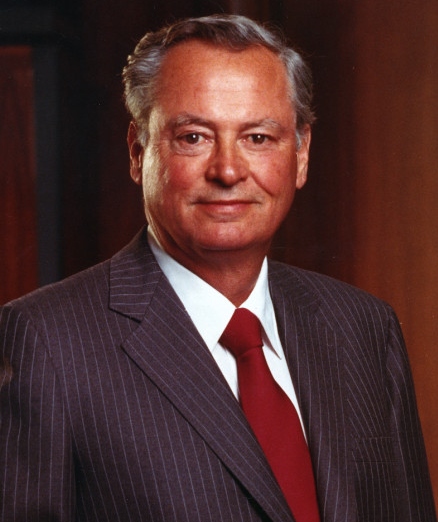
William Barron Hilton (October 23, 1927 – September 19, 2019) was an American business magnate, philanthropist and sportsman. The second son and successor of hotelier Conrad Hilton, he was the chairman, president and chief executive officer of Hilton Hotels Corporation and chairman emeritus of the Conrad N. Hilton Foundation. Hilton, a notable pilot and outdoorsman, was also a founder of the American Football League as the original owner of the Los Angeles Chargers, and helped forge the merger with the National Football League that created the Super Bowl. Like his father before him, he pledged 97 percent of his wealth to the humanitarian work of the Conrad N. Hilton Foundation. At the time, the gift was projected to increase the foundation's endowment from $2.9 billion to $6.3 billion, and will make his estate the organization's most significant donor.
Hilton was born in Dallas, Texas, to Mary Adelaide (née Barron) and Conrad Nicholson Hilton, founder of Hilton Hotels. Hilton grew up with three siblings, Conrad Nicholson Hilton, Jr., Eric Michael Hilton, and Constance Francesca Hilton. His father was of Norwegian and German descent and from New Mexico while his mother was from Kentucky. He was eight years old when his parents divorced, and he was attending school away from home when his father married actress Zsa Zsa Gabor in 1942. In interviews, Hilton described having “a misspent youth” and said that he had been “kicked out of four or five schools.” He also stated that he was not close to his father during that period, as Conrad Hilton was occupied with expanding his hotel business, which began with a property in Cisco, Texas, in 1919. He did not attend college after finishing school. He served in the Navy during World War II as a photographer. As a child, Hilton was fascinated by aviation, and learned to fly when he was 17. After his wartime discharge, he attended the University of Southern California Aeronautical School, where he earned his twin-engine rating at age 19.
Before joining his father in the hotel industry, Barron Hilton honed his business skills in a variety of entrepreneurial ventures. He acquired the Los Angeles-area distributorship of Vita-Pakt Citrus Products, co-founded MacDonald Oil Company, and founded Air Finance Corporation, one of the nation's first aircraft leasing businesses. In 1954, he was elected vice president of Hilton Hotels, running the company's franchise operations and creating the Carte Blanche credit card as a service to the company's customers. In 1959, Lamar Hunt offered Hilton the Los Angeles franchise in the new American Football League (AFL). Hilton named his team the Chargers, but denied that he did it to create synergy with his new credit card business. A fan had nominated the name in a contest, and Hilton selected it because of the bugle call and "Charge!" cheer that was often sounded during USC football games at the Los Angeles Memorial Coliseum. The Chargers began playing at the Coliseum in 1960, but in spite of winning the Western Division, the club found it difficult to compete for fans with the Rams of the National Football League (NFL) in their own stadium. Hilton moved the team to San Diego in time for the 1961 season and played in tiny Balboa Stadium, which the city had expanded to 30,000 seats. Hilton began working with the local newspapers to engender support for construction of a state-of-the-art stadium. Encouraged by San Diego Union sports editor Jack Murphy, among others, a referendum was passed in 1965, and the Chargers began play in the new San Diego Stadium in 1967. With the availability of a new stadium, the city received a baseball expansion franchise from the National League, and the San Diego Padres began play in 1969. Hilton also served as AFL president in 1965, and helped forge the merger between the AFL and the NFL, announced in 1966, which created the Super Bowl. In all, the Chargers won five divisional titles, and one AFL Championship, during Hilton's six years at the helm of the club. In 1966, directors of Hilton Hotels Corporation asked Hilton to succeed his father as president and chief executive officer of the company, provided that he drop his football responsibilities. He sold his majority interest in the team for $10 million—a record for any professional sports franchise at the time—after an initial investment in a franchise fee of just $25,000. With the death of the Bills' Ralph Wilson in 2014, Hilton became the last surviving member of the Foolish Club—the nickname the original AFL owners gave each other, as they absorbed the start-up expenses and player salaries necessary to compete with the established NFL.
In 1970, Hilton convinced the Hilton Hotels board to expand into Las Vegas by purchasing the International and the Flamingo from financier Kirk Kerkorian. Hilton Hotels became the first company listed on the New York Stock Exchange to venture into the gaming market. Renamed the Las Vegas Hilton and the Flamingo Hilton, the two resorts tapped a new source of income from gambling. Hilton saw Las Vegas as a leading convention destination and capitalized on the company's strength in that important market segment. Hilton installed video cameras throughout the casinos to replace the "eye in the sky" system of observers peering through two-way mirrors in the ceiling. After a decade in the movies, Elvis Presley again began performing in front of live audiences in 1969 at the opening of the International (a few years later renamed the Las Vegas Hilton). He went on to star at the Las Vegas Hilton two months a year—performing two shows a night, seven nights a week—until shortly before his death in 1977. Presley set a world entertainment record at the Las Vegas Hilton for selling out 837 consecutive concerts. Having played Las Vegas since 1944, Liberace had created the resident entertainer model on the Las Vegas Strip the year before he befriended Elvis at Presley's first foray on the Strip in 1956. Liberace was signed by Hilton to the same showroom as Presley beginning in 1972, for an unprecedented $300,000 per week. He played his last show at the Las Vegas Hilton in 1980, arriving on stage in a classic car, and closing by flying off stage in a 110 lbs. crystal and ostrich feather cape. The company's expansion into Nevada had an immediate impact on its net income. By 1972, the two resorts contributed 45 percent of the company's income (before interest income, interest expense, write down of investments and sales of properties), nearly matching the income from the other 160 Hilton hotels in the United States.
On the hotel front, in 1975 Hilton sold a 50 percent interest in six of the company's largest hotels to Prudential Insurance Company for $83 million. He took a leaseback to manage the properties, collecting lucrative management fees and a percentage of their gross profits. The sale proved that the hotels were worth double their book value, demonstrating the underlying value of the company's real estate holdings. The transaction also enhanced the value of the stock held by every HHC shareholder. Hilton used the proceeds to pay down high interest debt, and repurchase 20 percent of the company's stock—all at market rate—which was still trading well below the company's book value. Hilton continued to expand the domestic hotel chain through franchising and the selective acquisition of management contracts and hotels in emerging markets. In 1977, he completed a hotel purchase that his father had initiated 28 years earlier. When Conrad Hilton bought the Waldorf-Astoria in 1949, he actually bought the hotel's operating company and its 30-year lease to run the hotel. The building, and the land under it, were still owned by the realty arm of the Penn Central Railroad. Knowing that the lease would expire in 1979, Hilton deftly negotiated to buy the hotel and real estate from the railroad. The landmark property, whose current value is estimated around $1 billion, was purchased by Hilton for just $35 million. As competitors aggressively spread across the U.S. in the '80s, Hilton held his own by rehabbing his own hotels and increasing revenues in Las Vegas. Through a series of massive additions to the Flamingo Hilton and the Las Vegas Hilton, the company nearly tripled its rooms in Las Vegas by 1990, from 2,277 to 6,703. He also launched Conrad International in the '80s, and Hilton Garden Inn in the '90s. Hilton continued as chairman of the board through the next decade as his hand-picked successor, Steve Bollenbach expanded the company through a series of mergers and acquisitions. The advent of friendly capital markets in the late '90s enabled him to acquire such brands as Embassy Suites, DoubleTree, Hampton Inn, Homewood Suites, Bally's and Caesars. Then, in 2005, he reacquired Hilton International, 38 years after it had been sold to TWA. With the company now strategically complete, Bollenbach spun off the gaming business, which merged with Harrah's in 2005 and was renamed Caesars Entertainment. In 2007, private equity firm The Blackstone Group purchased Hilton Hotels Corporation, consisting of 2,800 hotels with 480,000 rooms in 76 countries and territories. Blackstone paid $47.50 per share, a 32 percent premium over the July 2 closing price. The $26 billion, all-cash transaction included $7.5 billion of debt. Host Hotels & Resorts veteran Chris Nassetta was hired to manage the company, which was renamed Hilton Worldwide and is now known as Hilton Inc. Now celebrating the 100th year since Conrad Hilton purchased his first hotel, the company has expanded to include 17 brands, 5,800 hotels, and 939,000 rooms in 114 countries of the world.
In 1979, Barron Hilton's father, Conrad Hilton, died at age 91. He left 13.5 million shares of Hilton Hotels Corporation stock—97 percent of his estate—to the Conrad N. Hilton Foundation, a charity that he had established in 1944.


