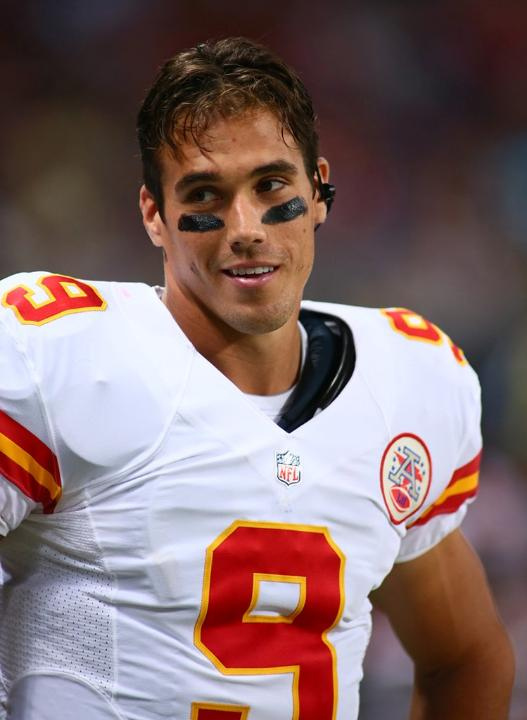
Background and career
Brayden Tyler Quinn (born October 27, 1984) is an American former professional football player who was a quarterback in the National Football League (NFL) for seven seasons. He played college football for the Notre Dame Fighting Irish, winning the Maxwell Award. Quinn was selected by the Cleveland Browns in the first round of the 2007 NFL draft. Following three seasons in Cleveland, he was traded to the Denver Broncos, where he played for two seasons. Quinn spent his last three seasons with the Kansas City Chiefs, the New York Jets, and the St. Louis Rams for one year each.
Quinn was born on October 27, 1984, in Columbus, Ohio, the middle child of Tyrone J. Quinn and Robin D. (née Slates) Quinn. He has an older sister, Laura Quinn, who is married to former NFL and Ohio State linebacker A. J. Hawk, and a younger sister, Kelly Katherine Quinn, who is married to NHL defenseman Jack Johnson. Quinn attended Dublin Coffman High School in Dublin, Ohio, and ranked sixth on the Detroit Free Press "Best of the Midwest" team and was listed at number 20 on ESPN's list of the nation's top 100 prospects. As a junior in 2001, Quinn threw for 2,200 yards and 21 touchdowns to go along with 15 interceptions, posting a 9–4 record and helped lead Coffman to the Division I state semi-finals. As a senior in 2002, he threw for 2,149 yards, threw 25 touchdowns with four interceptions, and completed 143 of 258 pass attempts, and rushed for 108 yards and six touchdowns. Quinn helped his team post an 8–3 record and played in the U.S. Army All-American Bowl in San Antonio, Texas. Quinn was named the Columbus Dispatch and Ohio Capital Conference Offensive Player of the Year and was an All-State choice. Quinn was named an All-Conference player in baseball as a junior and lettered three times and was a part of the 2001 State Championship team. He was a member of Young Life, the Rock Solid Club, and Who's Who Among America High School Students. In the fall of 2002, Quinn received a scholarship from the University of Notre Dame, acting on a tip from fellow recruit Chinedum Ndukwe's father.
Quinn accepted the offer to attend Notre Dame, where he set 36 Fighting Irish records during his four seasons with the team. There were ten career records, twelve single-season records, four single-game records and ten miscellaneous records broken by Quinn throughout those four years, including the record for career pass attempts with 1,602; completions with 929; yards-per-game with 239.6; touchdown passes with 95, and the Irish's lowest interception percentage with 2.43. Quinn won 29 games as a starter at Notre Dame, tied with Ron Powlus and Tom Clements for the second most in school history. In 2005, under Notre Dame's new head coach Charlie Weis, Quinn excelled as a starting quarterback, averaging 110 more passing yards per game than he had as a sophomore while increasing his number of touchdown passes from 17 in 2004 to 32 in 2005. Quinn was named to the 2005 AP All-America Team as a third-team quarterback and the 2006 SI.com All-American Team as a second-team quarterback. Quinn received the Sammy Baugh Trophy as the nation's top passer of the 2005 season. At the end of the season, Notre Dame faced Ohio State in the Fiesta Bowl. Quinn had 29 completions in 45 pass attempts for 286 yards in a 34–20 loss to Ohio State. Prior to the start of the 2006 college football season, Quinn was featured in a regional cover on the August 22, 2006 issue of Sports Illustrated's 2006 College Football Preview issue along with then-teammates Tom Zbikowski and Travis Thomas with the caption "Notre Dame: The Battle For No. 1." Quinn finished the season with 3,426 yards on 289 completions out of 467 attempts for a completion percentage of 61.9% and 7.34 yards per attempt. He threw 37 touchdowns to only 7 interceptions, and was sacked 31 times. Quinn finished the regular season with a passing efficiency rating of 146.65, which ranked him 18th in the country. Notre Dame was invited to the 2007 Sugar Bowl on January 3, 2007, where they played LSU. Quinn was held to 148 passing yards. Quinn threw two touchdown passes, both in the first half, and LSU held Notre Dame scoreless through the second half of the game to defeat the Fighting Irish 41–14. Following the 2006 season, Quinn won several awards, including the Johnny Unitas Golden Arm Award for the best college quarterback in the nation and the Maxwell Award for the best college football player. He was named the Cingular All-America Player of the Year and was named to the 2006 AP All-America Team as a second-team quarterback. Quinn graduated from Notre Dame with dual degrees in political science and finance.
Coming into the draft Quinn was considered to be one of the top players in the country, and was invited to the draft. Before the draft started, Quinn was labeled as a "franchise quarterback in the mold of Carson Palmer." He was projected to be picked in the top ten and even could have been the number one overall pick.
While some suspected the Cleveland Browns would select Quinn with the third pick, he fell to the 22nd pick in the draft before being picked by the Browns. Quinn signed a five-year deal with the Browns worth a reported $20.2 million, with $7.5 million guaranteed and up to $30 million in incentives. Quinn was originally placed third on the Browns' depth chart behind Charlie Frye and Derek Anderson. However, after a 34–7 defeat to the Pittsburgh Steelers in Week 1, Frye was traded to the Seattle Seahawks in exchange for a sixth round draft pick, moving Quinn to second on the Browns' depth chart. On December 30, 2007, when Anderson hurt his pinky and wrist, Quinn made his official NFL debut in the Browns' final game of the season against the San Francisco 49ers. Going 3-for-8 passing, Quinn led the Browns to a field goal. Despite speculation that the Browns would trade Anderson to get back into the first round of the 2008 NFL draft, Browns' general manager Phil Savage later stated that he hoped to sign Anderson, and keep both quarterbacks for the 2008 season.
After leading the Browns to a 10–5 record, Derek Anderson was named the starting quarterback for the 2008 season, leaving Quinn on the sidelines once again. After a mediocre 3–5 start by the team, however, head coach Romeo Crennel named Quinn the starting quarterback for the Browns' upcoming game against the Denver Broncos. Though he played well, and helped the Browns build a two-touchdown lead into the third quarter, the Broncos rallied back to win, causing Quinn's first official start to end in a loss. Nonetheless, he went on to win the next game against the Buffalo Bills, but he broke his right index finger on his throwing hand during the victory, and though he tried to play through it during the next game against the Houston Texans, he announced on November 25 that he would have surgery, sidelining him for the rest of the 2008 season.



