Background and career
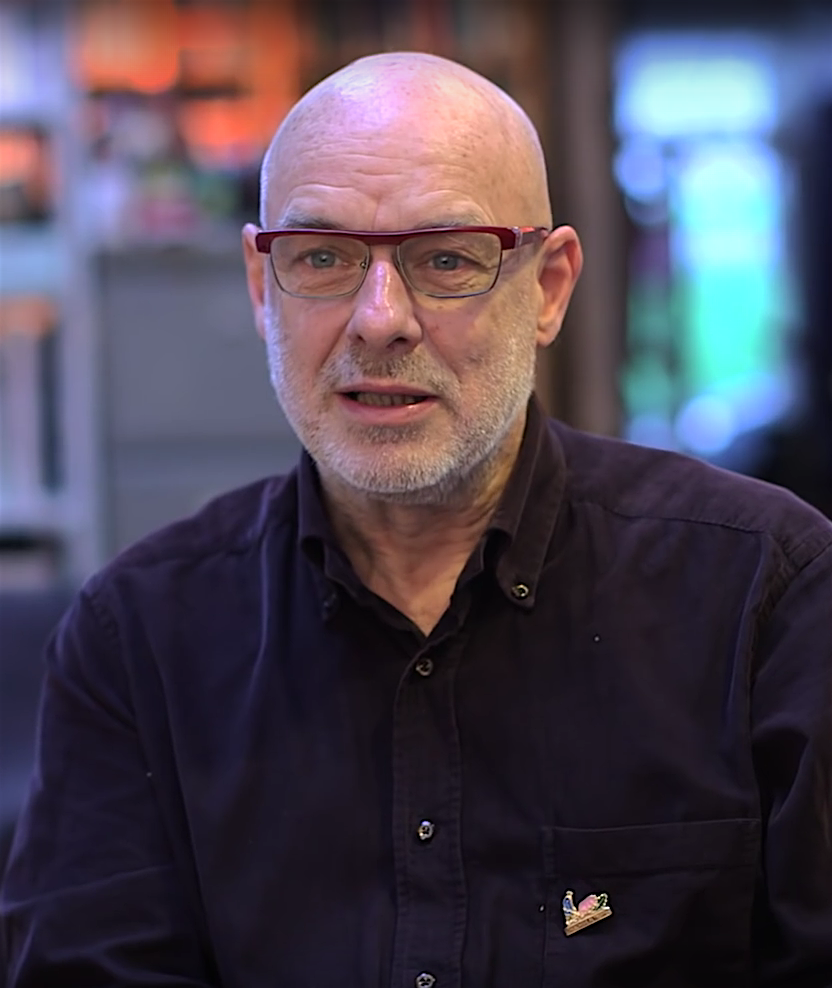
Brian Eno ( EE-no; born Brian Peter George Eno, 15 May 1948) is an English musician, record producer and artist. He is known for his pioneering contributions to ambient, electronic and generative music, and for producing, recording, and writing works in rock and pop music. He describes himself as a "non-musician" uninterested in virtuosity, and advocates for using the studio as a compositional tool. He has been described as one of popular music's most influential and innovative figures. Eno was born in Melton, Suffolk, and studied at Ipswich School of Art and the Winchester School of Art. He joined the glam rock band Roxy Music in 1971, contributing to their first two albums, and left in 1973. In 1974, Eno released his first solo albums, Here Come the Warm Jets and Taking Tiger Mountain (By Strategy). His third, Another Green World (1975), combined rock with minimal instrumental tracks. Eno coined the term "ambient music" to describe music he conceived to be "as ignorable as possible", and released a string of albums in the genre, including Ambient 1: Music for Airports (1979). Eno's profile rose when he contributed to the David Bowie albums Low (1977), Heroes (1977) and Lodger (1979), known as the Berlin Trilogy, and produced the Talking Heads albums More Songs About Buildings and Food (1978), Fear of Music (1979) and Remain in Light (1980). Eno and Daniel Lanois produced the U2 albums The Unforgettable Fire (1984), The Joshua Tree (1987) — one of the highest-selling albums in history — and Achtung Baby (1991). Eno produced Coldplay's album Viva la Vida or Death and All His Friends, the highest-selling album of 2008, and co-wrote their next album, Mylo Xyloto (2011). He has also produced albums by Ultravox, Devo, Harold Budd, Laraaji, James and Laurie Anderson, and released albums with artists including Robert Fripp, David Byrne, Jon Hassell, Cluster, Roger Eno, John Cale, Karl Hyde, Jon Hopkins and Fred Again. Eno composed the startup music for Windows 95 and has scored films including The Lovely Bones (2009). His visual art includes 77 Million Paintings, a generative art installation first exhibited in 2006. Rolling Stone's 2023 list of the 500 greatest albums includes two Eno albums, plus albums he created with Roxy Music, Bowie, Devo, Talking Heads and U2. In 2019, Eno was inducted into the Rock and Roll Hall of Fame as a member of Roxy Music. He is an activist on behalf of humanitarian, environmental, anti-war and pro-Palestinian causes and is a founding member of the Long Now Foundation.
Brian Peter George Eno was born on 15 May 1948 in the village of Melton, Suffolk, and grew up in the nearby town of Woodbridge. His parents were William Arnold Eno, a postal worker and clock and watch repairer, and Maria Alphonsine (née Buslot), a Belgian national. His grandfather played the saxophone and bassoon and built and repaired pianos and church organs. Eno has a younger brother, the musician Roger Eno, and a younger sister, Arlette. They have a half-sister, Rita, from their mother's previous relationship. The surname Eno derives from the Huguenot surname Hennot. Eno was raised Catholic. In 1959, he began attending St Joseph's College, Ipswich, a Catholic grammar school of the De La Salle Brothers order. His confirmation name, Brian Peter George St. Jean-Baptiste de la Salle Eno, is taken from the founder of the De La Salle Brothers, Jean-Baptiste de La Salle. There was a large American population due to the nearby US airbases RAF Bentwaters and RAF Woodbridge, through which Eno was exposed to American R&B, blues and doo-wop artists such Don and Juan and the Silhouettes. He was also inspired by the Dutch painter Piet Mondrian, whom he discovered while staying with his uncle, an art collector. At school, Eno used a tape recorder as a musical instrument. In 1964 he formed his first group, the Black Aces, with friends he met at a Melton youth club, with Eno on drums. By 1964, after earning four O-levels, including in art and mathematics, Eno had developed an interest in art and music and had no interest in a conventional job. He enrolled at the Ipswich School of Art, taking the newly established Groundcourse foundation art degree established by the new media artist Roy Ascott. One of Eno's teachers was the artist Tom Phillips, who became a lifelong friend and encouraged his musical ability. Phillips recalled the pair stripping pianos, aligning them in a hall and striking them with tennis balls. In late 1967, Eno formed the Merchant Taylor's Simultaneous Cabinet, an avant-garde performance trio with Winchester undergraduates. This was followed by short stints in multiple avant-garde and college groups, including the Maxwell Demon and Dandelion and the War Damage, with Eno as frontman who adopted a theatrical persona on stage and played the guitar. In 1969, Eno graduated with a diploma in Fine Arts at the Winchester School of Art. At Winchester, he attended a lecture by the Who guitarist Pete Townshend, another former student of Ascott. He cited this as the moment when he realised he could make music without formal training.
In 1969, after separating from his wife, Eno moved to London. Eno's first appearance on a commercially released recording is the Deutsche Grammophon edition of The Great Learning (1971) by Cornelius Cardew and the Scratch Orchestra, which features Eno as one of the voices on the track "Paragraph 7". He also composed the soundtrack to Berlin Horse (1970), a nine-minute experimental film by Malcolm Le Grice. For three months, Eno worked as paste-up assistant for the advertisement section of a local paper. Finding it uncreative, he quit and became an electronics dealer, making cabinets for old speakers and selling them to friends. Between 1970 and 1974, Eno played clarinet with the Portsmouth Sinfonia, an orchestra founded by Gavin Bryars that accepted players of any skill, and produced their first two albums. Eno said the mixture of skilled and unskilled players "was like a very blurry version, a soft-focus version, of classical music, and it produced some beautiful music ... There were some exquisite moments — the mixture of chance and choice." In 1971, Eno joined the glam rock band Roxy Music following a chance meeting with the saxophonist, Andy Mackay. Eno said later: "If I'd walked ten yards further on the platform, or missed that train, or been in the next carriage, I probably would have been an art teacher now." With his advance from EG Records, Roxy Music's management company, Eno purchased a flat in Maida Vale, London, which became his home and studio. Eno played on the first two Roxy Music albums, Roxy Music (1972) and For Your Pleasure (1973). He used the EMS VCS 3 synthesiser and is credited for tape effects, backing vocals and production. Initially, Eno did not appear on stage at Roxy Music shows, but operated the mixing desk off-stage, where he had a microphone to sing backup vocals. After Roxy Music secured a record deal, Eno joined them on stage playing the synthesiser and became known for his flamboyant and androgynous costumes and makeup. After the For Your Pleasure tour ended in mid-1973, Eno quit Roxy Music due to disagreements with the singer, Bryan Ferry.
In 1973, Eno released (No Pussyfooting), a collaboration with the King Crimson guitarist Robert Fripp. It was recorded using tape loops and delay systems, techniques both Eno and Fripp developed in their later work. Eno's first solo album, Here Come the Warm Jets, was released in February 1974, with Fripp on guitar. It came to be regarded as a classic. That year, Eno embarked on his only solo tour, backed by the pub rock band the Winkies, and recorded a Peel session. The tour ended early when Eno suffered a collapsed lung. Eno disliked touring, finding it uncreative, and spent the rest of his career working mostly in studios. Eno worked as a creative consultant and advisor for John Cale on his 1974 album Fear. Critics described Cale as a chaotic force tempered by Eno, and their relationship was sometimes fraught. Eno also contributed to Lady June's Linguistic Leprosy (1974) by Lady June. Eno released his second solo album, Taking Tiger Mountain (By Strategy), in November 1974. It features musicians including Phil Collins on drums, the Roxy Music guitarist Phil Manzanera and the Portsmouth Sinfonia, with lyrics about travel and dislocation inspired by a Chinese revolutionary opera. The critic Dave Thompson wrote that the song "Third Uncle" is "a near punk attack of riffing guitars and clattering percussion" that approached heavy metal. In 1974, Eno and the artist Peter Schmidt conceived Oblique Strategies, a set of cards intended to help artists overcome creative problems. Each card bears an instruction, such as "honour thy error as a hidden intention" or "discard an axiom". Eno used them in his work and with artists he worked with.
In November 1975, Eno released his third album, Another Green World, featuring musicians including Collins, Fripp and the bassist Percy Jones. It was a turning point in Eno's career, bridging the guitar-oriented experimental rock of his first two albums with the synthesiser-oriented minimalism of his subsequent work. J. D. Considine wrote in The Rolling Stone Album Guide (2004) that Eno had used the recording studio as an instrument, "moulding directed improvisations, electronic effects, and old-fashioned songcraft into perfectly balanced aural ecosystems". In 2016, Pitchfork called Another Green World Eno's definitive album. AllMusic described it as "a universally acknowledged masterpiece". In December 1975, Eno released his fourth album, Discreet Music. It was inspired by Eno's experience recuperating at home following a traffic accident, when his friend, the artist Judy Nylon, visited him and put on a record of harp music. After she had left, Eno realised the amplifier volume was too low and that one speaker was not playing, but he was too weak to get up and correct it. He wrote: "This presented what was for me a new way of hearing music – as part of the ambience of the environment just as the colour of the light and sound of the rain were parts of the ambience." The first side of Discreet Music comprises synthesiser notes in varying patterns, while the second comprises variations on Pachelbel's Canon, creating a "constantly shifting blanket of sound". Pitchfork described Discreet Music as Eno's first ambient record, though Eno had yet to coin the term. According to Eno, it was "universally despised by the English pop press". Also in December 1975, Eno and Fripp released their second album together, Evening Star. Pitchfork described it as "confidently serene" compared to the "brashly abrasive" "(No Pussyfooting)", with improved technique and attention to theme, which became crucial to Eno's later work. In September 1976, Eno recorded with the German band Harmonia, living and working in farm buildings in Forst, Lower Saxony. The work was not intended for release; in 1997, it was included on the compilation album Tracks and Traces 1997.
After returning to London, Eno co-produced Ultravox! (1977), the debut album by Ultravox. It was the first production role in which Eno demonstrated his potential as an artistic "catalyst", and his facility to combine conventional rock with experimental elements, which became his production hallmark. Eno was invited to collaborate by the English singer David Bowie on his next album in France, Low, working under the producer Tony Visconti. Though Eno had previously been unenthusiastic about Bowie, saying his music was "better than pleasant" but had "never given me a single new idea", he had enjoyed Bowie's latest album, Station to Station (1976). Bowie had enjoyed Discreet Music and planned to have Eno provide sounds and textures. Eno's initial role was to assist with overdubbing. When Bowie left for Paris to attend legal proceedings, Eno used the time to develop his own compositions, promising to pay for the studio time for any Bowie did not use; Bowie used almost all of them. On its release in 1977, Low divided listeners, but reached number 2 in the UK Album Chart and helped "cement Bowie's status as an art rock icon". The success boosted Eno's profile; according to his biographer, David Sheppard, Eno's "status as grand vizier to the crowned heads of British art rock was all but assured". In 2017, The Guardian suggested that the Low track "Warszawa" was Eno's best-known work. With Visconti, Eno co-produced Bowie's next album, Heroes (1977), in Berlin. He took a more involved role and received co-writing credits for three tracks, including the successful single "Heroes". Eno declined Bowie's invitation to join the Heroes tour. While in Germany, Eno recorded Cluster & Eno (1977) with the German duo Cluster, comprising former members of Harmonia. Eno was frustrated by the media attention generated by his work with Bowie and found it difficult to create new music. His systems-based compositional approach was no longer working, and he endlessly edited, saying he was "going mad". Facing pressure from the record company, his health suffered and he experienced stress and insomnia. Eventually, following advice from Bowie, Fripp, and Robert Wyatt, he assembled an album from disparate elements, Before and After Science, released in December 1977. It comprises uptempo art rock with "more pastoral" material on the second half. The critic Jim DeRogatis described its as Eno's coldest and "most clinical" pop record. Before and After Science was voted the year's 12th-best album in Pazz & Jop, an annual poll of American critics published in The Village Voice.


