Background and career
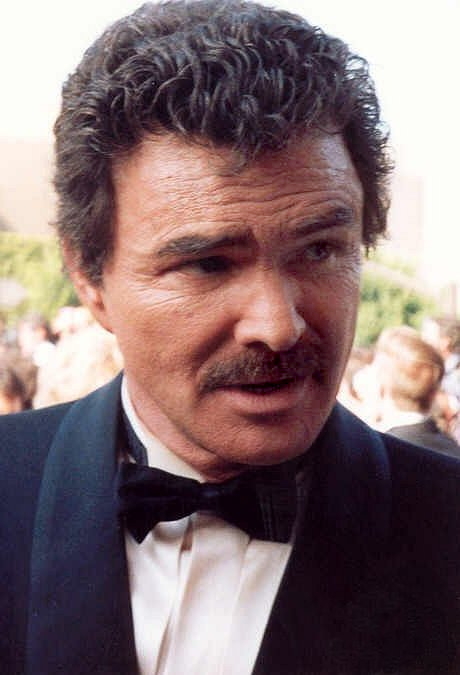
Burton Leon Reynolds Jr. (February 11, 1936 – September 6, 2018) was an American actor. His early work included the television series Gunsmoke (1962–1965), Hawk (1966) and Dan August (1970–1971). Following leading roles in the films Navajo Joe (1966), and 100 Rifles (1969), his breakthrough performance was as Lewis Medlock in Deliverance (1972). Reynolds played leading roles in films such as White Lightning (1973), The Longest Yard (1974), Smokey and the Bandit (1977) (which started a seven-year box-office reign), Semi-Tough (1977), The End (1978), Hooper (1978), Starting Over (1979), Smokey and the Bandit II (1980), The Cannonball Run (1981), Sharky's Machine (1981), The Best Little Whorehouse in Texas (1982), Smokey and the Bandit III (1983), and Cannonball Run II (1984), several of which he directed. He was nominated twice for the Golden Globe Award for Best Actor in a Motion Picture – Musical or Comedy. Reynolds was voted first in the annual Top Ten Money Making Stars Poll as the world's most bankable movie star from 1978 to 1982, a five-year record he shared with Bing Crosby, Clint Eastwood, and Tom Hanks, before Tom Cruise surpassed it in 2001. After a number of box-office failures, Reynolds returned to television. He starred in the situation comedy Evening Shade (1990–1994), for which he won a Golden Globe Award for Best Actor – Television Series Musical or Comedy and a Primetime Emmy Award for Outstanding Lead Actor in a Comedy Series. His performance as high-minded pornographer Jack Horner in Paul Thomas Anderson's Boogie Nights (1997) brought him renewed critical acclaim, earning the Golden Globe Award for Best Supporting Actor – Motion Picture, as well as nominations for an Academy Award for Best Supporting Actor, a BAFTA Award for Best Supporting Actor, and two Screen Actors Guild Awards.
Burton Leon Reynolds Jr. was born on February 11, 1936, to Burton Milo Reynolds Sr. (1906–2002) and Harriet Fernette "Fern" Reynolds (née Miller, 1902–1992). His family descended from Dutch, English, Scots-Irish, and Scottish ancestry. Reynolds also claimed some Cherokee and Italian ancestry. During his career, Reynolds often said he was born in Waycross, Georgia, although in 2015, he stated that he was actually born in Lansing, Michigan. In his autobiography, he stated that Lansing is where his family lived when his father was drafted into the United States Army. Reynolds, his mother, and his sister joined his father at Fort Leonard Wood, Missouri, where they subsequently lived for two years. When his father was sent to Europe, the family relocated to Lake City, Michigan, where his mother had been raised. In 1946, the family relocated to Riviera Beach, Florida, where in sixth grade, Reynolds began a lifelong close friendship with Dick Howser. Reynolds's father eventually became chief of police of Riviera Beach, which is adjacent to the north end of West Palm Beach, Florida. His nickname in Riviera Beach was "Buddy". At Palm Beach High School, Reynolds lettered in football and track and was named a first-team All-State fullback in 1953 and an honorable-mention selection to the 34th annual All-Southern team. He was initially offered a college football scholarship by University of Miami head coach Andy Gustafson, but ultimately chose to play for head coach Tom Nugent at Florida State University.
While at Florida State, Reynolds roomed with future college football coach, broadcaster, and analyst Lee Corso, and also became a brother in the Phi Delta Theta fraternity. Reynolds and Corso remained close friends for 64 years, staying in regular contact throughout their lives; according to Corso, they spoke about once a month and had last talked two weeks before Reynolds's death in 2018. He earned his first start of the 1954 football season at right halfback in FSU's inaugural victory of the season against the University of Louisville. Reynolds tallied a one-yard touchdown in the game. Despite suffering a separated shoulder in the middle of the season, Reynolds finished his freshman season with 16 carries for 134 rushing yards and two touchdowns. He also caught four passes for 76 yards, returned five punts, and had an interception while playing defense. In 1955, Reynolds was slated to start in the backfield for the Seminoles (8–4 in 1954), but suffered a torn cartilage in his right knee during preseason workouts. After testing the injured knee in a "B" game versus Georgia Tech, Reynolds realized he could not make cuts like he once did and left school. "I knew then I was finished as a football player," he told The Palm Beach Post. A week later, Reynolds underwent knee surgery at St. Mary's Hospital in West Palm Beach. His surgeon predicted he could resume his playing career the following year. However, two months later, Reynolds, then 19, was critically injured in an automobile accident on Florida State Road A1A, suffering internal injuries, including a ruptured spleen, after colliding with a stalled truck. The driver of the truck fled the scene, according to the newspaper report. Reynolds said he lost a prized wristwatch from the 1955 Sun Bowl game in the crash and left his vehicle totaled. Reynolds did not return to the Florida State campus for almost two years. To keep up with his studies, he enrolled at Palm Beach Junior College (PBJC) in neighboring Lake Park in early 1956. When Reynolds returned to Florida State in 1957, he rejoined the football team as a backup halfback, but was hampered by lingering injuries from the car accident. In an away game against Boston College, Reynolds averaged four yards on three carries and caught two passes. He was blamed, fairly or unfairly, for the team's loss to North Carolina State University on October 12, 1957. Immediately after the game, he told his teammates that he was done with football. Convinced that his playing days were over, Reynolds returned home and got engaged to Virginia Jean Hayden (1936–2013), a former beauty queen from Jacksonville, Florida, who was attending FSU. The couple did not wed. In 1959, Hayden, a speech major in college, wed FSU grad and Navy veteran Edwin Watson Richardson Jr., a car dealer in Tallahassee.
During his spring term at PBJC in 1956, Reynolds enrolled in an English class taught by Watson B. Duncan III. Duncan encouraged Reynolds to try out for a school play he was directing called Outward Bound. He cast Reynolds in a main role based on having heard him read Shakespeare in class. Reynolds's performance earned him a best actor award at the 1956 PBJC Drama Awards. "I read two words and they gave me a lead," In his autobiography, he referred to Duncan as his mentor and the most influential person of his life.
The drama award Reynolds won in junior college included a scholarship to the Hyde Park Playhouse, a summer stock theater in Hyde Park, New York. Reynolds considered the opportunity as an agreeable alternative to more physically demanding summer jobs, but did not yet consider acting a potential career. While working there, Reynolds met Joanne Woodward, who helped him find an agent. "I don't think I ever actually saw him perform," said Woodward. "I knew him as this cute, shy, attractive boy. He had the kind of lovely personality that made you want to do something for him." He was cast in Tea and Sympathy at the Neighborhood Playhouse in New York City. After his Broadway debut in Look, We've Come Through, he received favorable reviews for his performance and went on tour with the cast, driving the bus as well as appearing on stage. After the tour, Reynolds returned to New York City and enrolled in acting classes, along with Frank Gifford, Carol Lawrence, Red Buttons, and Jan Murray. "I was a working actor for two years before I finally took my first real acting class (with Wynn Handman at the Neighborhood Playhouse)," he said. "It was a lot of technique, truth, moment-to-moment, how to listen, improv." After a botched improvisation in acting class, Reynolds briefly considered returning to Florida. Nonetheless, in December 1956, he was cast in a supporting role in a revival of Mister Roberts at the New York City Center, in which Charlton Heston played the starring role and Orson Bean played Ensign Pulver. After the play closed, director John Forsythe arranged a movie audition with Joshua Logan for Reynolds. The movie was Sayonara (1957). Reynolds was told that he could not be in the movie because he looked too much like Marlon Brando. Logan advised Reynolds to go to Hollywood, although Reynolds did not feel confident enough to do so. (Another source says that Reynolds did a screen test after studio talent agent Lew Wasserman saw the effect that Reynolds had on secretaries in his office, but the test was unsuccessful.) While finding himself to be a struggling actor, Reynolds worked in a variety of jobs: waiting tables, washing dishes, driving a delivery truck, and even worked as a bouncer at the Roseland Ballroom. He wrote that while working as a dockworker, he was offered $150 to jump through a glass window on a live television show.
Reynolds began acting for television during the late 1950s, with guest roles on Flight, M Squad, Schlitz Playhouse, The Lawless Years, and Pony Express. He went on to sign a seven-year contract with Universal Studios. "I don't care whether he can act or not," said Wasserman. "Anyone who has this effect on women deserves a break." Reynolds's first big opportunity came when he was cast alongside Darren McGavin, the main actor of the television series Riverboat (1959–61), playing Ben Frazer, the boat's pilot. According to a contemporary report, Reynolds was considered "a double for Marlon Brando". The show played for two seasons, but Reynolds quit after only 20 episodes, claiming that he did not get along with McGavin nor the executive producer, and that he had "a stupid part". Subsequently, Reynolds said that he "couldn't get a job. I didn't have a very good reputation. You just don't walk out on a network television series." Reynolds returned to being a guest in television shows. As he put it, "I played heavies in every series in town," appearing in episodes of Playhouse 90, Johnny Ringo, Alfred Hitchcock Presents, Lock-Up, The Blue Angels, Michael Shayne, Zane Grey Theatre, The Aquanauts, and The Brothers Brannagan. "They were depressing years," he later said. Reynolds starred in the low-budget film Angel Baby (1961). He followed it up with a role in a war film Armored Command (1961). "It was the one picture that Howard Keel didn't sing on," reminisced Reynolds. "That was a terrible mistake." In 1961, he returned to Broadway to appear in Look, We've Come Through, directed by José Quintero, but it lasted only five performances. Reynolds continued to guest-star on episodes of Naked City, Ripcord, The Everglades, Route 66, Perry Mason, and The Twilight Zone ("The Bard", an hour-long send-up of Reynolds's look-alike Marlon Brando). He later said, "I learned more about my craft in these guest shots than I did standing around and looking virile on Riverboat."


