Background and career
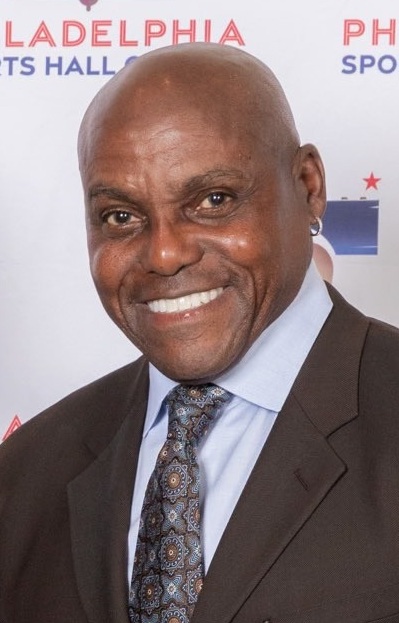
Frederick Carlton Lewis (born July 1, 1961) is an American former track and field athlete who won nine Olympic gold medals, one Olympic silver medal, and 10 World Championships medals, including eight gold. Lewis was a dominant sprinter and long jumper whose career spanned from 1979 to 1996, when he last won the Olympic long jump. He is one of six athletes to win gold in the same individual event in four consecutive Olympic Games, and is one of two people to win gold in the same individual athletics event in four Olympic Games, along with USA discus thrower Al Oerter. He is the head track and field coach for the University of Houston. Lewis topped the world rankings in the 100 m, 200 m and long jump events frequently from 1981 to the early 1990s. He set world records in the 100 m, 4 × 100 m and 4 × 200 m relays, while his world record in the indoor long jump has stood since 1984. His 65 consecutive victories in the long jump over a span of ten years is one of the sport's longest undefeated streaks. Lewis broke 10 seconds for the 100 meters fifteen times and 20 seconds for the 200 meters ten times. He also long jumped over 8.53 metres (28 ft) 71 times. His accomplishments have led to numerous accolades, including being voted "World Athlete of the Century" by the International Association of Athletics Federations, "Sportsman of the Century" by the International Olympic Committee, "Olympian of the Century" by Sports Illustrated and "Athlete of the Year" by Track & Field News in 1982, 1983, and 1984. After retiring from athletics, Lewis became an actor and has appeared in a number of films. In 2011, he attempted to run for a seat as a Democrat in the New Jersey Senate, but was removed from the ballot due to the state's residency requirement. Lewis owns a marketing and branding company named C.L.E.G., which markets and brands products and services, including his own.
Frederick Carlton Lewis was born in Birmingham, Alabama, on July 1, 1961, the son of William Lewis (1927–1987) and Evelyn née Lawler Lewis. His mother was a hurdler on the 1951 Pan-Am team. His elder brother Cleveland Lewis played professional soccer for the Memphis Rogues. His parents ran a local athletics club that provided a crucial influence on both him and his sister, Carol. She became an elite long jumper, finishing ninth at the 1984 Olympics and taking bronze at the 1983 World Championships. Lewis was initially coached by his father, who also coached other local athletes to elite status. At age 13, Lewis began competing in the long jump, and he emerged as a promising athlete while coached by Andy Dudek and Paul Minore at Willingboro High School in his hometown of Willingboro Township, New Jersey. He achieved the ranking of fourth on the all-time World Junior list of long jumpers. Many colleges tried to recruit Lewis, and he chose to enroll at the University of Houston where Tom Tellez was coach. Tellez would thereafter remain Lewis's coach for his entire career. Days after graduating from high school in 1979, Lewis broke the high school long jump record with a leap of 8.13 m (26 ft 8 in). By the end of 1979, Lewis was ranked fifth in the world for the long jump, according to Track and Field News. An old knee injury had flared up again at the end of the high school year, and this might have had consequences on his fitness. Lewis worked with Tellez and adapted his technique so that he was able to jump without pain, and he went on to win the 1980 National Collegiate Athletic Association (NCAA) title with a wind-assisted jump of 8.35 m (27 ft 4+1⁄2 in). Though his focus was on the long jump, he was now starting to emerge as a talent in the sprints. Comparisons were beginning to be made with Jesse Owens, who dominated sprint and long jump events in the 1930s. Lewis qualified for the American team for the 1980 Olympics in the long jump and as a member of the 4 × 100 m relay team. The Olympic boycott precluded Lewis from competing in Moscow, Russia; he instead participated in the Liberty Bell Classic in July 1980, which was an alternate meet for boycotting nations. He jumped 7.77 m (25 ft 5+3⁄4 in) for a bronze medal, and the American 4 × 100 m relay team won gold with a time of 38.61 s. He received one of 461 Congressional Gold Medals created specifically for the athletes on the 1980 U.S. Summer Olympics team. At year's end, he was ranked sixth in the world in the long jump and seventh in the 100 m.
At the start of 1981, Lewis's best legal long jump was his high school record from 1979. On June 20, Lewis improved his personal best by almost half a meter by leaping 8.62 m (28 ft 3+1⁄4 in) at the TAC Championships while still a teenager. While marks set at the thinner air of high altitude are eligible for world records, Lewis was determined to set his records at sea level. In response to a question about his skipping a 1982 long jump competition at altitude, he said, "I want the record and I plan to get it, but not at altitude. I don't want that '(A)' [for altitude] after the mark." When he gained prominence in the early 1980s, all the extant men's 100 m and 200 m records and the long jump record had been set at the high altitude of Mexico City. Also in 1981, Lewis became the fastest 100 m sprinter in the world. His relatively modest best from 1979 (10.67 s) improved to a world-class 10.21 the next year. But 1981 saw him run 10.00 s at the Southwest Conference Championships in Dallas on May 16, a time that was the third-fastest in history and stood as the low-altitude record. For the first time, Lewis was ranked number one in the world, in both the 100 m and the long jump. He won his first national titles in the 100 m and long jump. Additionally, he won the James E. Sullivan Award as the top amateur athlete in the United States. In 1982, Lewis continued his dominance, and for the first time it seemed someone might challenge Bob Beamon's world record of 8.90 m (29 ft 2+1⁄4 in) in the long jump set at the 1968 Olympics, a mark often described as one of the greatest athletic achievements ever. Before Lewis, 28 ft 0 in (8.53 m) had been exceeded on two occasions by two people: Beamon and 1980 Olympic champion Lutz Dombrowski. During 1982, Lewis cleared 28 ft 0 in (8.53 m) five times outdoors, twice more indoors, going as far as 8.76 m (28 ft 8+3⁄4 in) at Indianapolis on July 24. He also ran 10.00 s in the 100 m, the world's fastest time, matching his low-altitude record from 1981. He achieved his 10.00 s clocking the same weekend he leapt 8.61 m (28 ft 2+3⁄4 in) twice, and the day he recorded his new low-altitude record 8.76 m (28 ft 8+3⁄4 in) at Indianapolis, he had three fouls with his toe barely over the board, two of which seemed to exceed Beamon's record, the third which several observers said reached 30 ft 0 in (9.14 m). Lewis said he should have been credited with that jump, claiming the track officials misinterpreted the rules on fouls. He repeated his number one ranking in the 100 m and long jump, and ranked number six in the 200 m. Additionally, he was named Athlete of the Year by Track and Field News. From 1981 until 1992, Lewis topped the 100 m ranking six times (seven if Ben Johnson's 1987 top ranking is ignored), and ranked no lower than third. His dominance in the long jump was even greater, as he topped the rankings nine times during the same period, and ranked second in the other years.
The International Association of Athletics Federations (IAAF), the governing body of track and field, organized the first World Championships in 1983. Lewis' chief rival in the long jump was predicted to be the man who last beat him: Larry Myricks. But though Myricks had joined Lewis in surpassing 28 ft 0 in (8.53 m) the year before, he failed to qualify for the American team, and Lewis won at Helsinki with relative ease. His winning leap of 8.55 m (28 ft 1⁄2 in) defeated silver medalist Jason Grimes by 0.26 m (10 in). He also won the 100 m with relative ease. There, Calvin Smith who had earlier that year set a new world record in the 100 m at altitude with a 9.93 s performance, was soundly beaten by Lewis 10.07 s to 10.21 s. Smith won the 200 m title, an event which Lewis had not entered, but even there he was partly in Lewis' shadow as Lewis had set an American record in that event earlier that year. He won the 200 m on June 19 at the TAC/Mobil Championships in 19.75 s, the second-fastest time in history and the low-altitude record, only 0.03 s behind Pietro Mennea's 1979 mark. Observers here noted that Lewis probably could have broken the world record if he did not ease off in the final meters to raise his arms in celebration. Finally, Lewis ran the anchor in the 4 × 100 m relay, winning in 37.86 s, a new world record and the first in Lewis' career. Lewis' year-best performances in the 100 m and long jump were not at the World Championships, but at other meets. He became the first person to run a sub-10 second 100 m at low-altitude with a 9.97 s in Modesto on May 14. His gold at the World Championships and his other fast times earned him the number one ranking in the world that year, despite Calvin Smith's world record. At the TAC Championships on June 19, he set a new low-altitude record in the long jump, 8.79 m (28 ft 10 in) and earned the world number one ranking in that event. Track and Field News ranked him number two in the 200 m, despite his low-altitude record of 19.75 s, behind Smith, who had won gold at Helsinki. Lewis was again named Athlete of the Year by the magazine.
At the 1984 Olympic Games in Los Angeles, Lewis was entered into four events with realistic prospects of winning each of them and thereby matching the achievement of Jesse Owens at the 1936 Games in Berlin. Lewis started his quest to match Owens with a convincing win in the 100 m, running 9.99 s to defeat his nearest competitor, fellow American Sam Graddy, by 0.2 s. In his next event, the long jump, Lewis won with relative ease. His behavior in winning this event stoked controversy, even as knowledgeable observers agreed that his tactics were correct. Since Lewis still had heats and finals in the 200 m and the 4 × 100 m relay to compete in, he chose to take as few jumps as necessary to win the event. He risked injury in the cool conditions of the day if he over-extended himself, and his ultimate goal to win four golds might be at risk. He knew that his first jump at 8.54 m (28 ft 0 in) was sufficient to win the event. He fouled on his next jump and then passed on his remaining four allotted jumps. Lewis easily won gold, and Gary Honey of Australia settled for the silver medal with a jump of 8.24 m (27 ft 1⁄4 in). The public was generally unaware of the intricacies of the sport and had been repeatedly told by the media of Lewis's quest to surpass Bob Beamon's legendary long jump record of 8.90 m (29 ft 2+1⁄4 in). Lewis himself had often stated it was a goal of his to surpass the mark. A television advertisement with Beamon appeared before the final, featuring the record-holder saying, "I hope you make it, kid." So, when Lewis decided not to make any more attempts to try to break the record, he was loudly booed. When asked about those boos, Lewis said, "I was shocked at first. But after I thought about it, I realized that they were booing because they wanted to see more of Carl Lewis. I guess that's flattering." His third gold medal came in the 200 m, where he won with a time of 19.80 s, a new Olympic record and the third fastest time in history. Finally, he won his fourth gold in the 4 × 100 m relay when he anchored the final leg of the race; he broke the tape with a time of 37.83 s, setting a new world record.
Although Lewis had achieved what he had set out to do, matching Jesse Owens' feat of winning four gold medals in the same events at a single Olympic Games, he did not receive the lucrative endorsement offers that he had expected. The long jump controversy was one reason and his self-congratulatory conduct did not impress several other track stars. Further, Lewis's agent Joe Douglas compared him to pop star Michael Jackson, a comparison which did not go over well. Douglas said he was inaccurately quoted, but the impression that Lewis was aloof and egotistical was firmly planted in the public's perception by the end of the 1984 Olympic Games. Additionally, rumors circulated at that time that Lewis was gay. Although he denied the rumors, it likely hurt his marketability. Lewis' physical appearance at the Games, with a flattop haircut and flamboyant clothing, added fuel to the reports. "It doesn't matter what Carl Lewis' sexuality is", high jumper Dwight Stones said. "Madison Avenue perceives him as homosexual." Coca-Cola had offered a lucrative deal to Lewis before the Olympics, but Lewis and Douglas turned it down, confident that Lewis would be worth more after the Olympics. But Coca-Cola rescinded the offer after the Games. Nike already had Lewis under contract for several years, despite questions about how it affected his amateur status, and he was appearing in Nike television advertisements in print and on billboards. Nike was faced with Lewis's new negative image and dropped him after the Games. "If you're a male athlete, I think the American public wants you to look macho", said Don Coleman, a Nike representative. "They started looking for ways to get rid of me", Lewis said. "Everyone there was so scared and so cynical they did not know what to do." Lewis and Nike eventually did split, and Lewis signed an endorsement deal with Mizuno. Lewis himself would lay the blame on some inaccurate reporting, especially the "Carl bashing", as he put it, typified by a Sports Illustrated article before the Olympics. At year's end, Lewis was again awarded the top rankings in the 100 m and the long jump and was additionally ranked number one in the 200 m, and for the third year in a row he was awarded the Athlete of the Year title by Track & Field News. The Chicago Bulls drafted Lewis in the 1984 NBA draft as the 208th overall pick, although he had played neither high school nor college basketball. Lewis never played in the NBA. A poll on the NBA's website ranked Lewis second to Lusia Harris, the only woman to be drafted by the NBA, as the most unusual pick in the history of the NBA Draft. Ron Weiss, the head West Coast scout of the Bulls, and Ken Passon, the assistant West Coast scout, recommended Lewis because he was the best athlete available. Similarly, Lewis was drafted by the Dallas Cowboys as a wide receiver in the 12th round of the 1984 NFL draft, even though he did not play football in college. He never played in the NFL either.


