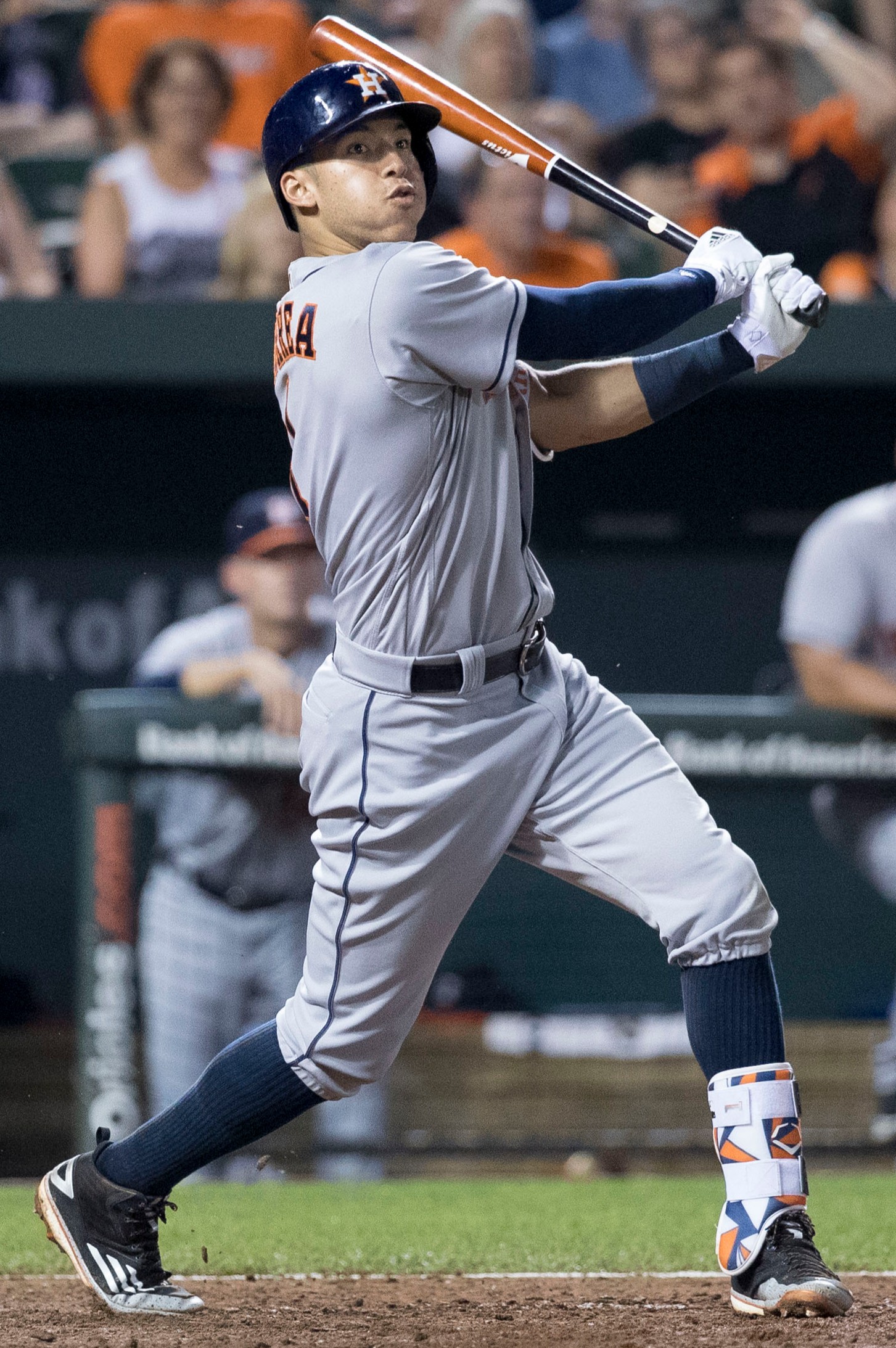
Background and career
Carlos Javier Correa Oppenheimer Jr. (born September 22, 1994) is a Puerto Rican professional baseball shortstop and third baseman for the Houston Astros of Major League Baseball (MLB). He has previously played in MLB for the Minnesota Twins. The Astros selected him first overall in the 2012 MLB draft. Correa made his MLB debut with the Astros in 2015, and won the American League (AL) Rookie of the Year Award. In 2017, Correa appeared in the World Baseball Classic, won the AL Player of the Month Award for May, was named an MLB All-Star, and won the World Series. In 2021, he was named to his second All-Star Team and won the Gold Glove and Platinum Glove awards. After seven seasons with Houston, he entered free agency and signed a three-year deal with the Twins which he later opted out of after his first season with the team. Following agreements with both the San Francisco Giants and New York Mets that fell apart due to failed physicals, Correa re-signed with the Twins. Minnesota traded him back to the Astros during the 2025 season.
Correa was born in Ponce, Puerto Rico, to Carlos Correa Sr. and Sandybel Oppenheimer. Although the family's income was low, they had enough money to build a small house in Barrio Velázquez, a fishing village located in Santa Isabel, Puerto Rico, where Correa was raised. From an early age, Correa often played catch in an alley adjacent to his home, which prompted a neighbor to suggest enrolling him in a youth league, the parent-pitch category, when he was five years old. Correa was assigned to play as a first baseman due to his hitting ability, while his father continued training him every day during their free time. In 1998, Hurricane Georges caused heavy damage to the family's house. This forced his father to take several odd jobs, but he continued training Correa Jr. on a daily basis. When he was seven years old, Correa was performing solidly in Santa Isabel's Playita Cortada American Baseball Congress affiliate, hitting up to 150 home runs. When the team was eliminated, the league's champion, Rio Grande, recruited Correa to play in the championship series held in Atlanta. However, the distance between Santa Isabel and the municipality of Rio Grande made this difficult for the family. His mother worked as well, but when this was not enough, she began selling food. The citizens of Santa Isabel began helping them organize charity games and his original team donated their sales income to help pay for the travel. Correa was Rio Grande's pitcher and was named the tournament's Most Valuable Player after striking out eight batters in a team comeback. By the time that he was 11 years old, the family was traveling to the municipality of Caguas to have him practice with higher-level teams. Correa was also an honor student and received a scholarship to attend Raham Baptist Academy. Three years later, the family moved from Barrio Velázquez due to recurrent floods, but kept close ties with those who stayed behind. Joined by his brother, Jean Carlos, in baseball practices, the family once again was forced to work more odd jobs. Soon after, the Puerto Rico Baseball Academy and High School (PRBAHS) brought Correa in as a scholarship student. His discipline and talent prompted his coaches to work extra hours to improve his bat and they helped by offering transportation when the family's car was totaled in an accident. In 2010, Correa participated in the Perfect Game BCS Finals and the WWBA PG Underclassman World Championships. After attending one of these Perfect Game events, Correa made adjustments to his batting swing with his hitting coach, José Rivera. The following year he appeared at the 2011 PG BCS Under-18 Finals and East Coast Professional Showcase. However, it was Correa's performance at the 2011 PG World and National Showcases that promoted him to the top of his class, earning him a spot in the Aflac-PG All-American Game, where he was named Rawlings' Defensive Player of the Year. He closed the year with an appearance in the PG WBAA World Championships. Correa opened 2012 by being selected the MVP in the Víctor Pellot Excellence Tournament, following an extraordinary performance for a shortstop that included a two-home run game. At the 2012 PG World Showcase, he established a PG record with a 97-miles per hour throw across the infield. After graduating from the PRBAHS, Correa signed a letter of commitment with the University of Miami. Besides competing for the PRBAHS, Correa was also a member of Team Mizuno and the Puerto Rico National Baseball Team that participated in the youth Pan-American tournament.
Despite being the youngest high-profile player to enter the 2012 Major League Baseball draft, in the months leading up to the event the 17-year-old Correa was already projected as a top-ten pick by several major sources, including Sports Illustrated and ESPN. His stock rose during the month before the draft, with outstanding performances in team workouts, including one that reportedly left the Houston Astros' scouts "blown away". On June 4, 2012, the Astros selected him as the first overall pick, ahead of the projected top pick, pitcher Mark Appel. Correa was incredulous, only saying that he must have been dreaming, after entering the stage while hoisting the flag of Puerto Rico. With his selection, Correa became the highest-selected player to be drafted directly from a Puerto Rican high school, besting Ramón Castro's 17th pick in 1994, while joining several other top-10 Puerto Rican picks such as Francisco Lindor and Javier Báez, all of whom had moved to the mainland United States to complete their high school or college education after developing in the local youth leagues. Correa became the third Latino to be the first overall selection in the MLB Draft, after Alex Rodriguez and Adrián González, as well as the first Puerto Rican and Latin American-born player to do so. During the ceremony, he was congratulated by Puerto Rican great Iván Rodríguez. Upon returning to Puerto Rico the following day, Correa was greeted by a victory parade in his native Santa Isabel, which was attended by hundreds of people. Correa signed with the Astros on June 7, 2012, agreeing to a $4.8 million signing bonus. He chose to wear the number 12 in his introduction to the media, donning it in homage to Hall of Famer Roberto Alomar, but abandoned it afterwards. The organization assigned him to their extended spring training team in Kissimmee, Florida. He began his professional career with the Gulf Coast Astros of the Rookie-level Gulf Coast League, and was promoted to Greeneville Astros of the Rookie-level Appalachian League, and batted a combined .258/.305/.400 in 190 at bats. He opened the 2013 season with the Quad City River Bandits of the Class A Midwest League.
Correa was ranked the top prospect in the Astros' farm system prior to the 2013 season and opened the year on a ten-game hitting streak that was halted by injury. He was selected the team's Player of the Month during this run and became the youngest player selected to play in the 2013 Midwest League All-Star Game, where he represented the Western Division All-Stars. Correa became the first player in the history of the All-Star Futures Game to be selected by popular vote to complete the World Team. He also became the first position player in the River Bandits' history to be selected in his first year with the team. The youngest player in the event, Correa entered the game as a defensive backup in the eighth inning. Despite not having an official at-bat, his pre-game batting practice was scouted as impressive, including some home runs that reached the second deck of Citi Field. When Mark Appel joined the River Bandits in July, this marked the first time that two consecutive first overall draft picks played for the same minor league team. For the 2013 season, Correa batted .320/.405/.467 in 450 at bats. After the team prevented him from playing for Gigantes de Carolina in Puerto Rico, Correa began a training camp to improve his physique and add speed, which lasted from October to February. On January 14, 2014, the Astros invited Correa to spring training as a non-roster player. They assigned him to the Lancaster JetHawks of the Class A-Advanced California League to start the 2014 season. On June 21, Correa fractured his right fibula, requiring surgery on the fibula and a ligament that ended his season. He batted .325/.416/.510 in 249 at bats over 62 games for Lancaster. The Astros invited Correa to spring training in 2015, and assigned him to minor league camp in late March to prepare for an assignment with the Corpus Christi Hooks of the Class AA Texas League. After Correa hit .385/.459/.727 in 117 at bats over 29 games for Corpus Christi, the Astros promoted him to the Fresno Grizzlies of the Class AAA Pacific Coast League on May 11. In 24 games with the Grizzlies, he hit .276/.345/.449 in 98 at bats with three home runs and 12 runs batted in (RBIs).
On June 8, 2015, the Astros promoted Correa to the major leagues. He debuted in a 3–1 loss to the Chicago White Sox, going 1-for-4 with a RBI single off of Chris Sale. On June 9, Correa stole his first career base and hit his first MLB home run off of Zach Duke. By stealing three bases in his ninth game, he became the second-youngest player to do so in a century, only trailing Rickey Henderson by 21 days. Correa established a new franchise record for most hits during his first ten games by batting 14. He went on to also break the franchise record for most hits through 15 career games with 20. Correa set a franchise record for most doubles during his first 20 games, batting 9. Five home runs were also hit during this timeframe for a total of 14 extra-base hits, tied for the second-most since the 1993 MLB expansion. Correa also tied two other players by reaching base safely in 18 of these games. He won the American League's Rookie of the Month award for June. On July 5, 2015, Correa became the first player since 1914 to record five games with a minimum of three hits and a home run in 25 plate appearances since his debut. By his 42nd game he was leading the American League in home runs by shortstops. This game was also Correa's seventh with at least three hits, a record for rookies in this league. By hitting nine home runs during this timeframe, he also became the first shortstop in a century to accomplish this in his first 42 games. On August 1, Correa recorded his first multi-homer game, also setting a franchise record by hitting 12 home runs in his first 46 games. By his 50th game he had batted more home runs in that number of games than any other shortstop in history, recording four more than the previous record-holder. On August 19, Correa delivered his first walk-off hit with a single off Tampa Bay Rays pitcher Matt Andriese. On October 12, 2015, Correa became the youngest shortstop to hit a home run in playoff competition, as well as the second youngest player to record a postseason multi-homer game. For the 2015 season with Houston, he batted .279/.345/.512 in 387 at bats. He had the 7th-best Power-Speed # in the American League, at 17.1. Playing 99 games at shortstop, he had a fielding percentage of .967. Following the conclusion of the season, Correa was selected as the Sporting News AL Rookie of Year. At the 2015 Players Choice Awards he received the AL Outstanding Rookie Award. On November 16, 2015, MLB and the Baseball Writers' Association of America (BBWAA) recognized Correa as the AL Rookie of the Year. He became the first Astro to win a Rookie of the Year award since Jeff Bagwell did in 1991.
Correa began the 2016 season by becoming the youngest player in the Astros' history to hit a home run on Opening Day. He missed playing time in September due to a shoulder injury. Correa ended the season with a .274 batting average, a .361 on-base percentage, a .451 slugging percentage, 36 doubles (10th in the AL), 20 home runs, and 96 RBIs in 577 at bats. He hit one ball with an exit velocity of 118.2 mph; the only major leaguer to hit a ball harder in 2016 was Giancarlo Stanton. Baseball-Reference.com calculated that Correa's 2016 season was worth 5.9 wins above replacement. He had four walk-off hits during the season, the most in MLB.



