Background and career
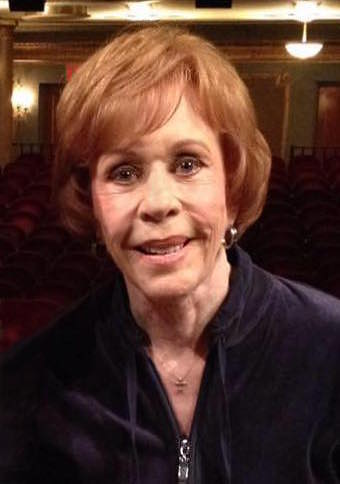
Carol Creighton Burnett (born April 26, 1933) is an American comedienne, actress, singer and writer. Burnett has played dramatic and comedic roles on stage and screen. She has received numerous awards and accolades, including five Golden Globe Awards, a Grammy Award, seven Primetime Emmy Awards, twelve People's Choice Awards, two Peabody Awards. Burnett was honored with a Special Tony Award in 1969, Star on the Hollywood Walk of Fame in 1975, the Presidential Medal of Freedom in 2005, the Mark Twain Prize for American Humor in 2013, the Screen Actors Guild Life Achievement Award in 2015, and the inaugural Golden Globe Carol Burnett Award in 2019. Burnett was born and raised in San Antonio, Texas, until her family moved to Hollywood, living a block away from Hollywood Boulevard. She attended Hollywood High School and eventually studied theater and musical comedy at UCLA. Later, she moved to New York City, performed in nightclubs there, and had a breakout success on Broadway in 1959 in Once Upon a Mattress, for which she received a Tony Award nomination. She soon made her television debut, regularly appearing on The Garry Moore Show for the next three years, and won her first Emmy Award in 1962. Eventually, Burnett moved back to Los Angeles and began an 11-year run as star of the CBS variety-sketch comedy series The Carol Burnett Show from 1967 to 1978. She is the first woman to host a comedy-variety series. With its vaudeville roots, The Carol Burnett Show was a variety show that combined comedy sketches with song and dance. The comedy sketches included film parodies and character pieces. Burnett created many memorable characters during the show's run, and both she and the show won numerous Emmy and Golden Globe Awards. Burnett's film roles include Pete 'n' Tillie (1972), The Front Page (1974), A Wedding (1978), The Four Seasons (1981), Annie (1982), Noises Off (1992), and Horton Hears a Who! (2008). On television, she won an Emmy Award for her guest role in Mad About You. She appeared in multiple specials with Julie Andrews. She was nominated for a Tony for her role in Moon Over Buffalo (1995). Recently she has acted in Better Call Saul (2022), Palm Royale (2024), and Hacks (2025). She recorded her memoir In Such Good Company (2016), for which she won a Grammy Award. In 2019, the Golden Globes created the Carol Burnett Award for career achievement in television, giving Burnett the first award. She was honored with an NBC special Carol Burnett: 90 Years of Laughter + Love celebrating her 90th birthday.
Carol Creighton Burnett was born on April 26, 1933, at Nix Hospital in San Antonio, Texas, the daughter of Ina Louise (née Creighton), a publicity writer for movie studios, and Joseph Thomas Burnett, a movie theater manager. She was named after Carole Lombard. Her maternal grandparents were William Henry Creighton (1873–1918) and Mabel Eudora "Mae" Jones (1885–1967). Her parents divorced in the late 1930s. Subsequently, both parents independently moved to Hollywood and Burnett moved with her grandmother to a one-room apartment near her mother. They lived in an impoverished area of Hollywood, California, in a boarding house with Burnett's younger half-sister Chrissie. When Burnett was in second grade, she briefly invented an imaginary twin sister named Karen, with Shirley Temple-like dimples. She later recalled that, motivated to further the pretense, she "fooled the other boarders in the rooming house where we lived by frantically switching clothes and dashing in and out of the house by the fire escape and the front door. Then I became exhausted and Karen mysteriously vanished." When Burnett was nine, she taught herself how to do the "Tarzan yell", which she realized years later was a good vocal exercise for volume, and it became a fan favorite. Burnett's first experiences with singing were with her family. Her grandmother was a trained musician who could play the piano (although they did not have one at the time), and her mother played the ukulele, so they sometimes sang popular songs in harmony together around the kitchen table. Her grandmother frequently took Burnett and her sister to the movies. They would take a few rolls of toilet paper home from the theater. The movies she saw in her youth influenced the sketch content in The Carol Burnett Show.
Burnett worked as an usherette at the Warner Brothers Theater (now the Hollywood Pacific Theatre). When the cinema screened Alfred Hitchcock's Strangers on a Train (1951), having already seen and enjoyed the film, she advised two patrons arriving during the last five minutes of a showing to wait until the beginning of the next showing to avoid spoiling the ending for them, but the couple insisted on being seated. The manager observed Burnett not letting the couple in and fired her, stripping the epaulettes from her uniform on the spot. Years later in the 1970s after achieving TV stardom, when the Hollywood Chamber of Commerce offered her a star on the Hollywood Walk of Fame, they asked her where she wanted it. She replied "Right in front of where the old Warner Brothers Theater was, at Hollywood and Wilcox", which is where it was placed, at 6439 Hollywood Blvd. After graduating from Hollywood High School in 1951, Burnett received an anonymous envelope containing $50 for one year's tuition at UCLA, where she initially planned on studying journalism. During her first year of college, she switched her focus to theater arts and English, with the goal of becoming a playwright. She found she had to take an acting course to enter the playwright program. On the subject, she later reflected: "I wasn't really ready to do the acting thing, but I had no choice." During her first performance, she got a sudden impulse to speak her lines in a new way. "Don't ask me why, but when we were in front of the audience, I suddenly decided I was going to stretch out all my words and my first line came out 'I'm baaaaaaaack!'" The audience response moved her deeply:
They laughed and it felt great. All of a sudden, after so much coldness and emptiness in my life, I knew the sensation of all that warmth wrapping around me. I had always been a quiet, shy, sad sort of girl and then everything changed for me. You spend the rest of your life hoping you'll hear a laugh that great again. During this time, she performed in several university productions, garnering recognition for her comedic and musical abilities. Her mother disapproved of her acting ambitions:
She wanted me to be a writer. She said you can always write, no matter what you look like. When I was growing up she told me to be a little lady, and a couple of times I got a whack for crossing my eyes or making funny faces. Of course, she never, I never, dreamed I would ever perform. The young Burnett, always insecure about her looks, responded many years later to her mother's advice of "You can always write, no matter what you look like" by noting "God, that hurt!" in her memoir One More Time (1986). During her junior year at UCLA in 1954, a professor invited Burnett and some other students to perform at a party in place of their class final that had been canceled (which required a performance in front of an audience). Afterwards, a man and his wife approached her while Burnett was stuffing cookies in her purse to take home to her grandmother. Instead of reprimanding her, the man complimented her performance and asked about her future plans. When he learned that she wanted to travel to New York in order to try her luck in musical comedy but could not afford the trip, he offered her and her boyfriend (Don Saroyan) each, on the spot, a $1,000 (equivalent to $11,989 in 2025) interest-free loan; the man, who was a millionaire from La Jolla, California, wasn't affiliated with show business and had earned his wealth from the shipbuilding industry. His conditions were simply that the loans were to be repaid within five years, his name was never to be revealed, and if she achieved success, she would help other aspiring talents to pursue their artistic dreams. Burnett took him up on his offer, and she and Saroyan left college and moved to New York to pursue acting careers. That same year, her father died of causes related to his alcoholism.
Burnett spent her first year in New York working as a hat-check girl and trying to land acting jobs. She and other girls living at the Rehearsal Club (a boarding house for women seriously pursuing acting careers) put on The Rehearsal Club Revue on March 3, 1955. They mailed invitations to agents, who showed up along with stars like Celeste Holm and Marlene Dietrich. Such attendance opened doors for several of the girls. Burnett was cast in a minor role on The Paul Winchell and Jerry Mahoney Show in 1955. She played the girlfriend of a ventriloquist's dummy on the popular children's program. This role led to her starring role opposite Buddy Hackett in the short-lived sitcom Stanley from 1956 to 1957.


