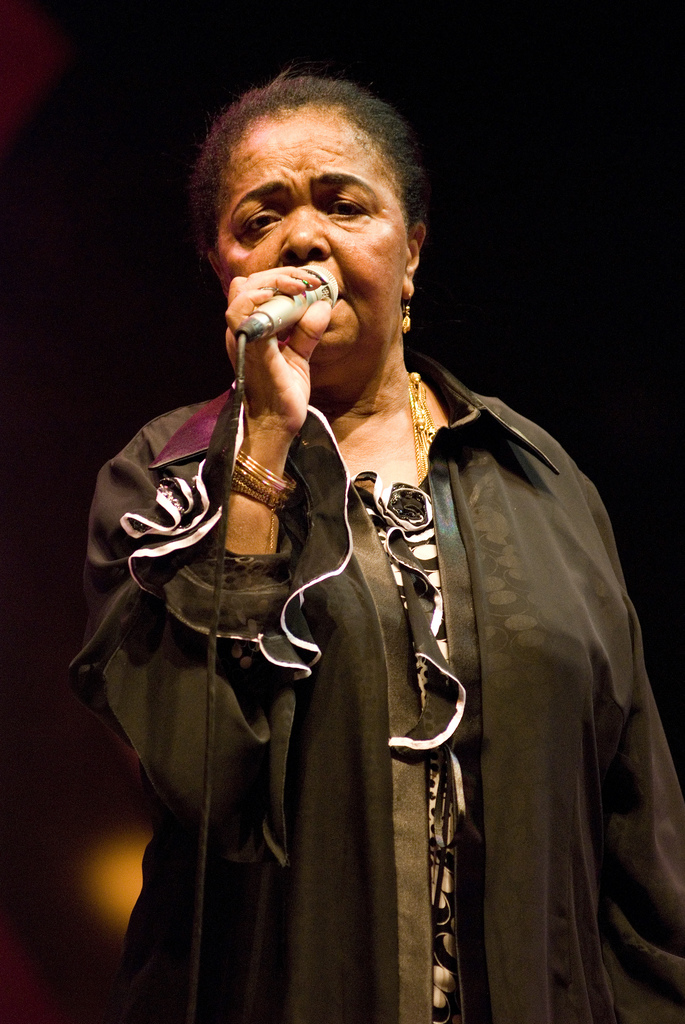
Background and career
Cesária Évora GCIH (Portuguese pronunciation: [sɨˈzaɾiɐ ˈɛvuɾɐ]; 27 August 1941 – 17 December 2011) was a Cape Verdean singer known for singing morna, a genre of music from Cape Verde, in her native Cape Verdean Creole. Her songs were often devoted to themes of love, homesickness, nostalgia, and the history of the Cape Verdean people. She was known for performing barefoot and for her habit of smoking and drinking on stage during intermissions. Évora's music received many accolades, including a Grammy Award in 2004, and it has influenced many Cape Verde diaspora musicians as well as American pop singer Madonna. Évora is also known as Cize, the Barefoot Diva, and the Queen of Morna.
Growing up in poverty, Évora began her singing career in local bars at age sixteen. She saw some success within Cape Verde over the following years, but she retired from singing when it did not provide her with enough money to care for her children. Évora returned to music in 1985, when she contributed to a women's music anthology album in Portugal. There, she met music producer José "Djô" da Silva, who signed Évora to his record label, Lusafrica. She released her debut album, La Diva Aux Pieds Nus, in 1988. Évora saw worldwide success after releasing her fourth and fifth albums: Miss Perfumado (1992) and Cesária (1995). She developed health problems in the late 2000s and died from respiratory failure and hypertension in 2011.
Cesária Évora was born on 27 August 1941, in Mindelo, São Vicente (then a colony in Portuguese Cape Verde), as one of seven children. Her father Justino was a violinist; he died while she was still a child. Her mother Joana was a cook and a maid who was forced to raise her many children alone following her husband's death. The family's poverty, and that of the entire colony, meant that she received little formal education. Évora was raised by her grandmother, and by the time she was ten years old, she was moved to an orphanage, as her family could not support her.
Évora took up singing as a child. When she was 16 years old, she began a romantic relationship with a guitarist who encouraged her to begin performing morna and coladeira, and so she began performing in local bars. Living in Mindelo provided her with an advantage, as its status as an international port town meant that the city had a lively nightlife and many venues at which to perform. She became the headliner for Mindelo's Café Royal before achieving wider success in Cape Verde by performing on Radio Mindelo.
Évora began performing across the country alongside musician Luís Morais. She also developed a following in the Netherlands and in Portugal in the 1950s, but she did not build on or capitalize on this success. Évora recorded multiple songs for the radio in the 1960s and released two singles. Her early endeavors in music were challenged by those who believed in traditional gender roles, as music was considered largely the province for men in Cape Verde. She was further challenged over her mixed race and her social class. To express her frustration, she sometimes wrote songs about these problems, knowing that most of her foreign audience would not understand the lyrics.
How Cesária Évora makes money
In 1995, after a successful tour in the United States, Évora released her fifth album, Cesaria Evora, with the American label Nonesuch Records. On tour in Australia in 2008, she suffered a stroke and had to end the tour early.


