Background and career
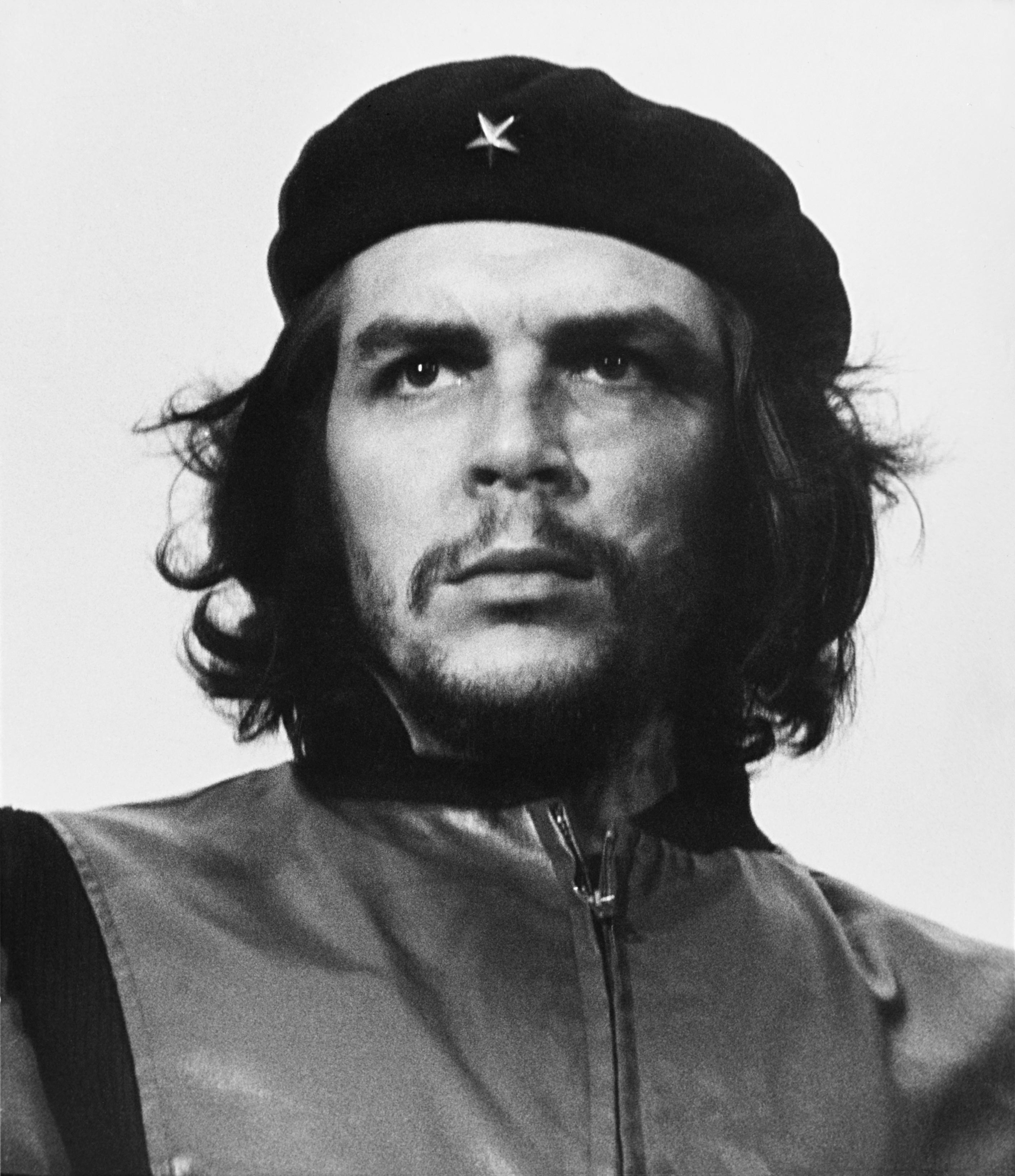
Ernesto "Che" Guevara de la Serna (14 May 1928 – 9 October 1967) was an Argentine Marxist revolutionary, author, guerrilla leader, diplomat, politician, and military theorist. A major figure of the Cuban Revolution, his stylized visage has become a countercultural symbol of rebellion and global insignia in popular culture. As a medical student, Guevara travelled throughout South America and was appalled by the poverty, hunger, and disease he witnessed. His burgeoning desire to help overturn what he saw as the capitalist exploitation of Latin America by the US prompted his involvement in Guatemala's social reforms under President Jacobo Árbenz, whose CIA-assisted overthrow at the behest of the United Fruit Company solidified Guevara's political ideology. In Mexico City, Guevara met Raúl and Fidel Castro, joined their 26th of July Movement, and sailed to Cuba aboard the yacht Granma with the intention of overthrowing US-backed dictator Fulgencio Batista. Guevara rose to prominence among the insurgents, was promoted to second-in-command, and played a pivotal role in the two-year guerrilla campaign which deposed the Batista regime. After the Cuban Revolution, Guevara played key roles in the new government. These included reviewing the appeals and death sentences for those convicted as war criminals during the revolutionary tribunals, instituting agrarian land reform as minister of industries, helping spearhead a successful literacy campaign, serving as president of the National Bank and instructional director for Cuba's armed forces, and traversing the globe as a diplomat on behalf of Cuban socialism. Such positions allowed him to play a central role in training the militia forces who repelled the Bay of Pigs Invasion, and bringing Soviet nuclear-armed ballistic missiles to Cuba, a decision which precipitated the 1962 Cuban Missile Crisis. Guevara was a prolific writer and diarist, composing a seminal guerrilla warfare manual, along with a best-selling memoir about his motorcycle journey. His experiences and studying of Marxism–Leninism led him to posit that the Third World's underdevelopment and dependence was an intrinsic result of imperialism, neocolonialism, and monopoly capitalism, with the only remedies being proletarian internationalism and world revolution. Guevara left Cuba in 1965 to foment continental revolutions across Africa and South America, first unsuccessfully in Congo-Kinshasa and later in Bolivia, where he was captured by CIA-assisted Bolivian forces and summarily executed. Guevara remains a revered and reviled figure, polarized in the collective imagination in biographies, memoirs, essays, documentaries, songs, and films. As a result of his perceived martyrdom, poetic invocations for class struggle, and desire to create the consciousness of a "new man" driven by moral rather than material incentives, Guevara has evolved into a quintessential icon of many leftist movements. His critics accuse him of promoting authoritarianism and endorsing violence against his opponents. Despite disagreement on his legacy, Time named him one of the 100 most influential people of the 20th century, while an Alberto Korda photograph of him, titled Guerrillero Heroico, was cited by the Maryland Institute College of Art as "the most famous photograph in the world".
Ernesto Guevara was born to Ernesto Guevara Lynch and Celia de la Serna y Llosa, on 14 May 1928, in Rosario, Argentina. Although the legal name on his birth certificate was "Ernesto Guevara", his name sometimes appears with "de la Serna" or "Lynch" accompanying it. He was the eldest of five in an upper-class Argentine family of pre-independence immigrants that have Spanish, Basque, and Irish ancestry. Two of Guevara's 18th-century ancestors included Luis María Peralta, a Californio landowner in colonial California, and Patrick Lynch, who emigrated from Ireland to the Río de la Plata Governorate. Referring to Che's "restless" nature, his father declared "the first thing to note is that in my son's veins flowed the blood of the Irish rebels". Che Guevara was fond of Ireland, and according to Irish actress Maureen O'Hara, "Che would talk about Ireland and all the guerilla warfare that had taken place there. He knew every battle in Ireland and all of its history" and told her that everything he knew about Ireland he learned on his grandmother's knee.
Early in life, Ernestito (as he was then called) developed an "affinity for the poor". Growing up in a family with leftist leanings, Guevara was introduced to a spectrum of political perspectives. His father, a staunch supporter of Republicans from the Spanish Civil War, would host veterans in the home. As a young man, he contemplated a career selling insecticides, and set up a laboratory in his family's garage to experiment with effective mixtures of talc and gammaxene under the brand name Vendaval, but was forced to abandon his efforts after suffering a severe asthmatic reaction. Despite bouts of acute asthma that affected him throughout his life, he excelled as an athlete, enjoying swimming, football, golf, and shooting, while becoming an "untiring" cyclist. He was an avid rugby union player. Sources say he first played for Estudiantes of Córdoba, then San Isidro Club (1947), Yporá Rugby Club (1948), and Atalaya Polo Club (1949), although other sources claim he played for Club Universitario de Buenos Aires (CUBA), at fly-half. His rugby playing earned him the nickname "Fuser"—a contraction of El Furibundo (furious) and his mother's surname, de la Serna—for his aggressive play.
Guevara learned chess from his father and began participating in tournaments by the age of 12. During adolescence and throughout his life, he was passionate about poetry, especially that of Pablo Neruda, John Keats, Antonio Machado, Federico García Lorca, Gabriela Mistral, César Vallejo, and Walt Whitman. He could recite Rudyard Kipling's If— and José Hernández's Martín Fierro by heart. The Guevara home contained 3,000 books, which allowed Guevara to be an enthusiastic and eclectic reader, with interests including Karl Marx, William Faulkner, André Gide, Emilio Salgari, and Jules Verne. He enjoyed the works of Jawaharlal Nehru, Franz Kafka, Albert Camus, Vladimir Lenin, and Jean-Paul Sartre, as well as Anatole France, Friedrich Engels, H. G. Wells, and Robert Frost.
He developed an interest in the Latin American writers Horacio Quiroga, Ciro Alegría, Jorge Icaza, Rubén Darío, and Miguel Asturias. Many of these authors' ideas he cataloged in his notebooks of concepts, definitions, and philosophies of influential intellectuals. These included composing analytical sketches of Buddha and Aristotle, along with examining Bertrand Russell on love and patriotism, Jack London on society, and Nietzsche on death. Sigmund Freud's ideas fascinated him, and he quoted him on topics from dreams and libido to narcissism and the Oedipus complex. His favorite subjects included philosophy, mathematics, engineering, political science, sociology, history, and archaeology. A 1958 CIA personality report made note of Guevara's range of interests and intellect – describing him as "quite well read", while adding that "Che is fairly intellectual for a Latino".
In 1948, Guevara entered the University of Buenos Aires to study medicine. His "hunger to explore the world" led him to intersperse his collegiate pursuits with two long introspective journeys that changed the way he viewed himself and economic conditions in Latin America. The first expedition, in 1950, was a 4,500-kilometer (2,800 mi) solo trip through the rural provinces of northern Argentina on a bicycle on which he had installed a small engine. Guevara then spent six months working as a nurse on Argentina's merchant marine freighters and oil tankers. His second expedition, in 1952, was a nine-month, 8,000-kilometer (5,000 mi) continental motorcycle trek through South America. He took a year off his studies to embark with his friend, Alberto Granado, with the final goal of spending a few weeks volunteering at the San Pablo leper colony in Peru, on the banks of the Amazon River. Guevara claimed to have first been introduced to the work of Karl Marx by Dr. Hugo Pesce, a leprosy specialist and former protégé of José Carlos Mariátegui. In Chile, Guevara was angered by the working conditions of the miners at Anaconda's Chuquicamata copper mine, moved by his overnight encounter in the Atacama Desert with a persecuted communist couple who did not even own a blanket, describing them as "the shivering flesh-and-blood victims of capitalist exploitation". On the way to Machu Picchu he was stunned by the poverty of rural areas, where peasant farmers worked small plots owned by wealthy landlords. Guevara was impressed by the camaraderie among the people living in a leper colony, stating, "The highest forms of human solidarity and loyalty arise among such lonely and desperate people." Guevara used notes taken during this trip to write an account (not published until 1995), titled The Motorcycle Diaries, which became a New York Times best seller, and a 2004 film.


