Background and career
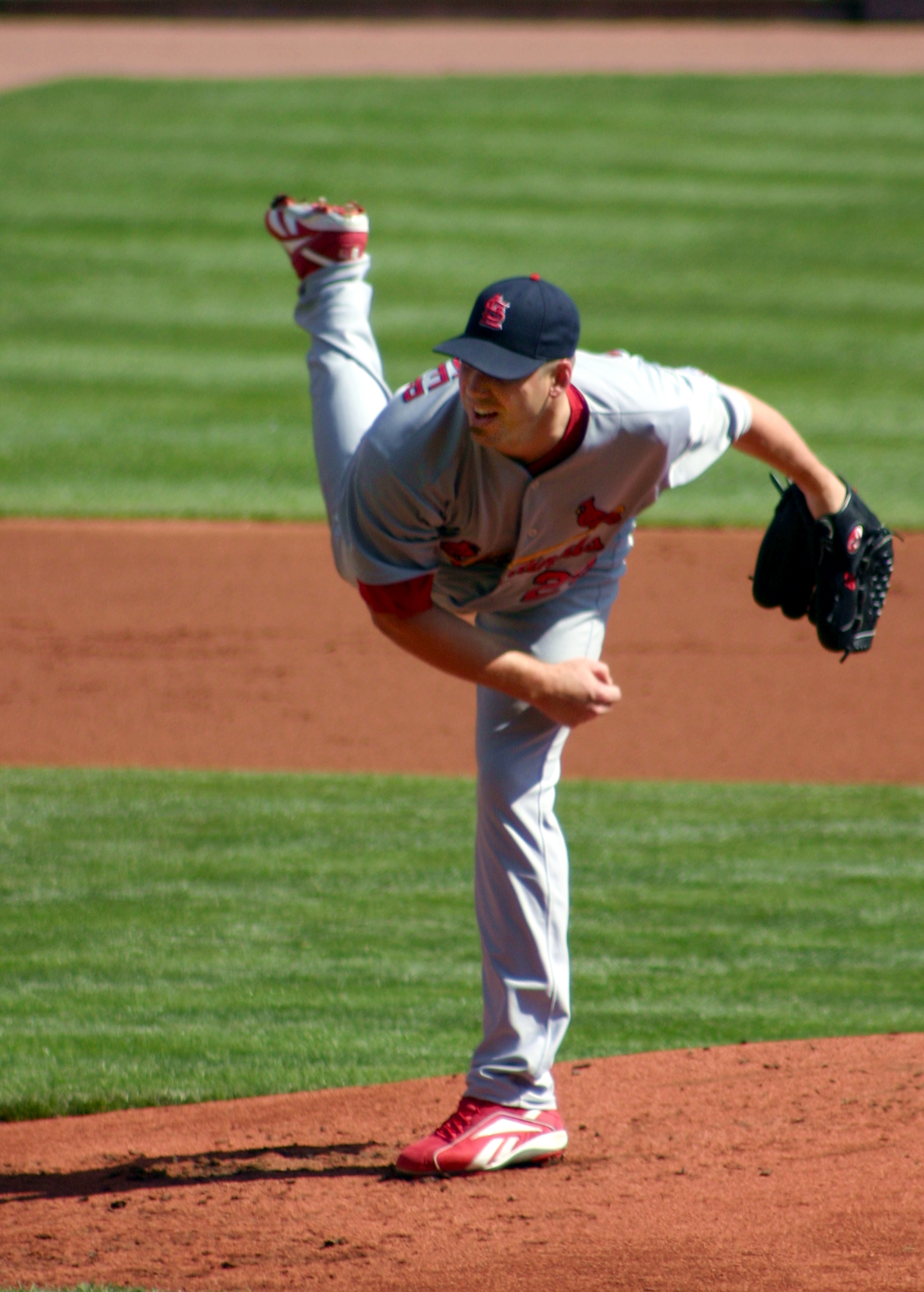
Christopher John Carpenter (born April 27, 1975) is an American former professional baseball pitcher. He played 15 seasons in Major League Baseball (MLB) for the Toronto Blue Jays and St. Louis Cardinals from 1997 to 2012. A Cy Young Award winner and two-time World Series champion, he was also a three-time All-Star selection. Additionally, he was twice named the Sporting News National League Pitcher of the Year, and received votes for a number of Comeback Player of the Year awards after surmounting various injuries. The Blue Jays selected Carpenter in the first round of the 1993 amateur draft from Trinity High School in New Hampshire. He made his MLB debut for Toronto in 1997. However, injuries and ineffectiveness delayed his career before the Blue Jays released him in 2002. After the Cardinals signed him, he emerged as an ace in 2004, winning the Cy Young Award in 2005 and helping lead the Cardinals to World Series titles in 2006 and 2011. For much of his career, Carpenter relied on a cutter that produced a heavy bore and finished with a sharp drop, a 12-to-6 curveball, and a sinker. Multiple injuries that were deemed career-threatening—including three surgeries on his elbow, two on his shoulder and another on his rib cage—caused Carpenter to miss nearly five full seasons. However, he rehabilitated and returned to pitch after each of these injuries. In nine seasons playing for the Cardinals, he won 95 regular-season games and compiled a 3.07 ERA in 197 starts and 1348+2⁄3 innings pitched. His .683 winning percentage during that period led the Major Leagues. In 18 postseason starts, he won 10 games with a 3.00 ERA over 108 innings.
Christopher John Carpenter was born on April 27, 1975, in Exeter, New Hampshire, but grew up in Raymond, New Hampshire, later moving to Bedford. He played in Little League Baseball, Babe Ruth League, and American Legion Baseball. While attending Trinity High School in Manchester, New Hampshire, he was selected all-state for three years in both baseball and hockey. As a junior in 1992, his baseball team won the state championship. He was selected for The Boston Globe All-Scholastic team as a senior. In 1993, his senior campaign, he earned Athlete of the Year honors. He committed to play college baseball for Creighton.
The Toronto Blue Jays selected Carpenter in the first round as the 15th overall pick of the 1993 Major League Baseball draft; he was chosen as a compensation pick from the Texas Rangers for signing Tom Henke. He was the first player from New Hampshire ever taken in the first round of the draft. He signed for $580,000. Standing 6 ft 6 in (1.98 m), scouts saw potential in his size, projectability, low-90s fastball, and power curveball. However, he needed to develop his control and changeup—he consistently struggled with his control early in his career. He began his professional career in 1994 in Minor League Baseball with the Medicine Hat Blue Jays of the short-season Pioneer League. In his debut against the Great Falls Dodgers, he tossed six scoreless innings of one-hit ball, fanning nine along the way. When he defeated the Lethbridge Mounties, he claimed the July 2 Pitcher of the Week award. His early success continued throughout the season as he finished with a 2.56 earned run average (ERA) with 80 strikeouts (SO), 39 bases on balls (BB) and 76 hits allowed in 84+2⁄3 innings pitched (IP). He ended the season with a win–loss record of 6–3 and turned in the league's third-lowest ERA. He was also picked as the Pioneer League's number-three prospect by league managers, behind Aaron Boone and Ray Brown. The Blue Jays promoted Carpenter to the Class-A Advanced Dunedin Blue Jays of Florida State League in 1995. Baseball America rated him the #100 prospect in the minor leagues before the season. He made 15 starts and yielded a 2.17 ERA in 99+1⁄3 innings. In 13 of those starts, he yielded three or fewer earned runs (ER). However, he posted a poor strikeout-to-walk ratio (K/BB) of 1.12, with 56 strikeouts and 50 walks. After a promotion to the AA Knoxville Blue Jays of the Southern League, he struggled with a 5.18 ERA, 53 strikeouts and 31 for 1.17 K/BB. Returning to Knoxville the next season, Carpenter's Baseball America rating moved up to #82 among all minor leaguers, and was third in the organization. Pitching against the Carolina Mudcats on May 17, he struck out six batters in the sixth and seventh innings, and 10 total in a 5–0 win. For the month of May, he was Knoxville's Pitcher of the Month after allowing a 1.91 ERA and a 3–0 record. He spent the entire season there, starting 28 games, pitching 171+1⁄3 innings, allowing 161 hits, 75 earned runs, and 91 walks while striking out 150 and compiling a 1.61 strikeout-to-walk ratio. He struck out eight or more batters in nine different games and led the club in starts, innings pitched and strikeouts. The strikeout total tied him for third in club history behind Alex Sanchez' 166 recorded in 1988 and were third in the organization. Playing for the Phoenix Desert Dogs in the off-season Arizona Fall League (AFL), he posted a 2–0 record in 10 starts, 2.33 ERA (second in the AFL) and 43 strikeouts (third). He was named that club's most valuable player (MVP). His command continued to be problematic, although his curve and changeup improved. In 1997, Baseball America promoted Carpenter's prospect ranking to 28th in the minor leagues. He started the season with the AAA Syracuse SkyChiefs of the International League, where he made his first seven starts of the season for a 3.88 ERA and 1–3 record. The Blue Jays purchased his contract on May 10, conferring his first major-league call-up.
Carpenter made his Major League Baseball (MLB) debut as a starter against the Minnesota Twins on May 12, 1997, completing three innings with eight hits, seven runs, and three walks while striking out five in a 12–2 loss. His first strikeout victim was Paul Molitor. At 22 years and 18 days old, he became the sixth-youngest starting pitcher for the Blue Jays. After two more appearances with a 12.71 ERA and 0–2 record, he returned to Syracuse. Carpenter's second round at Syracuse consisted of 12 more starts, including a seven inning complete game–shutout against the Richmond Braves on May 28. Totaling 19 games started at Syracuse in 1997, he pitched 120 innings, allowed 113 hits, and a 4.20 ERA. He posted 97 strikeouts with 53 walks for a 1.83 K/BB, his best figure since playing at Medicine Hat. However, his home run (HR) rate jumped after surrendering 16 home runs—a rate of 1.2 home runs per nine innings (HR/9). His previous high (0.7) was at Knoxville in 1996. The Blue Jays recalled Carpenter from Syracuse on July 29, where he remained in the starting rotation for the remainder of the season. Losing his first five MLB decisions, Carpenter defeated the Chicago White Sox 6–5 on August 19 for his first major league win. He pitched his first MLB complete game-shutout on September 9 in a 2–0 victory over the Anaheim Angels. In each of his final nine starts of the season, Carpenter lowered his season ERA with the Blue Jays. In that duration, he allowed 22 earned runs in 60 innings for a 3.30 ERA and was credited with a 3–3 record. He finished his rookie season with a 3–7 record and a 5.09 ERA. Performance struggles plagued Carpenter early in 1998. After just 10 innings with a combined 9.00 ERA in his first two starts, the Blue Jays moved him into the bullpen, where he remained until the end of May. On May 18, he totaled four innings and struck out six, which was a season-high for Toronto relievers. That stage included his total relief work for the season, where he made nine appearances and completed 22+2⁄3 innings, allowing a 2.38 ERA and carrying a 1–0 record. After Carpenter returned to the starting rotation, he earned a four-hit complete game-shutout on July 4 against the Tampa Bay, his first complete game and shutout of the season. 12 days later, he struck out a season-high 10—and then-career high—against the White Sox. Facing the Texas Rangers on August 4, he walked a career-high seven in an 11–9 loss. He won three games in a row from August 11–21. His September totals were a 3–0 record and 2.55 ERA in five starts and 35+1⁄3 innings with just nine walks and 26 strikeouts. Carpenter's finish to the season proved superior to the beginning; in eight of his final ten starts, he was charged three earned runs or fewer. His K/9 rate of 6.99 was 10th in the American League (AL). However, his home and road performances were uneven; in Toronto his ERA was 3.66 and his road ERA 5.24. He also won six of his last seven decisions as the Blue Jays made a late push for a playoff spot. However, Toronto missed the playoffs, finishing four games behind the Boston Red Sox for the AL wild card. With a 12–7 record and 4.37 ERA, his 12 wins tied Pat Hentgen for the second-highest total on the club. Carpenter battled through an injury-plagued 1999 season. Initially, he continued the skillful finish from the season before, allowing three or fewer earned runs in his first nine starts, and was credited with a 3–4 record and 3.02 ERA. His first loss of the season came in a 1–0 decision in Baltimore on April 10. His second start of the season resulted in an 11–1 complete game two-hitter at home on April 15 against Tampa Bay. For the month of April, his performance included a 2–1 record and 2.55 ERA. However, the results reversed in May; he was 1–4 in six starts with a 4.50 ERA. Pitching elbow inflammation placed him on the DL from June 3–28. After returning to play, he won the next five decisions of eight starts through August 11. He shut out Tampa Bay on July 3, the third of his career, and allowed just three hits. His season output at the All-Star break was a 3.24 ERA with a 6–5 record. He remained effective in June and throughout July, allowing 20 earned runs in 49+1⁄3 innings for a 3.62 ERA. However, Carpenter's performance waned following the All-Star break; in ten starts, his record was 3–3 with a 6.31 ERA. Carpenter's August ERA was 6.46 and his season ended early on September 16 when Dr. James Andrews performed surgery to remove a bone spur. He finished with a 9–8 record, 4.38 ERA in 150 innings and 24 starts. He allowed 177 hits, a rate of 10.6 hits per nine innings pitched (H/9), 1.500 walks plus hits per inning pitched (WHIP) and one HR/9. In 16 of 24 starts, he allowed three earned runs or fewer. Just three of nine baserunners successfully stole a base. His home and road performances also evened from the season before—his ERA at home was 4.21 and 4.54 on the road. Although Carpenter found significantly improved health the following season, he struggled through the statistically worst season of his career. He lost his first three starts, in which he pitched just 16 innings, allowing 18 hits, six home runs and ten walks for a 7.31 ERA. His first win of the season was an 8–3 complete game margin against the New York Yankees on April 21. Carpenter won his next start and finished April with a 5.25 ERA and 2–3 records. Opposing Red Sox ace Pedro Martínez—the eventual Cy Young Award winner that year—in Boston on May 23, Carpenter emerged victorious in a 3–2 decision. The only point in the season in which he had a winning record, however, was on June 14 when the Blue Jays defeated the Detroit Tigers 8–1, putting his personal record at 6–5. He went 3–7 the rest of the way. Ironically, he allowed a career-high nine earned runs against Detroit in his next start. He would again allow nine earned runs against Baltimore two starts later. The Blue Jays moved him to the bullpen where he made his first relief appearance in more than two years on July 22. He returned to the rotation for two starts, but lasted just 3+1⁄3 innings both times. At the beginning of August, after posting a 7–10 record with a 6.99 ERA, he was again shifted from the starting rotation to the bullpen. He made six more relief appearances, winning two, but allowed a 6.63 ERA. His eighth win came in 4+1⁄3 innings of scoreless relief against the Kansas City Royals. Carpenter pitched another 5+1⁄3 innings in relief for his ninth win on August 13 in opposition to the Minnesota Twins, striking out seven, which matched an AL season-high in relief. From August 29 to September 28, he returned to the rotation. In a September 16 contest against the Chicago White Sox, a ball hit off the bat of José Valentín struck him in the face, forcing him from the game. He returned to the mound twelve days later. However, in his final start that season, he was the losing pitcher in a 23–1 defeat to the Orioles, yielding four earned runs in three innings. With improved health, Carpenter pitched a new career-high 175+1⁄3 innings, but surrendered an AL-high 122 earned runs for a 6.26 ERA, by far the highest of his career. He allowed 204 hits a 1.637 WHIP, and 30 home runs, or 1.5 HR/9. His starting ERA was 6.55. His home ERA ballooned to 7.53 from 4.21 of the season before while his road ERA was 5.25. Beginning his 2001 season with 13 scoreless innings—a career high—he won his first start 11–0 against Tampa with 11 strikeouts (also a new career high). His April totals included a 3.15 ERA and 2–1 record. He tossed a six-hitter in a 4–0 victory over the White Sox on May 29 for his first complete game and shutout of the season. He gained three wins in May, his first three-win month since September 1998. At the end of June, Carpenter had a 7–4 record with a 3.67 ERA. However, he lost his next seven decisions in ten starts from July 1 to August 19 to fall to 7–11 and a 4.59 ERA. During that stretch he allowed 12 home runs and 40 earned runs in 56+2⁄3 innings for an ERA of 6.35. Lee Stevens became his 500th career strikeout casualty in a July 6 game against Montreal. The losing streak ended on August 24 with seven shutout innings against Baltimore. On September 4, his third complete game of the season was a 14–0 defeat of the Yankees in a contest in which he set a career high with 12 strikeouts. He won his last four decisions in eight starts, allowing just 14 earned runs in 51 innings for a 2.52 ERA. He finished with a record of 11–11 and an ERA of 4.09. His 11 victories tied him with Esteban Loaiza and Paul Quantrill for the team high, and he was considered one of the Blue Jays' starters of the future along with Roy Halladay. Prior to the All-Star break, he was 7–5 with a 3.99 ERA. After, he was 4–6 with a 4.21 ERA. He allowed 29 home runs on the season, which was the fourth-highest total in the AL. His two shutouts placed fourth and three complete games ninth. The Blue Jays named Carpenter their opening day starter for the first time in his career on April 1, 2002, at Fenway Park against the Red Sox. He was rocked in this start, recording 2+1⁄3 innings and allowing six runs. He received a no-decision as Toronto prevailed, 12–11. The Blue Jays placed him on the DL due to a shoulder injury after that start. Making his second start on April 21, Carpenter lasted only three innings, allowing three runs against the New York Yankees. He took the loss as New York won, 9–2. However, he was back on the DL after that start due to shoulder tendonitis. After recovering, Carpenter made six rehab starts between Tennessee and Syracuse. He allowed seven home runs in his first four starts covering 16 innings. Carpenter's first win of the season came against the Arizona Diamondbacks, after completing five innings and allowing two runs. Carpenter landed on the DL in August for the third time in 2002, where he remained for the rest of the season. Shoulder surgery followed in September to repair a torn glenoid labrum. Surgeons inserted three tacks to anchor the labrum. He allowed four home runs in his last 58 innings. Carpenter finished the year 4–5 with a 5.28 ERA. After the season—and plagues of injuries and control issues that did not fully resolve over his career in the Toronto organization—the Blue Jays removed him from the 40-man roster and offered him a minor league, incentive-based deal. Carpenter refused, allowing him to become a free agent.
The St. Louis Cardinals signed Carpenter on December 13, 2002, while he was still recovering from elbow surgery in anticipation he would be ready by the middle of the 2003 season. He made eight minor league starts as rehabilitation assignments before it was discovered he had torn his labrum again after the pins anchoring it had destabilized. Scar tissue developed, necessitating further surgery and a DL stay for the remainder of the season. On November 3, 2003, the Cardinals declined Carpenter's option for 2004 worth $2 million, instead buying him out for $200,000 and making him a free agent again. The two sides negotiated on a new contract and re-signed for $300,000 on December 3, 2003. Fully recovered for the 2004 season, Carpenter became a regular in the Cardinals' starting rotation. The first 11 starts of his Cardinals career included a 3.42 ERA and a 7–1 record. On April 9, he earned his first Cardinals win and 50th of his career against the Arizona Diamondbacks in a 13–7 score. He matched up against the Houston Astros and former Blue Jays rotation mate Roger Clemens on May 28, pitching eight scoreless innings while allowing just two hits. He did not factor in the decision as the Cardinals won 2–1 in 10 innings. In May, Carpenter started five games and was credited with a 4–0 record and a 2.62 ERA; eventually his win streak reached six games. On July 5 against the Cincinnati Reds, he struck out eight, including Adam Dunn for the 700th of his career, in a 4–1 victory. He established a new career-high 13th win in the second game of an August 20 doubleheader against the Pittsburgh Pirates. In an August 26 rematch against Cincinnati, he struck out 11 in an eight-inning complete game, his only one of the season. Carpenter walked just 22 while striking out 113 in his last 19 starts. A nerve problem in his right bicep ended his season early in September. For the season, Carpenter established then-career bests with 15 victories, a 3.46 ERA, 7.5 K/9 and allowed less than one hit per inning for the first time as a Major Leaguer. He tallied 182 innings, his highest total since 2001. His ERA placed thirteenth in the NL, 1.137 WHIP fourth, 1.879 BB/9 sixth, K/BB ratio of 4.000 placed fifth, and overall record of 15–5 with a .750 winning percentage ranked second. The Cardinals staff finished second in the league in ERA (3.75) as they won a National League-high 105 games, their most since 1944, and first NL pennant since 1987. The nerve problem caused Carpenter to miss the postseason, including what would have been his first World Series appearance, which the Boston Red Sox won. Carpenter won the National League Comeback Player of the Year Awards from the Sporting News and the Major League Baseball Players Association (MLBPA) Players Choice Award series.
The Cardinals called on Carpenter for his first Opening Day start for the club in 2005, and second of his career. He faced off against the Astros for his first for the Cardinals and second overall, allowing four hits in seven innings in a 7–3 win. On April 15, he signed a two-year extension through 2007 with a vesting option for 2008. He earned his first shutout in three years against the Chicago Cubs on April 21, and, on April 27, tied a career-high by striking out 12 Milwaukee Brewers in 7+2⁄3 innings. On June 14, Carpenter hurled a one-hit shutout against the team that drafted him, the Blue Jays, while striking out 10 in a 7–0 win. It was the 19th complete game one-hitter in Cardinals history. That contest launched the first of his 17 consecutive starts the Cardinals won, a streak that spanned until September 23. Other streaks coincided with that game. One was a 13-game personal winning streak with a 1.36 ERA over 16 starts, during which he yielded just 20 earned runs in 132+1⁄3 innings. Second, he was the first pitcher in the live-ball era (since 1920) to go undefeated in 16 consecutive starts, complete seven innings or more, and allow three or fewer runs in each game. Third, dating back to May 7, he also produced 22 consecutive quality starts. Fourth, he won his first 12 road starts of the season. Fifth, he was the first NL pitcher to win 10 consecutive road outings since Bob Gibson in 1970. Two starts after playing against Toronto, Carpenter picked up his third complete-game shutout against Pittsburgh, striking out 11 in an 8–0 win. He allowed four earned runs in 40 innings for a major-league leading 0.90 ERA in June. From June 25 to July 6, he threw 21+2⁄3 consecutive scoreless innings, a career high. With 13 wins before the All-Star break, Carpenter became just the third Cardinals pitcher ever to achieve the feat, following Joaquín Andújar in 1984 and 1985, and Kent Bottenfield in 1999. He was picked to start an All-Star Game at Comerica Park in Detroit, the first Cardinals pitcher in 32 years since Rick Wise to do so. He pitched one scoreless inning. On another occasion facing Clemens on July 17, Carpenter struck out nine Astros while giving up just three hits and no walks as St. Louis won, 3–0. It was his sixth consecutive start allowing one or no runs. He yielded five earned runs over 40+2⁄3 innings in July for a 1.11 July ERA (second in MLB), 33 strikeouts, seven walks and 24 hits, and one home run. Carpenter became the first Cardinals pitcher since Andújar in 1985 to record 15 wins before August 1. Carpenter's August resulted in a 4–0 record, 2.17 ERA, 38 strikeouts and six walks in six starts. On September 3, he won a complete game in Houston to become the majors' first 20-game winner. It was his 28th start, making him the fastest Cardinal to win 20 since Dizzy Dean in his 23rd start in 1934. With a 2–0 record, 1.69 ERA, 13 strikeouts and 16+2⁄3 innings, Carpenter won his first NL Player of the Week Award for the week ending September 4. On September 23, the Cardinals' streak of winning 17 consecutive starts by Carpenter ended with a 9–6 loss to Milwaukee. For the second consecutive season, the Cardinals repeated as Central division champions, and won at least 100 games with the best record in the National League. Carpenter set career bests with a 2.83 ERA, 213 strikeouts, 241+2⁄3 innings, seven complete games, four shutouts and a 21–5 record. as the club won 26 of his 33 regular season starts. While not a leader in any one major statistical category in 2005—aside from leading MLB in complete games—he was the only pitcher to finish in the top five in all of MLB in the pitching Triple Crown categories (ERA, wins and strikeouts). In road games, he went 12–1 in 15 starts with a 2.90 ERA, ranking fifth in the NL. The .923 winning percentage on the road is highest in franchise history for all pitchers with at least 10 wins on the road. He was the first Cardinals pitcher to strike out 200 in a season since José DeLeón in 1989. Finally healthy for an entire season, Carpenter pitched in the postseason for the first time in his career, debuting on October 4 against the Padres in Game 1 of the National League Division Series (NLDS). In six shutout innings, he earned the win in an 8–5 margin, but left due to hand cramping. The Cardinals defeated the Padres in the NLDS but fell to the Astros in the National League Championship Series (NLCS). His combined postseason totals were a 2–0 record with a 2.14 ERA in 21 innings. After winning several awards for his regular season performance, Carpenter was the National League Cy Young Award winner. He amassed 19 first-place votes for 132 points while runner-up Dontrelle Willis of the Florida Marlins garnered 112 total points. Carpenter became just the second pitcher in team history to win a Cy Young Award since Gibson, who had last won in 1970. He won the Major League Baseball Players Association (MLBPA) Players Choice Award for the National League Outstanding Pitcher, and the Sporting News Award for the National League Pitcher of the Year. He also won the This Year in Baseball Starting Pitcher of the Year Award. To recognize his selection as the NL Outstanding Pitcher, MLBPA Trust contributed $20,000 to Kristen's Gift in Lebanon, New Hampshire. The St. Louis chapter of the Baseball Writers' Association of America (BBWAA) selected him, along with Albert Pujols, as co-St. Louis Baseball Man of the Year Award winners. He finished eighth in the NL MVP voting, the highest placement of all pitchers.
Sources
Net-worth figure: Celebrity Net Worth (October 2026), in USD. Biography and career facts: the person's Wikipedia article and linked reporting. Snapshot date for all StarWorth figures: 28 October 2026.


