Background and career
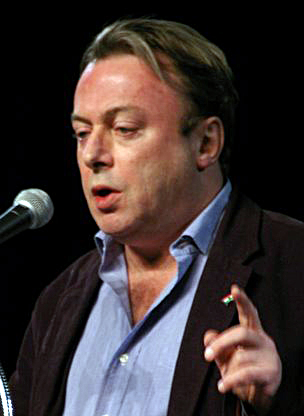
Christopher Eric Hitchens (13 April 1949 – 15 December 2011) was a British and American author and journalist. Known as one of the "Four Horsemen" of New Atheism (along with Richard Dawkins, Sam Harris, and Daniel Dennett), he gained prominence as a columnist and speaker. Hitchens's epistemological razor, which states that "what can be asserted without evidence can also be dismissed without evidence", is used in philosophy and law. Hitchens was born and educated in Britain, graduating in 1970 from the University of Oxford with a degree in philosophy, politics, and economics. In the early 1980s, he emigrated to the United States and wrote for The Nation and Vanity Fair. Hitchens's political views evolved greatly throughout his life. Originally describing himself as a democratic socialist, he was a member of various socialist organisations in his early life, including the Trotskyist International Socialists. Hitchens was critical of aspects of American foreign policy, including its involvement in Vietnam, Chile, and East Timor. However, he supported the United States in the Kosovo War, Bosnian War, and other interventions. Hitchens emphasised the centrality of the American Revolution and Constitution to his political philosophy. He held complex views on abortion: being ethically opposed to it in most instances, and believing that a foetus was entitled to personhood, while holding ambiguous, changing views on its legality. He supported gun rights and supported same-sex marriage, while opposing the war on drugs. Beginning in the 1990s, and particularly after 9/11, his politics were widely viewed as drifting to the right, but Hitchens objected to being called 'conservative' and maintained he was a 'leftist'. During the 2000s, he argued for the invasions of Iraq and Afghanistan, endorsed George W. Bush for president in 2004 and Barack Obama in 2008, and viewed Islamism as the principal threat to the Western world. Hitchens described himself as an antitheist and saw all religions as false, harmful, and authoritarian. He endorsed free expression, scientific scepticism, and separation of church and state, arguing science and philosophy are superior to religion as an ethical code of conduct for human civilisation. Hitchens authored 18 books on faith, religion, culture, politics, and literature. He notably wrote critical biographies of Catholic nun Mother Teresa in The Missionary Position (1995), Bill Clinton in No One Left to Lie To (1999), and American diplomat Henry Kissinger in The Trial of Henry Kissinger (2001). Hitchens died from complications related to esophageal cancer in December 2011, at the age of 62.
Hitchens was born in Portsmouth, Hampshire, the elder of two boys; his brother, Peter, became a socially conservative journalist. Their parents, Commander Eric Ernest Hitchens (1909–1987) and Yvonne Jean Hitchens (née Hickman; 1921–1973), met in Scotland when serving in the Royal Navy during World War II. His mother had been a Wren, a member of the Women's Royal Naval Service. She was of Jewish origin, something that Hitchens discovered when he was 38; he thus came to identify as a Jew. Hitchens often referred to his father simply as 'the Commander'. Eric Hitchens was deployed on HMS Jamaica, which took part in the sinking of the Scharnhorst in the Battle of the North Cape on 26 December 1943. He paid tribute to his father's contribution to the war: "Sending a Nazi convoy-raider to the bottom is a better day's work than any I have ever done." Eric's naval career required the family to move from base to base throughout Britain and its colonies; including to Malta, where Peter Hitchens was born in Sliema in 1951. Eric later worked as a bookkeeper for boatbuilders, speed boat manufacturers, and a prep school. Hitchens attended two private schools—Mount House School, Tavistock, Devon, from the age of eight, and the Leys School in Cambridge. Hitchens went up to Balliol College, Oxford, in 1967 where he read philosophy, politics and economics and was tutored by Steven Lukes and Anthony Kenny. He graduated in 1970 with a third-class degree. In his adolescence, he was "bowled over" by Richard Llewellyn's How Green Was My Valley, Arthur Koestler's Darkness at Noon, Fyodor Dostoyevsky's Crime and Punishment, R. H. Tawney's critique on Religion and the Rise of Capitalism, and the works of George Orwell. In 1968, he took part in the TV quiz-show University Challenge. In the 1960s, Hitchens joined the political left; drawn by disagreement over the Vietnam War, nuclear weapons, racism, and oligarchy, including that of "the unaccountable corporation". He expressed affinity with the politically charged counter-cultural and protest movements of the 1960s and 1970s. He avoided the recreational drug-use of the time, saying "in my cohort we were slightly anti-hedonistic ... it made it very much easier for police provocation to occur, because the planting of drugs was something that happened to almost everyone one knew." Hitchens was inspired to become a journalist after reading a piece by James Cameron. Hitchens was bisexual during his younger days, and joked that, as he aged, his appearance "declined to the point where only women would go to bed with [him]". He said he had sexual relations with two male students at Oxford who would later become government ministers during the premiership of Margaret Thatcher, although he would not reveal their names publicly. Hitchens joined the Labour Party in 1965, but along with the majority of the Labour students' organisation was expelled in 1967, because of what Hitchens called "Prime Minister Harold Wilson's contemptible support for the war in Vietnam". Under the influence of Peter Sedgwick, who translated the writings of the Russian revolutionary and Soviet dissident Victor Serge, Hitchens forged an ideological interest in Trotskyism and anti-Stalinist socialism. Shortly after, he joined "a small but growing post-Trotskyist Luxemburgist sect", the International Socialists. Hitchens recruited James Fenton to the International Socialists.
Early in his career Hitchens began working as a correspondent for the magazine International Socialism, published by the International Socialists, the forerunners of today's British Socialist Workers Party. This group was broadly Trotskyist, but differed from more orthodox Trotskyist groups in its refusal to defend communist states as "workers' states". Their slogan was "Neither Washington nor Moscow but International Socialism". In 1971 after spending a year travelling the United States on a scholarship, Hitchens went to work at the Times Higher Education Supplement where he served as a social science correspondent. Hitchens was fired after six months in the job. Next he was a researcher for ITV's Weekend World. In 1973 Hitchens went to work for the New Statesman, where his colleagues included the authors Martin Amis, whom he had briefly met at Oxford, as well as Julian Barnes and James Fenton, with whom he had shared a house in Oxford. Amis described him at the time as, "handsome, festive [and] gauntly left-wing". Around that time, the Friday lunches began, which were attended by writers including Clive James, Ian McEwan, Kingsley Amis, Terence Kilmartin, Robert Conquest, Al Alvarez, Peter Porter, Russell Davies, and Mark Boxer. At the New Statesman Hitchens acquired a reputation as a left-winger while working as a war correspondent from areas of conflict such as Northern Ireland, Libya, and Iraq. In November 1973, while in Greece, Hitchens reported on the constitutional crisis of the military junta. It became his first leading article for the New Statesman. In December 1977 Hitchens interviewed Argentine dictator Jorge Rafael Videla, a conversation he later described as "horrifying". In 1977, unhappy at the New Statesman, Hitchens moved to the Daily Express, where he became a foreign correspondent. He returned to the New Statesman in 1978 where he became assistant editor and then foreign editor.
Hitchens went to the United States in 1981 as part of an editor exchange programme between the New Statesman and The Nation. After joining The Nation, he penned vociferous critiques of Ronald Reagan, George H. W. Bush and American foreign policy in South and Central America. Hitchens became a contributing editor of Vanity Fair in 1992, writing ten columns a year. He left The Nation in 2002 after profoundly disagreeing with other contributors over the Iraq War. There is speculation that Hitchens was the inspiration for Tom Wolfe's character Peter Fallow in the 1987 novel The Bonfire of the Vanities, but others—including Hitchens—believe it to be Spy Magazine's "Ironman Nightlife Decathlete", Anthony Haden-Guest. In 1987, Hitchens's father died of cancer of the oesophagus, the same disease that would later claim his own life. In April 2007, Hitchens became a US citizen; he later stated that he saw himself as Anglo-American. He became a media fellow at the Hoover Institution in September 2008. At Slate, he usually wrote under the news-and-politics column Fighting Words. Before Hitchens's political shift, the American author and polemicist Gore Vidal spoke of Hitchens as his "dauphin" or "heir". In 2010 Hitchens attacked Vidal in a Vanity Fair piece headlined "Vidal Loco", calling him a "crackpot" for his adoption of 9/11 conspiracy theories. On the back of Hitchens's memoir Hitch-22, among the praise from notable figures, Vidal's endorsement of Hitchens as his successor is crossed out in red and annotated "NO, C.H." Hitchens's strong advocacy of the war in Iraq gained him a wider readership, and in September 2005 he was named as fifth on the list of the "Top 100 Public Intellectuals" by Foreign Policy and Prospect magazines. An online poll ranked the 100 intellectuals, but the magazines noted that the rankings of Hitchens (5), Noam Chomsky (1), and Abdolkarim Soroush (15) were partly due to their respective supporters' publicising of the vote. Hitchens later responded to his ranking with a few articles about his status as such. Hitchens did not leave his position writing for The Nation until after the September 11 attacks, stating that he felt the magazine had arrived at a position "that John Ashcroft is a greater menace than Osama bin Laden". The 11 September attacks "exhilarated" him, bringing into focus "a battle between everything I love and everything I hate" and strengthening his embrace of an interventionist foreign policy that challenged "fascism with an Islamic face". Hitchens recalls in his memoir having been "invited by Bernard-Henri Lévy to write an essay on political reconsiderations for his magazine La Règle du jeu. I gave it the partly ironic title: 'Can One Be a Neoconservative?' Impatient with this, some copy editor put it on the cover as 'How I Became a Neoconservative.' Perhaps this was an instance of the Cartesian principle as opposed to the English empiricist one: It was decided that I evidently was what I apparently only thought." Indeed, in a 2010 BBC interview, he stated that he "still [thought] like a Marxist" and considered himself "a leftist". In 2007, Hitchens published one of his most controversial articles titled "Why Women Aren't Funny" in Vanity Fair. While providing no empirical evidence, he argued that there is less societal pressure for women to practice humour and that "women who do it play by men's rules". Over the following year, Vanity Fair published several letters that it received, objecting to the tone or premise of the article, as well as a rebuttal by Alessandra Stanley. Amid further criticism, Hitchens reiterated his position in a video and written response. In 2007 Hitchens's work for Vanity Fair won the National Magazine Award in the category "Columns and Commentary". He was a finalist in the same category in 2008 for some of his columns in Slate but lost out to Matt Taibbi of Rolling Stone. Hitch-22 was short-listed for the 2010 National Book Critics Circle Award for Autobiography. He won the National Magazine Award for Columns about Cancer in 2011. Hitchens also served on the advisory board of Secular Coalition for America and offered advice to the Coalition on the acceptance and inclusion of nontheism in American life. In December 2011, prior to his death, Asteroid 57901 Hitchens was named after him.
Hitchens wrote a monthly essay in The Atlantic magazine and occasionally contributed to other literary journals. One of his books, Unacknowledged Legislation: Writers in the Public Sphere, collected these works. In Why Orwell Matters, he defends Orwell's writings against modern critics as relevant today and progressive for his time. In the 2008 book Christopher Hitchens and His Critics: Terror, Iraq, and the Left, many literary critiques are included of essays and other books of writers, such as David Horowitz and Edward Said. During a three-hour In Depth interview on Book TV, he named authors who influenced his views, including Aldous Huxley, George Orwell, Evelyn Waugh, Kingsley Amis, P. G. Wodehouse and Conor Cruise O'Brien. He once remarked on the adage "everyone has a book inside of them" that this is "exactly where I think it should, in most cases, remain".
Hitchens was a visiting professor in the following institutions:


