Background and career
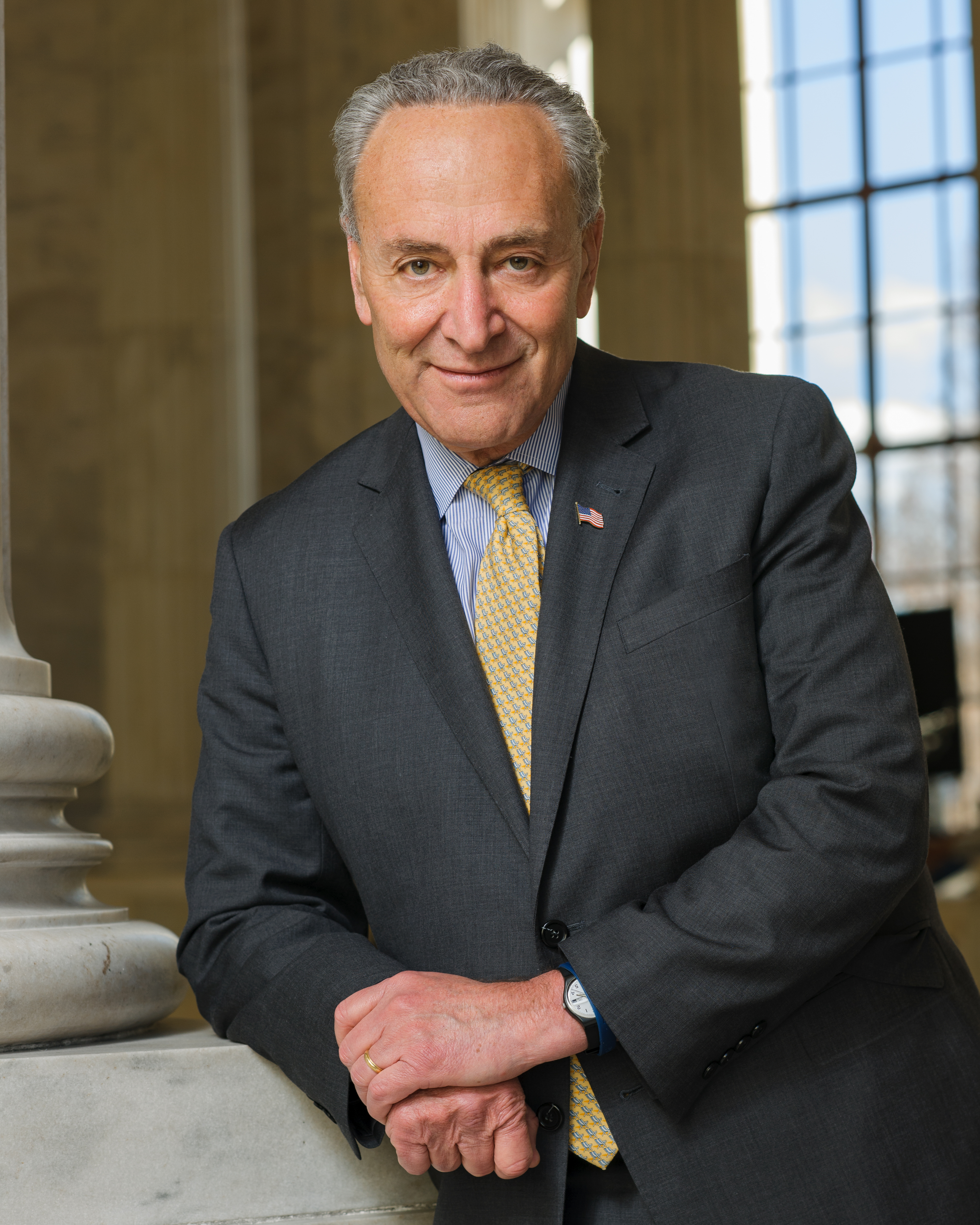
Charles Ellis Schumer ( SHOO-mər; born November 23, 1950) is an American politician serving since 1999 as a United States senator from New York. A member of the Democratic Party, he has led the Senate Democratic Caucus since 2017 and served as Senate majority leader from 2021 to 2025. He has served two stints as Senate minority leader, from 2017 to 2021 and since 2025. He became New York's senior senator in 2001, upon Daniel Patrick Moynihan's retirement. Elected to a fifth term in 2022, Schumer surpassed Moynihan and Jacob K. Javits as the longest-serving U.S. senator from New York. He is the dean of New York's congressional delegation. A native of Brooklyn and a graduate of Harvard College and Harvard Law School, Schumer was a three-term member of the New York State Assembly from 1975 to 1980. He served nine terms in the United States House of Representatives from 1981 to 1999, first representing New York's 16th congressional district before being redistricted to the 10th congressional district in 1983 and 9th congressional district 10 years later. In 1998, Schumer was elected to the Senate, defeating three-term Republican incumbent Al D'Amato. He was reelected in 2004 with 71% of the vote, in 2010 with 66% of the vote, in 2016 with 70% of the vote, and in 2022 with 56% of the vote. Schumer chaired the Democratic Senatorial Campaign Committee from 2005 to 2009, overseeing 14 Democratic gains in the Senate in the 2006 and 2008 elections. He was the third-ranking Democrat in the Senate, behind Senate majority leader Harry Reid and majority whip Dick Durbin. He served as Vice Chair of the Democratic Caucus in the Senate from 2007 to 2017 and chaired the Senate Democratic Policy Committee from 2011 to 2017. Schumer won his fourth term in the Senate in 2016 and was then unanimously elected Democratic leader to succeed Reid, who was retiring. In January 2021, Schumer became Senate majority leader, becoming the first Jewish Senate leader in U.S. history. As majority leader, Schumer shepherded through the Senate some of the Biden administration's major legislative initiatives, including the American Rescue Plan Act of 2021, the Infrastructure Investment and Jobs Act, the Inflation Reduction Act of 2022, the CHIPS and Science Act, the Bipartisan Safer Communities Act and the Respect for Marriage Act. Under his leadership, the Senate confirmed the most federal judges during the first two years of any presidency since John F. Kennedy's, and the most diverse slate of federal judicial nominations in American history, including Ketanji Brown Jackson, the first African American woman to serve on the Supreme Court.
Schumer was born on November 23, 1950, in Midwood, Brooklyn, the son of Selma (née Rosen) and Abraham Schumer. His father ran an exterminating business, and his mother was a homemaker. He and his family are Jewish, and he is a second cousin, once removed, of comedian Amy Schumer. His ancestors originated from the town of Chortkiv, Galicia, in what is now western Ukraine. Schumer attended Brooklyn public schools, scoring 1600 on the SAT and graduating as the valedictorian of James Madison High School in 1967. He competed for Madison High on the television quiz show It's Academic. He attended Harvard College, where he originally majored in chemistry before switching to social studies after volunteering on Eugene McCarthy's presidential campaign in 1968. After graduating magna cum laude and Phi Beta Kappa in 1971, Schumer attended Harvard Law School, earning his Juris Doctor with honors in 1974. He passed the New York state bar exam in early 1975, but never practiced law, opting rather for a career in politics.
In 1974, Schumer ran for and was elected to the New York State Assembly, filling a seat previously held by Schumer's mentor, U.S. representative Stephen Solarz. Schumer served three terms, from 1975 to 1981, sitting in the 181st, 182nd and 183rd New York State Legislatures. In 1980, 16th district U.S. representative Elizabeth Holtzman won the Democratic nomination for the Senate seat of Republican Jacob Javits. Schumer ran for Holtzman's vacated House seat and won. He was reelected eight times from the Brooklyn and Queens-based district, which changed numbers twice in his tenure (it was numbered the 16th from 1981 to 1983, the 10th from 1983 to 1993, and the 9th from 1993). In 1982, as a result of redistricting, Schumer faced a potential matchup with Solarz, but the matchup did not materialize. In preparation, Schumer "set about making friends on Wall Street, tapping the city's top law firms and securities houses for campaign donations. 'I told them I looked like I had a very difficult reapportionment fight. If I were to stand a chance of being re-elected, I needed some help,' he would later tell the Associated Press." Schumer introduced the Religious Freedom Restoration Act (also known as RFRA) on March 11, 1993. As a member of the House Judiciary Committee, Schumer was one of four members of Congress who oversaw the House investigation (leading the Democratic party's defense of the Clinton administration), of the Waco siege hearings in 1995.
In 1998, Schumer ran for the Senate. He won the Democratic primary with 51% of the vote against Geraldine Ferraro (21%) and Mark Green (19%). He received 54% of the vote in the general election, defeating three-term incumbent Republican Al D'Amato (44%). In 2004, Schumer was reelected with 71% of the vote, defeating the Republican nominee, Assemblyman Howard Mills of Middletown, and conservative Marilyn F. O'Grady. Many New York Republicans were dismayed by the selection of Mills over the conservative Michael Benjamin, who held significant advantages over Mills in both fundraising and organization. Benjamin publicly accused GOP chairman Sandy Treadwell and governor George Pataki of trying to muscle him out of the Senate race and undermine the democratic process. Schumer defeated Mills by 2.8 million votes. He won every county in the state except Hamilton County, in the Adirondacks, the least populous and most Republican county. Mills conceded defeat minutes after the polls closed, before returns had come in. An April 2009 SurveyUSA poll placed Schumer's approval rating at 62%, with 31% disapproving. Notable former aides to Schumer include former U.S. representative Anthony Weiner, former New York state senator Daniel Squadron, and New York state assemblymembers Phil Goldfeder and Victor M. Pichardo. Before the 2016 United States presidential election, Schumer said, "For every blue-collar Democrat we lose in western Pennsylvania, we will pick up two moderate Republicans in the suburbs in Philadelphia. And you can repeat that in Ohio and Illinois and Wisconsin." This assertion was criticized by left-wing and conservative voices. After the 2016 election, Schumer said the Democrats lost because they lacked "a strong, bold economic message" and he called on Democrats to push for reforms in the affordability of college and trade laws.
The Senate Democratic Caucus elected Schumer minority leader in November 2016. Schumer had been widely expected to lead Senate Democrats after Reid announced his retirement in 2015. He is the first New Yorker, as well as the first Jewish person, to serve as a Senate leader. On January 20, 2021, Democrats gained control of the Senate with the swearing-in of newly elected Georgia senators Jon Ossoff and Raphael Warnock, following the 2020–21 election runoff and special election runoff, making Schumer the majority leader, replacing Republican Mitch McConnell.
During Schumer's final months as Senate Majority Leader in the 118th Congress, Senate Democrats struck a deal with the chamber's Republican minority that gave President Trump the ability to fill four circuit judgeships during the first year of his second term in exchange for Democrats being able to hold votes on several federal district court nominees in a chamber they already controlled. As a result of the deal and President Biden's decision not to nominate a candidate for a Third Circuit vacancy in Delaware, Trump later appointed Whitney Hermandorfer, Emil Bove, Jennifer Mascott, and Joshua Dunlap to the vacant circuit judgeships that Senate Democrats declined to fill when Schumer led the chamber.


