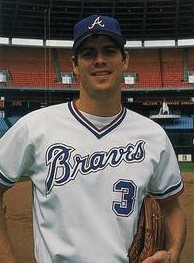
Background and career
Dale Bryan Murphy (born March 12, 1956) is an American former outfielder in Major League Baseball (MLB) who played for three National League (NL) teams, mainly the Atlanta Braves, from 1976 to 1993. A seven-time All-Star, he led the NL in home runs, runs batted in and slugging percentage twice each. Playing on frequently poor teams that posted only three winning seasons in his 15 years with Atlanta, he was named the NL's Most Valuable Player (MVP) in 1982 after leading the Braves to their first division title in 13 years, topping the league with 109 RBI. He was again named the MVP in 1983 after improving his batting figures in nearly every category, batting .302 with a career-high 121 RBI, and becoming only the sixth player in history with 30 home runs and 30 stolen bases in a season. A model of reliability in the Braves lineup, he played in 740 consecutive games from 1981 to 1986, then the sixth-longest streak in NL history. His 308 home runs in the 1980s were the second most by any major league player, behind only Mike Schmidt, and his 929 RBI in the decade tied him with Schmidt for the most in the NL, despite the Braves posting the league's worst record in that time. Highly regarded for his throwing arm, Murphy won five consecutive Gold Glove Awards as a center fielder, and his 99 assists and 21 double plays in the 1980s topped all NL outfielders. Murphy's 398 career home runs ranked sixth in NL history among right-handed hitters when he retired, and his 202 home runs as a center fielder ranked ninth in major league history; his .469 slugging percentage was the fifth highest among NL players with 1,000 games in center field. His 371 home runs with the Braves remain the Atlanta record for a right-handed hitter, and he also set Atlanta records for career games (1,926), at bats (7,098), hits (1,901), RBI (1,143), runs (1,103), doubles (306), walks (912) and total bases (3,394), all of which were later broken by Chipper Jones. In 1994, he became the fifth player to have his uniform number retired by the Braves. Murphy was inducted into the World Sports Humanitarian Hall of Fame in 1995, and the Oregon Sports Hall of Fame and Georgia Sports Hall of Fame in 1997.
Dale Murphy was born in Portland, Oregon, on March 12, 1956, to parents Charles and Betty. He had a sister, Sue. Murphy attended Woodrow Wilson High School and played American Legion Baseball, becoming a star catcher who batted .465 in his senior year. After being selected by the Braves with the fifth pick in the 1974 amateur draft, Murphy opted to sign with the team instead of accepting a scholarship offer from Arizona State University. He was assigned to the Rookie League Kingsport Braves in the Appalachian League, and batted .254 in 54 games. In 1975 he was moved up to the class-A Greenwood Braves in the Western Carolinas League. Although he batted only .228, he was moved up in 1976 to the double-A Savannah Braves in the Southern League, where he batted .267 before advancing midseason to the triple-A Richmond Braves in the International League, hitting .260 over the rest of the year.
Murphy began his major league career in 1976 with a nineteen-game stint catching as a September call-up with the Atlanta Braves. He made his debut in the second game of a road doubleheader against the Los Angeles Dodgers on September 13 with a pair of RBI singles in a 4–3 loss. After returning to Richmond for most of 1977, he appeared in only eighteen games for Atlanta that September, hitting his first two home runs in a 10-inning, 8–7 road win over the San Diego Padres on September 15. In 1978, the Braves shifted Murphy into becoming a first baseman; at the plate he had only a .226 batting average with a league-leading 145 strikeouts, but he also showed hints of his future power by hitting 23 home runs and led the team with 79 RBI. On July 2, he drove in a career-high six runs with a grand slam and a 2-run single in a 9–7 win over the San Francisco Giants, and on May 18, 1979, Murphy had the only 3-home run game of his career in a 6–4 win over the Giants. But within days, with his batting average at .348, he was sidelined due to cartilage damage in his left knee that required arthroscopic surgery, and he appeared briefly in only one more game in the next eight weeks. After returning, he had a career-high five hits including a pair of home runs and a triple on September 14 in a 10–7 road win over the Padres. Murphy switched to the outfield in 1980, a move that would help initiate a decade of highly productive play in the National League. Beginning the season briefly in left field and then in right field, in mid-May he was switched to center field, the position at which he would find his greatest success. He was named to his first All-Star team, hitting .300 at the midseason break. He ended the year leading the team in total bases and tied with Bob Horner for the lead with 89 RBI as the Braves finished 81-80 for their first winning season in six years, and their first season out of last place since 1975. By 1982, the former catcher had transformed himself into an MVP outfielder who appeared in each of Atlanta's 162 games; at the All-Star break, he was batting .285 with 23 home runs and 62 RBI as the Braves found themselves in first place, and he hit .343 in July as the team opened up a 7-game lead, eventually holding off the defending World Series champion Dodgers to win the division by one game as they led the league in scoring for the first time in nine years. His turnaround as a fielder was equally stark. In 1978, Murphy had led all NL first basemen in errors. In 1982, spending time at all three outfield positions, he won the first of five consecutive Gold Gloves, as well as the first MVP award by a Brave since 1957, when Hank Aaron won the award with the then-Milwaukee Braves. Playing in the decade before the Braves began their dominance of the National League East, Murphy also made his only postseason appearance in 1982. The league's most valuable player failed to translate his regular season preeminence into October success, picking up only three singles and scoring one run as the eventual World Series-champion St. Louis Cardinals swept the Braves in three games in the National League Championship Series. Murphy rebounded from the postseason sweep with another MVP award in 1983, leading the league in RBI and slugging percentage. The Braves built a lead of 61/2 games in mid-August, but ultimately lost the division by three games to the Dodgers despite Murphy's best efforts, as he batted .327 in September with 10 home runs and 29 RBI to pick up Player of the Month honors. On September 13, he stole three bases in a 6–0 road loss to the Cincinnati Reds, including back-to-back steals of second and third base. On September 24, he stole his 30th base of the season and scored on a Rafael Ramírez single in the ninth inning for a 3–2 win over the Dodgers, becoming the sixth player in history and the first NL player in ten years to join the 30–30 club. This time period ultimately proved the high-water era of Murphy's career; in 1984 he led the NL in home runs, slugging and total bases, and in 1985 he led the league in home runs, runs scored and walks. On August 18, 1984, he again picked up five hits including three leadoff doubles, scoring four times in an 8–3 road win over the St. Louis Cardinals. Each year during the four-season span from 1982 to 1985 he won a Gold Glove, appeared in the All-Star Game, and placed in the top nine in MVP voting. In 1987, he enjoyed another strong season, hitting a career-high 44 home runs, including his 300th career home run on August 21 in a 5–4 victory over the Pittsburgh Pirates. He ended the season with a .295 batting average and 105 RBI, though the Braves finished in fifth place, only a slight improvement over their last-place finish a year earlier. In 1988, however, after being voted the previous year to what was to be his final All-Star appearance, Murphy's production began to decline. He saw his batting average free-fall to .226; only once more, in 1991, would Murphy bat above .250. Once a consistent source of power at the plate, he never again hit 25 home runs or more in a season. Still, his totals of 24 home runs and 77 RBI in 1988 and 84 RBI in 1989 led the Braves as the team continued a downward slide. In 1988 the team lost 106 games, posting their worst record since 1935 when the franchise was located in Boston; slight improvements couldn't help the team avoid the league's worst record again in 1989 and 1990. On April 21, 1989, Murphy hit his 336th home run in a 5–3 loss to the Padres, passing Aaron to become Atlanta's career leader (Aaron had previously hit 398 home runs while the Braves were located in Milwaukee). Also in 1989, he twice equalled his career high of 6 RBI in a game, in a 9–4 win over the Padres on April 23, and a 10-1 drubbing of the Giants on July 27 with a pair of three-run home runs to begin and end the carnage as the Braves scored all their runs in the sixth inning.
The Braves traded Murphy to the Philadelphia Phillies for Jeff Parrett on August 3, 1990. Murphy's time with the Phillies was mostly uneventful, though one highlight was his 2,000th career hit, a double in a 2–1 win over the Montreal Expos on May 29, 1991. He enjoyed one of his last highlights on August 6 with a walk-off grand slam in the bottom of the 11th inning for a 6–2 win over the Chicago Cubs. Though his average rose as high as .296 on May 3, he ended the campaign batting .252, but his 81 RBI were the second most on the club, and his 33 doubles were the second highest total of his career. A degenerative, arthritic condition in his left knee limited Murphy to only 18 games in the 1992 season with the Phillies, although he did hit two home runs in that time to bring his career total to 398. He was released by the Phillies at the end of 1993 spring training and, on the same day, signed a minor league contract with the Colorado Rockies for their inaugural season. He was used mostly as a pinch hitter, and had an RBI single in the first win in Rockies history, an 11–4 win over the Expos on April 9. After going 0-for-3 with a strikeout in the Rockies' 8–0 road loss to the Dodgers on May 21, 1993 (a rare start and, even more rare, only the fourth time all season he was in a game from the first pitch to the final out), Murphy did not play in the next 4 games. On the morning of May 27, while the Rockies were in Houston to begin a series with the Astros, he suddenly announced his retirement from baseball at age 37. He explained the Rockies were needing to make a 25-man roster move and informed him ahead of time he was going to be released. The team gave him the chance to retire instead of being released, which he did. Murphy finished at 398 career home runs, failing to homer for the Rockies in 49 plate appearances and reach the 400-homer milestone. At the time of his retirement, he was 27th on the all-time home run list (12th in National League history) and 4th among active players, two behind Andre Dawson of the Boston Red Sox.
Murphy finished his career with 398 home runs, 1,266 RBI, and a .265 lifetime batting average. His MVP awards in 1982 and 1983 make him one of only four outfielders in major league history with consecutive MVP years; at the time, he was the youngest to have accomplished the feat. His many honors include seven All-Star appearances, five Gold Gloves, and four Silver Slugger Awards. Murphy led the National League in home runs, RBI and slugging percentage twice each, and in runs, walks and total bases once each; in addition to trailing only Mike Schmidt in home runs in the 1980s, he also led the major leagues in home runs and RBI over the 10-year span from 1981 to 1990. During the 1980s, Murphy led the NL in games, at bats, runs, hits, extra base hits, RBI, runs created, total bases, and plate appearances. He also accomplished a 30–30 (30 home runs with 30 stolen bases) season in 1983. Murphy played in 740 consecutive games, at the time the 11th longest such streak in baseball history. His jersey number 3 was retired by the Atlanta Braves on June 13, 1994; the number had been earlier worn by Babe Ruth, who wore Boston Braves number 3 during the partial 1935 season with which his career concluded. Murphy was inducted into both the Oregon Sports Hall of Fame and the Georgia Sports Hall of Fame in 1997.
Murphy's clean-living habits off the diamond were frequently noted in the media. Raised as a Presbyterian, he converted to the Church of Jesus Christ of Latter-day Saints (LDS Church) in 1975 while in the minor leagues after conversations with teammate Barry Bonnell. As a devout church member, Murphy did not drink alcoholic beverages, would not allow women to be photographed embracing him, and paid his teammates' dinner checks as long as alcoholic beverages were not on the tab. He also refused to give television interviews unless he was fully dressed. For several years The Atlanta Constitution ran a weekly column, wherein Murphy responded to young fans' questions and letters. In 1987 he shared Sports Illustrated's "Sportsmen and Sportswomen of the Year" award with seven others, characterized as "Athletes Who Care", for his work with numerous charities, including the Make-a-Wish Foundation, the Georgia March of Dimes and the American Heart Association. One of his more memorable incidents was reminiscent of a scene from the classic black-and-white baseball film The Pride of the Yankees:
Sources
Net-worth figure: Celebrity Net Worth (October 2026), in USD. Biography and career facts: the person's Wikipedia article and linked reporting. Snapshot date for all StarWorth figures: 28 October 2026.


