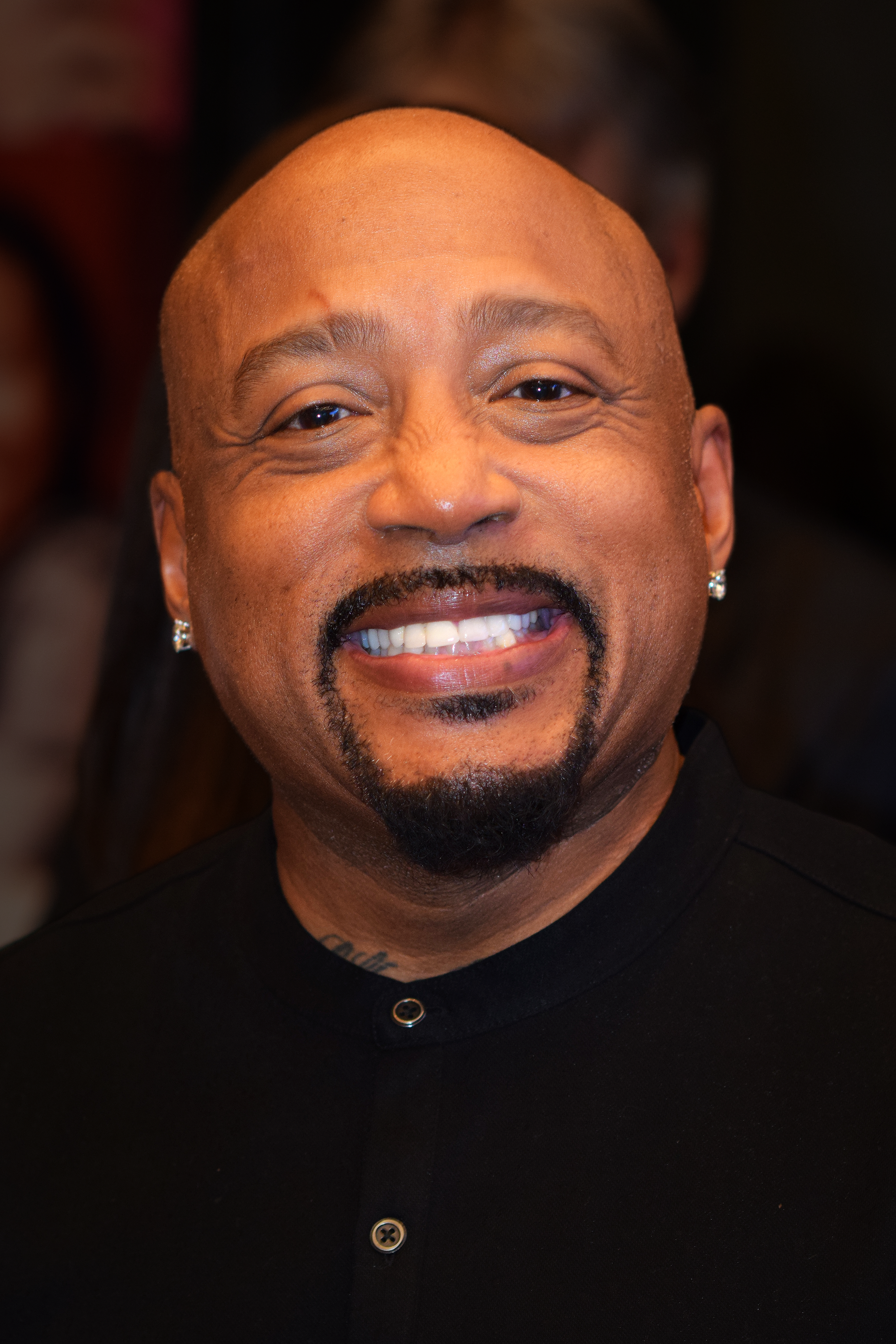
Background and career
Daymond Garfield John (born February 23, 1969) is an American businessman, investor, author and television personality. He is a Shark on the ABC reality television series Shark Tank. He is the founder and chief executive officer of FUBU.
John was born on February 23, 1969, in Brooklyn, New York City, and was raised in Hollis, Queens. He attended Catholic school for seven years. He began working at the age of 10, when his parents divorced; one early job entailed handing out flyers for $2 ($8.38 in 2023) an hour. In high school, he participated in a program that allowed him to work a full-time job and attend school on an alternating weekly basis, which he credits with instilling an entrepreneurial spirit. After graduating from high school, he started a commuter van service and waited tables at Red Lobster. When John was 16, his mother had a boyfriend, an attorney, whom he considered a stepfather and mentor.
John started FUBU in his mother's house in Hollis, Queens. When John first had the idea for a clothing company for young men, his mother taught him how to sew and supported him by allowing her house to be taken over to grow the business. Wool ski hats with their tops tied off with fishing line were popular at the time, and John noticed them being sold for $20, which he considered overpriced. He went home and sewed about 90 hats with his next-door neighbor. They sold their homemade hats for $10 each on the corner of Jamaica Avenue and made $800 in a single day in 1992. After the hats, they began selling screen-printed T-shirts. To break into the market, they sold on consignment and at large events around the Northeast. To make ends meet, John held a full-time job at Red Lobster, working on the FUBU business in between shifts. In addition to Brown, he recruited longtime friends J. Alexander Martin and Keith Perrin into the business, and began sewing the FUBU logo onto hockey jerseys, sweatshirts, and T-shirts. They loaned about 10 of the hockey jerseys out to rappers for their music videos for two years and got product placements in about 30 videos. Due to these placements, FUBU was perceived as a large and visible clothing brand, and stores started requesting their products. In 1993, he convinced LL Cool J, an old neighborhood friend, to wear a FUBU T-shirt for a promotional campaign. Later, while filming a 30-second advertising spot for The Gap, LL Cool J wore a FUBU hat in the commercial and incorporated the line "for us, by us" in his rapping. In 1994, John and his business partners received $300,000 in retailers' orders at the Las Vegas fashion trade show Magic. Needing capital to make the products, John and his mother obtained a second mortgage on their house—a strategy John would later decline to recommend, as he had risked losing ownership of the house. After being turned down by 26 or 27 banks for a loan, his mother used the last of their money to take out an advertisement in The New York Times. As a result of the ad, FUBU made a deal with Samsung Textiles, allowing them to complete their orders. FUBU has earned over $6 billion in global sales. FUBU is featured at the Smithsonian's National Museum of African-American History and Culture.
In 2009, John received a call from Mark Burnett asking him to join the cast of ABC's new reality business show Shark Tank, which gives entrepreneurs the opportunity to pitch their businesses to investors, or "Sharks" in the hopes of receiving an investment. As of 2026, Shark Tank has run for 17 seasons. John has invested $8,567,000 of his own money in Shark Tank companies as of May 12, 2017. One of his favorite investments to date is Bombas socks. According to Forbes, Bombas has eclipsed $1 billion in lifetime sales. Shark Tank has won 5 Emmy Awards and has been nominated 27 times. The show won Outstanding Reality Program from 2012 to 2014. On Season 5 of Shark Tank, John invested in Bubba's-Q Boneless Ribs on and helped grow the company from $154,000 in sales to $16 million in 3 years. In 2017, Bubba's-Q Boneless Ribs partnered up with Carl's Jr. to create the limited-edition Baby Back Rib Burger. In 2023, the LA Times published an article based on interviews with the Baker family, the owners of Bubba-Q's, where they expressed great dissatisfaction in dealing with John and his investment company. A permanent restraining order was later issued against the Bakers by federal judge Robert B. Kugler, who found that they had violated a 2019 settlement agreement requiring all parties to work together and not air their disagreements publicly. John also made a unique deal with 15-year-old Moziah "Mo" Bridges, owner of Mo's Bows. John decided not to invest in Mo's Bows but instead to mentor the young entrepreneur. The company would eventually take on a seven-figure licensing partnership with the NBA to create bow ties that use the teams' logos. On Season 6 of the show, John invested in Bombas socks. For every pair of socks sold, the company donates a pair to someone in need. Following his investment, total sales for the company increased from $450,000 in the first nine months to $12 million. As of May 2023, it is the best-selling Shark Tank product of all time, with $1.3 billion in cumulative sales according to Sony Pictures Television. He also invested in Sun-Staches, which would subsequently make $4.2 million in sales.
John is the CEO and founder of The Shark Group, a brand management and consulting firm with headquarters in South Beach, Miami. The firm manages celebrity brands, Shark Tank investments, and John's public speaking business. The Shark Group has received four Webby Awards and a nomination for their work on Black Entrepreneurs Day.
In addition to his business and television career, Daymond John is an international public speaker who delivers keynote presentations at conferences, corporate events, universities and business forums worldwide. His speaking topics include entrepreneurship, business strategy, branding, leadership, motivation, resilience, health, and personal development, drawing on his experiences as an entrepreneur, investor, author and television personality.