Background and career
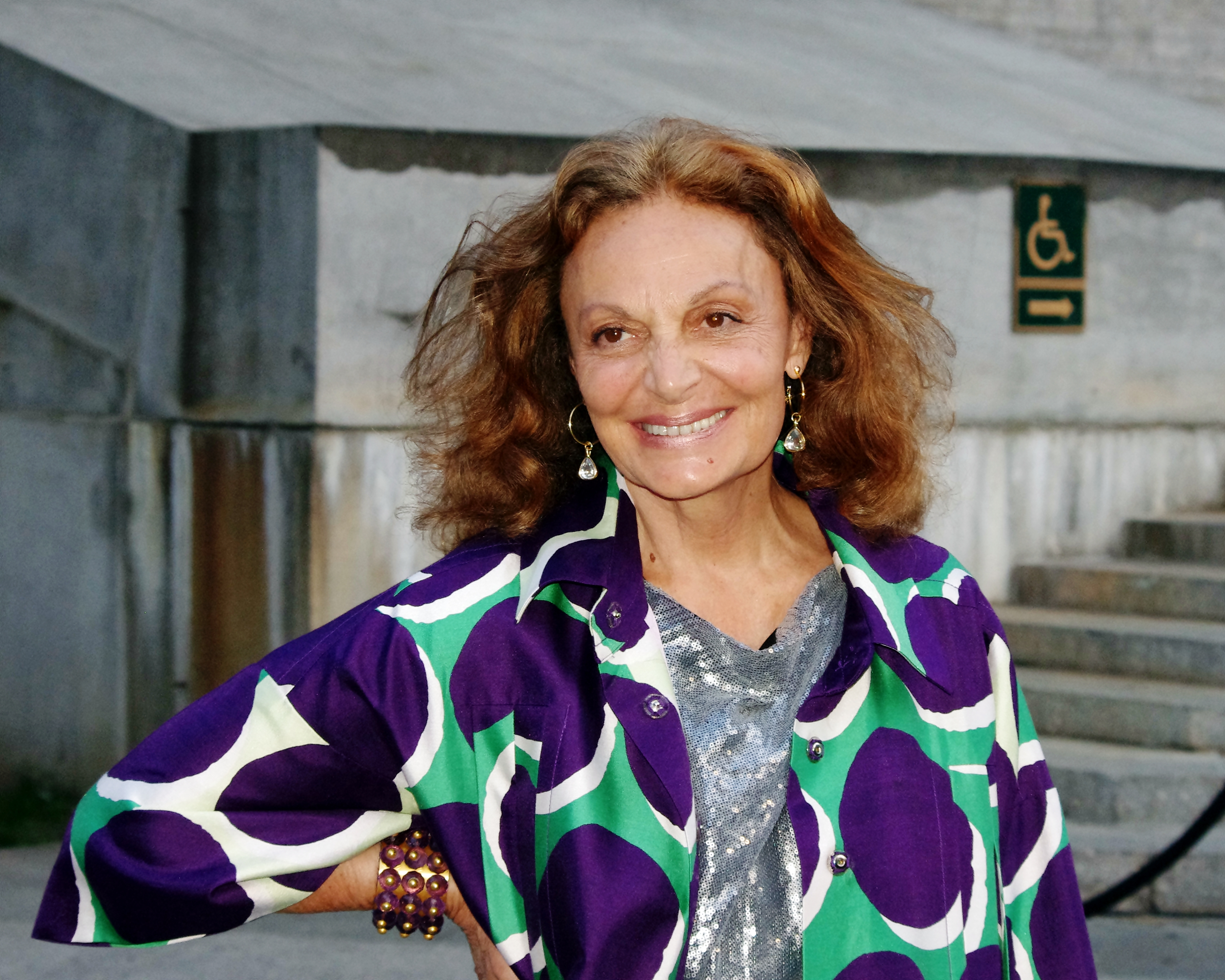
Diane von Fürstenberg (born Diane Simone Michele Halfin; 31 December 1946) is a Belgian fashion designer best known for her wrap dress. She initially rose to prominence in 1969 when she married into the German princely House of Fürstenberg, as the wife of Prince Egon von Fürstenberg. Following their separation in 1972 and divorce in 1983, she has continued to use his family name. Her fashion company, Diane von Furstenberg (DvF), is available in over 70 countries and 45 free-standing shops worldwide, with the company's headquarters and flagship boutique located in Manhattan's Meatpacking District. She is the past chairwoman of the Council of Fashion Designers of America (CFDA), a position she held from 2006 to 2019; in 2014 was listed as the 68th most powerful woman in the world by Forbes; and in 2015 was included in the Time 100, as an icon, by Time magazine. In 2016, she was awarded an honorary doctorate from the New School. In 2019, she was inducted into the National Women's Hall of Fame.
Diane Simone Michele Halfin was born in Brussels, Belgium, to Jewish parents. Her father, Bessarabian-born Leon (Lipa) Halfin, migrated to Belgium in 1929 from Chişinău, Kingdom of Romania (later Moldova) and later sought refuge from the Nazis in Switzerland. Her mother was Greek-born Liliane Nahmias, from Thessaloniki, a Holocaust survivor, who was captured by the Nazis while she was a member of the Resistance during World War II. Nahmias was taken to Auschwitz, then transferred to Ravensbrück, where she was liberated 20 months before Fürstenburg's birth. Weighing only 49 pounds, her mother was told by doctors that she should not have children, that she could die in childbirth, and that her baby would not be normal. Fürstenberg has spoken broadly about her mother's influence in her life, crediting her with teaching her that "fear is not an option." Fürstenberg attended a boarding school in Oxfordshire. She studied at Complutense University of Madrid before transferring to the University of Geneva to study economics. She then moved to Paris and worked as an assistant to fashion photographer's agent Albert Koski. She left Paris for Italy to apprentice with the textile manufacturer Angelo Ferretti in his factory, where she learned about cut, color and fabric. It was here that she designed and produced her first silk jersey wrap tops and skirts as separates, and after seeing a customer wearing the pieces together, Fürstenberg converted the design to a one-piece dress.
A year after marrying, Fürstenberg began designing women's clothes: "The minute I knew I was about to be Egon's wife, I decided to have a career. I wanted to be someone of my own, and not just a plain little girl who got married beyond her desserts." In her 2024 documentary, Fürstenberg stated that she sought to upstage her then in-laws, who were acknowledged to have disapproved of her Jewish background and, despite attending Diane and Egon's wedding ceremony, opted to boycott their wedding reception. After the Fürstenbergs separated in 1973, Egon also became a fashion designer. After moving to New York, she met high-profile Vogue editor Diana Vreeland, who declared her designs "absolutely smashing". She had her name listed on the fashion calendar for New York Fashion Week, and so her business was created. She moved into an estate in Connecticut she named Cloudwalk, and has lived there since. In 1974, she introduced the knitted jersey "wrap dress", which became an iconic piece in women's fashion; it is included in the collection of the Costume Institute of the Metropolitan Museum of Art. Von Fürstenberg opted to first advertise the wrap dress in Women’s Wear Daily in 1974, and included the tag line: "Feel like a woman, wear a dress!" Soon after the launch, 25,000 dresses were selling each week; one million dresses had been sold by 1976, according to Forbes. Tailored during the 1970s women's liberation era, the wrap dress also managed to embody the shifting roles of women in society at the time and was regarded as a dress for a "woman in charge." After the success of the wrap dress, von Fürstenberg was featured on the cover of Newsweek magazine in 1976. The accompanying article declared her "the most marketable woman since Coco Chanel." She launched a cosmetic line and her first fragrance, "Tatiana", named after her daughter. The New York Times reported that by 1979 the annual retail sales for the company were $150 million (equivalent to $665 million in 2025). Her fortunes would take a hit in the early 1980s. In 1985, von Fürstenberg moved to Paris, where she founded Salvy, a French-language publishing house. She started a number of other businesses, including a line of cosmetics and a home-shopping business, which she launched in 1991. In 1992, von Fürstenberg sold $1.2 million (equivalent to $2.8 million in 2025) of her Silk Assets collection in two hours on QVC. She credits the success with giving her the confidence to relaunch her company.
Fürstenberg relaunched her company in 1997, and reintroduced the wrap dress, which gained popularity with a new generation of women. Initially, the relaunch was a failure but, with the appointment of Paula Sutter as president of the brand, it was seemingly restored to its earlier success in the mid-seventies. Fürstenberg owned the company, Diane von Furstenberg Studio, along with Barry Diller and her two children from her first marriage, Alexandre and Tatiana. It lost money for its first three years, broke even in 2002, and turned its first profit in 2003. In 2004, the brand introduced the DVF by H. Stern fine jewelry collection, and entered into a licensing agreement with Italian silk manufacturer Mantero for the production and distribution of a beach line and scarf collection. In 2008, DVF launched its first resort collection, new line of travel-oriented clothes.
In 2009, Michelle Obama wore the DVF signature "Chain Link" print wrap dress on the official White House Christmas card. In 2011, DVF introduced a home collection, and a signature fragrance, Diane. In 2012, Fürstenberg launched her first children's collection with GapKids and a denim collaboration with Current/Elliott.
Her clothes have been worn by celebrities including Catherine, Princess of Wales, Gwyneth Paltrow, Kate Beckinsale, Madonna, Tina Brown, Jessica Alba, Susan Sarandon, Priyanka Chopra, Jennifer Lopez and Whitney Houston. Google Glass made its New York Fashion Week debut at the designer's Spring 2013 fashion show. In 2016, Scottish designer and print specialist Jonathan Saunders was appointed as the company’s first chief creative officer. His collections were well received by buyers and press, but he departed within 18 months, after reportedly clashing with Fürstenberg. Between 2017 and 2019, the DVF brand lost nearly $80 million, leading to an eventual 75% of the workforce made redundant in the U.S in May 2020. By 2018, sales, which had been $300 million before the 2008 recession, were down to $150 million. In 2018, the brand banned mohair use after a PETA exposé showed workers mutilating and killing goats to obtain it. All fur, angora and exotic skins were also banned from future collections. In June 2020, DVF announced the pending closure 18 of its 19 U.S. stores, after laying off 300 of their 400 employees in May 2020. That same year, the company's UK division entered administration due to restrictions caused by the COVID-19 pandemic. From 2020 to 2025, DVF’s global operations, including design, production, marketing and distribution, were managed by Glamel Trading Limited in Hong Kong. Throughout the licensing arrangement, Fürstenberg herself had approval rights over the design of her namesake products.