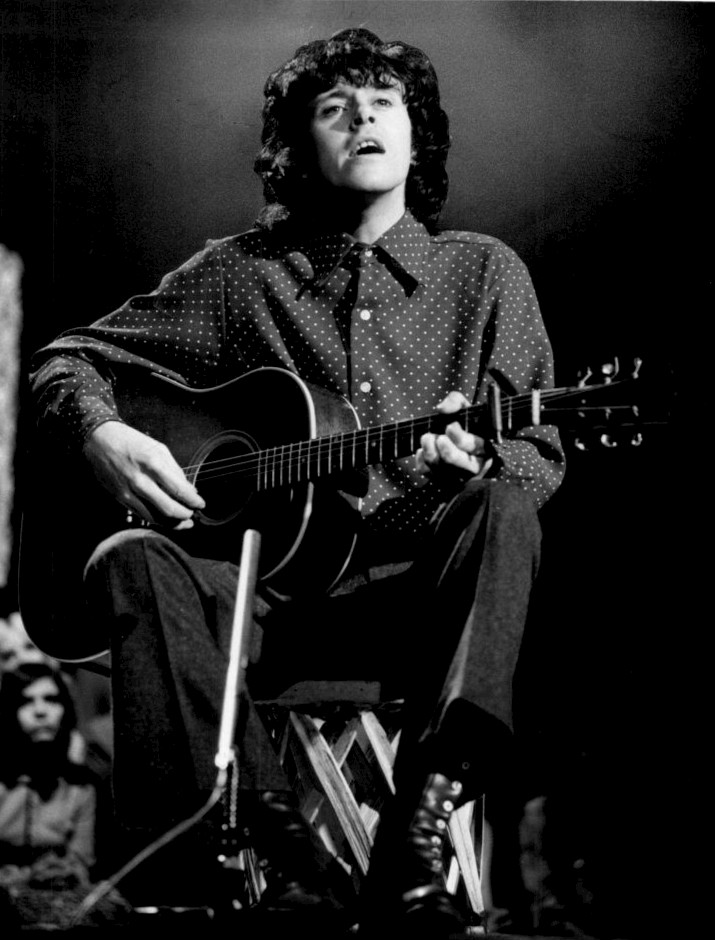
Background and career
Donovan Phillips Leitch (born 10 May 1946) is a Scottish musician, songwriter and record producer. He emerged from the British folk scene in early 1965 and scored many international hit singles and albums during the late 1960s. His work became emblematic of the flower power era with its blend of folk, pop, psychedelia and jazz stylings. Donovan first achieved recognition with live performances on the pop TV series Ready Steady Go! in 1965. Having signed with Pye Records that year, he recorded singles and two albums in the folk vein for Hickory Records, scoring three UK hit singles: "Catch the Wind", "Colours" and "Universal Soldier", the last written by Buffy Sainte-Marie. He then signed to CBS/Epic in the US and became more successful internationally, beginning a long collaboration with British record producer Mickie Most. In September 1966, "Sunshine Superman" topped America's Billboard Hot 100 chart for one week and went to No. 2 in Britain, followed by "Mellow Yellow" at US No. 2 in December 1966, then 1968's "Hurdy Gurdy Man" in the top 5 in both countries and then "Atlantis", which reached US No. 7 in May 1969. The compilation Donovan's Greatest Hits was released in March 1969 and peaked at No. 4 on the Billboard 200. Donovan became a friend of other prominent musicians such as Joan Baez, Brian Jones and the Beatles. He taught John Lennon a finger-picking guitar style in 1968 that Lennon employed in "Dear Prudence", "Julia", "Happiness Is a Warm Gun" and other songs. His backing musicians included the Jeff Beck Group and John Bonham, Jimmy Page and John Paul Jones, who later rose to fame as members of Led Zeppelin. Donovan's commercial fortunes waned after parting with Most in 1969, and he left the industry for a time. Donovan continued to perform and record intermittently in the 1970s and 1980s. His musical style and hippie image were scorned by critics, especially after the rise of punk rock. His performing and recording became sporadic until a revival in the 1990s with the emergence of Britain's rave scene and, in 1994, he moved permanently to Ireland. In 1996, he recorded the album Sutras with producer Rick Rubin and, in 2004, made the album Beat Cafe. Donovan was inducted into the Rock and Roll Hall of Fame in 2012 and the Songwriters Hall of Fame in 2014.
Donovan was born on 10 May 1946, in Maryhill, Glasgow to a Protestant father and a Catholic mother, Donald and Winifred (née Phillips) Leitch. His grandmothers were both Irish. He contracted polio as a child. The disease and treatment left him with a limp. His family moved to the new town of Hatfield, Hertfordshire, England. Influenced by his family's love of folk music, he began playing the guitar at 14. He enrolled in art school but soon dropped out, to live out his beatnik aspirations by going on the road. Donovan bought his first guitar in St Ives, Cornwall, in the early 1960s, as well as a fisherman's cap that he wore for years afterward.
Returning to Hatfield, Donovan spent several months playing in local clubs, absorbing the folk scene around his home in St Albans, learning the crosspicking guitar technique from local players such as Mac MacLeod and Mick Softley and writing his first songs. In 1964, he travelled to Manchester with Gypsy Dave, then spent the summer in Torquay, Devon. In Torquay, he stayed with Mac MacLeod and took up busking, studying the guitar and learning traditional folk and blues. In late 1964, Donovan was offered a management and publishing contract by Peter Eden and Geoff Stephens of Pye Records in London, for which he recorded a 10-track demo tape which included the original of his first single, "Catch the Wind" and "Josie". The first song revealed the influence of Woody Guthrie and Ramblin' Jack Elliott, who had also influenced Bob Dylan. Comparisons with Dylan followed for some time. In an interview with KFOK radio in the US on 14 June 2005, MacLeod said: "The press were fond of calling Donovan a Dylan clone as they had both been influenced by the same sources: Ramblin' Jack Elliott, Jesse Fuller, Woody Guthrie and many more." While recording the demo, Donovan befriended Brian Jones of the Rolling Stones, who was recording nearby. He had recently met Jones' ex-girlfriend, Linda Lawrence, who is the mother of Jones' son, Julian Brian (Jones) Leitch. The on-off romantic relationship that developed over five years was a force in Donovan's career. She influenced Donovan's music but refused to marry him and she moved to the United States for several years in the late 1960s. They met by chance in 1970 and married soon after. Donovan had other relationships – one of which resulted in the birth of his first two children, Donovan Leitch and Ione Skye, both of whom became actors.
During Bob Dylan's trip to the UK in the spring of 1965, the British music press were making comparisons of the two singer-songwriters which they presented as a rivalry. This prompted The Rolling Stones guitarist Brian Jones to say,
We've been watching Donovan too. He isn't too bad a singer but his stuff sounds like Dylan's. His 'Catch The Wind' sounds like 'Chimes of Freedom'. He's got a song, 'Hey Tangerine Eyes' and it sounds like Dylan's 'Mr. Tambourine Man'. Donovan is the undercurrent In D. A. Pennebaker's film Dont Look Back documenting Dylan's tour. Near the start of the film, Dylan opens a newspaper and exclaims, "Donovan? Who is this Donovan?" and Alan Price from The Animals spurs the rivalry on by telling Dylan that Donovan is a better guitar player, but that he has only been around for three months. Throughout the film, Donovan's name is seen next to Dylan's on newspaper headlines and on posters in the background, and Dylan and his friends refer to him consistently. Donovan finally appears in the second half of the film, along with Derroll Adams, in Dylan's suite at the Savoy Hotel, despite Donovan's management refusing to allow journalists to be present, saying they do not want "any stunt on the lines of the disciple meeting the messiah". According to Pennebaker, Dylan told him not to film the encounter, and Donovan played a song that sounded just like "Mr. Tambourine Man" but with different words. When confronted with lifting his tune, Donovan said that he thought it was an old folk song. Once the camera rolled, Donovan plays his song "To Sing For You" and then asks Dylan to play "Baby Blue". Dylan later told Melody Maker: "He played some songs to me. ... I like him. ... He's a nice guy." Melody Maker noted that Dylan had mentioned Donovan in his song "Talking World War Three Blues" and that the crowd had jeered, to which Dylan had responded backstage: "I didn't mean to put the guy down in my songs. I just did it for a joke, that's all." In an interview for the BBC in 2001 to mark Dylan's 60th birthday, Donovan acknowledged Dylan as an influence early in his career while distancing himself from "Dylan clone" allegations:
The one who really taught us to play and learn all the traditional songs was Martin Carthy – who incidentally was contacted by Dylan when Bob first came to the UK. Bob was influenced, as all American folk artists are, by the Celtic music of Ireland, Scotland and England. But in 1962 we folk Brits were also being influenced by some folk Blues and the American folk-exponents of our Celtic Heritage ... Dylan appeared after Woody [Guthrie], Pete [Seeger] and Joanie [Baez] had conquered our hearts, and he sounded like a cowboy at first but I knew where he got his stuff – it was Woody at first, then it was Jack Kerouac and the stream-of-consciousness poetry which moved him along. But when I heard 'Blowin' in the Wind' it was the clarion call to the new generation – and we artists were encouraged to be as brave in writing our thoughts in music ... We were not captured by his influence, we were encouraged to mimic him – and remember every British band from the Stones to the Beatles were copying note for note, lick for lick, all the American pop and blues artists – this is the way young artists learn. There's no shame in mimicking a hero or two – it flexes the creative muscles and tones the quality of our composition and technique. It was not only Dylan who influenced us – for me he was a spearhead into protest, and we all had a go at his style. I sounded like him for five minutes – others made a career of his sound. Like troubadours, Bob and I can write about any facet of the human condition. To be compared was natural, but I am not a copyist.


