Background and career
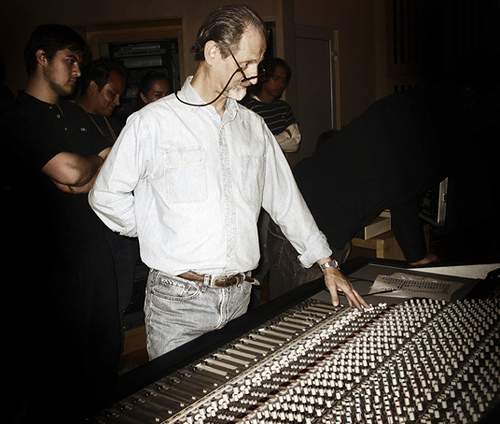
Edwin H. Kramer (born 19 April 1942) is a South African-born recording producer and engineer. He has collaborated with Jimi Hendrix, the Beatles, David Bowie, the Rolling Stones, Led Zeppelin, Eric Clapton, the Kinks, Kiss, John Mellencamp, and Carlos Santana, among others, as well as records for other well-known artists in various genres. Kramer's film soundtrack credits include Blue Wild Angel: Live at the Isle of Wight, Festival Express, Jimi Plays Monterey, Jimi Plays Berkeley, Live at the Fillmore East, Mad Dogs and Englishmen, The Pursuit of Happiness, Rainbow Bridge, The Song Remains the Same, and Woodstock: Music from the Original Soundtrack and More. Kramer was interviewed extensively in Jimi Hendrix: Hear My Train a Comin', a two-hour American Masters documentary which debuted in November 2013. He is also a photographer who has exhibited a number of his intimate images of performers, particularly Hendrix, with whom he worked on Are You Experienced, Axis: Bold as Love, Electric Ladyland, Band of Gypsys, and The Cry of Love, as well as the posthumous Valleys of Neptune, People, Hell and Angels, Miami Pop Festival, and other releases produced through Experience Hendrix, the organization formed by Hendrix's heirs. Eddie also did some indie work with 24K, a band from Toronto, Ontario, Canada.
Kramer was born in Cape Town to Jewish art and music-loving parents Sonny and Minna Kramer, active opponents of apartheid who moved from South Africa to London in the early 1960s for political reasons. At age four he began studying the piano. That instrument remained his first love, but he also dabbled with the violin and the cello. He studied classical piano at the South African College of Music. During these studies he became fascinated with jazz and rock, much to his father's chagrin. Kramer moved to London at age 19, some six months after his parents' relocating there. There he recorded jazz groups in a home studio with primitive recording equipment, installed hi-fi equipment in antique furniture, and installed album playback systems for the Soho Record Centre, the preeminent London record store chain of the day.
Kramer got his first industry job in 1962 at Advision Studios. A year later he was hired by Pye Studios, where he assisted on mobile recordings of classical works. He also assisted on Pye Studios recordings by the Kinks, the Searchers, the Undertakers, Petula Clark, and Sammy Davis Jr. In 1964 he founded KPS Studios, a mono- and two-track facility which was acquired in 1965 by Regent Sound, where the Rolling Stones had recorded their first album. Regent then tasked Kramer to help build and run their new four-track studio. The Beatles had recorded "Fixing a Hole" there, later to be featured on their 1967 album Sgt. Pepper's Lonely Hearts Club Band. Kramer engineered two Beatles songs that appeared as a single and on Magical Mystery Tour—"All You Need Is Love" and "Baby, You're a Rich Man". The two songs were recorded at Olympic Studios, where, in 1967, Kramer engineered albums for the Rolling Stones, Small Faces, Traffic, and Jimi Hendrix. Kramer became a permanent part of Hendrix's creative process, collaborating on the four albums which Hendrix released before his death in 1970. In 1968 Kramer relocated to New York, primarily to continue working with Hendrix. Headquartered first at The Record Plant and later working as an independent producer and engineer, Kramer produced the first Johnny Winter album and engineered a sequence of five Led Zeppelin albums, beginning with Led Zeppelin II. Kramer and his crew engineered the sound at the 1969 Woodstock Festival; they recorded the entire festival in a harried, sleepless, three-day binge, using vitamin B shots for stamina. The brilliant performances from several of rock's then-reigning acts are documented in both the film, Woodstock, and the three-disc album Woodstock: Music from the Original Soundtrack and More.
Kramer began the second decade of his career working alongside architect John Storyk to oversee creation of Jimi Hendrix's state-of-the-art studio, Electric Lady Studios, built and equipped for a then-astonishing $1 million. He served as Director of Engineering there from 1970 to 1974, producing Carly Simon's debut solo album, Carly Simon, as well as albums for Sha Na Na and Peter Frampton, and also engineering albums for Lena Horne, Dionne Warwick, and David Bowie, David Live and Young Americans. (The latter featured rhythm guitar from John Lennon on its Number One hit, "Fame".) In 1971 he mixed Humble Pie's double album Performance Rockin' the Fillmore, featuring Steve Marriott and Peter Frampton, as well as Larry Corryell's Barefoot Boy, his first and only album for Flying Dutchman label, and Curtis Mayfield's double album Curtis/Live!, his first release after leaving the Impressions. In 1973 Kramer mixed Led Zeppelin's Houses of the Holy. In the same year he began a lengthy association with Kiss. Earlier he had produced a four-song demo that won their first recording contract. He eventually produced Alive!, Alive II, Double Platinum, Rock and Roll Over, Love Gun, Alive III as well as Ace Frehley's first solo album, Ace Frehley, which yielded a hit single, "New York Groove". Also in 1973 he engineered the live Derek and the Dominos album In Concert. Also released in 1973 was the debut album by Jobriath. The following year saw the release of Jobriath's sophomore (and final) album, Creatures Of The Street, also co-produced by Kramer. Kramer left Electric Lady Studios in 1975. Working independently, he engineered the Rolling Stones' Love You Live, Led Zeppelin's Physical Graffiti and The Song Remains the Same, and Peter Frampton's Frampton Comes Alive!, the biggest-selling album of 1976, a 2-disc release that sold over 14 million units. In the same year he mixed Bad Company's third album, Run with the Pack.
Kramer produced Buddy Guy, classical guitarist John Williams, award-winning country group the Kentucky Headhunters, hard rock and metal bands such as Whitesnake, Triumph, Icon, Pretty Maids, Fastway, Alcatrazz featuring Steve Vai and Graham Bonnet, and Anthrax. He produced Among the Living for Anthrax in 1987, which yielded a Top 10 single in the UK, "I Am the Law".
September 1992 saw the publication of a book co-authored by Kramer and John McDermott. Hendrix: Setting the Record Straight was built on Kramer's years of collaboration with Hendrix, augmented by fresh interviews with key musicians and other participants in the meteoric Hendrix career. In 1993 Kramer produced and engineered Stone Free: A Tribute to Jimi Hendrix, featuring tracks by Jeff Beck, Eric Clapton, the Cure, Buddy Guy, classical violinist Nigel Kennedy, Living Colour, jazz guitarist Pat Metheny, hip hop artists P.M. Dawn, Spin Doctors, and others. The album raised $750,000 for music and dance scholarships (Berklee College of Music, the Juilliard School, and Dance Theatre of Harlem), administered by the United Negro College Fund. In 1994 Kramer released a two-part video series, "Adventures in Modern Recording", utilizing interviews with Les Paul, the seminal guitarist as well as pioneer of both electric guitar development and modern recording techniques such as multi-tracking and looping. In the same year Kramer produced the Spin Doctors' single for Woodstock '94, as well as Buddy Guy's Slippin' In the 1995 Grammy winner for Best Blues Album and winner of the W.C. Handy Award for Album of the Year in 1996. Buddy Guy and the Saturday Nite Live Band with G.E. Smith, also produced by Kramer, was a 1996 Grammy nominee. At the time of his death, Jimi Hendrix had a considerable backlog of material recorded in anticipation of future album releases. In a multimillion-dollar lawsuit which concluded in 1995, the heirs of Jimi Hendrix won back the rights to his voluminous recordings. Since then, Kramer has served as co-producer of all Hendrix releases. Kramer produced a second Hendrix tribute album in 1995, In From the Storm. Its diverse artists' roster included the London Metropolitan Orchestra, Toots Thielemans, Carlos Santana, Robben Ford, Taj Mahal, Sting, Steve Vai, Buddy Miles, Brian May, and Bootsy Collins. In 1997 he produced Now, the third Paul Rodgers studio album. He won a 1999 Grammy award for his audio production on the video for Jimi Hendrix's live album Band of Gypsys.
Sources
Net-worth figure: Celebrity Net Worth (October 2026), in USD. Biography and career facts: the person's Wikipedia article and linked reporting. Snapshot date for all StarWorth figures: 28 October 2026.