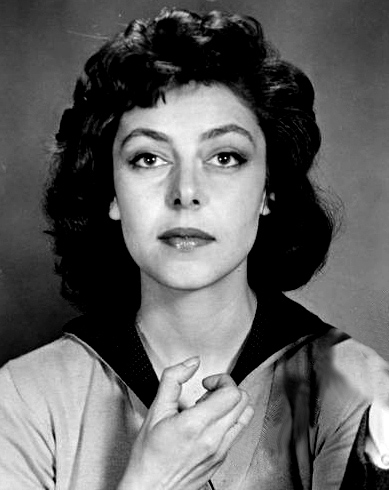
Background and career
Elaine Iva May (née Berlin; born April 21, 1932) is an American actress, comedian, writer, and director. She first gained fame in the 1950s for her improvisational comedy routines with Mike Nichols before going on to write and direct several critically acclaimed films. She has received numerous awards, including a BAFTA Award, a Grammy Award, and a Tony Award. She was honored with the National Medal of Arts from President Barack Obama in 2013, and an Honorary Academy Award in 2022. In 1955, May moved to Chicago and became a founding member of the Compass Players, an improvisational theater group. She began working alongside Nichols and in 1957, they both quit the group to form their own stage act, Nichols and May. In New York, they performed nightly in clubs in Greenwich Village alongside Joan Rivers and Woody Allen, as well as on the Broadway stage. They also made regular appearances on television and radio broadcasts. They released multiple comedy albums and received four Grammy Award nominations, winning Best Comedy Album for An Evening with Mike Nichols and Elaine May in 1962. Their collaboration was covered in the PBS documentary Nichols and May: Take Two (1996). May infrequently acted in films, including Luv, Enter Laughing (both 1967), California Suite (1978), and Small Time Crooks (2000). She became the first female director with a Hollywood deal since Ida Lupino when she directed the 1971 black screwball comedy A New Leaf. Experimenting with genres, she directed the dark romantic comedy The Heartbreak Kid (1972), the gangster film Mikey and Nicky (1976), and adventure comedy Ishtar (1987). May later earned acclaim writing the screenplays for Warren Beatty's Heaven Can Wait (1978), and Mike Nichols' The Birdcage (1996) and Primary Colors (1998). Heaven Can Wait and Primary Colors each earned her a nomination for the Academy Award for Best Adapted Screenplay, while the latter won her the BAFTA Award for Best Adapted Screenplay. May returned to acting in Woody Allen's Amazon Prime series Crisis in Six Scenes (2016) and on Broadway in the revival of the Kenneth Lonergan play The Waverly Gallery (2018) the latter of which earned her the Tony Award for Best Actress in a Play. The win made May the second-oldest performer behind Lois Smith to win a Tony Award for acting. In 2022, the Academy of Motion Pictures Arts and Sciences gave May an Honorary Academy Award for her "bold, uncompromising approach to filmmaking, as a writer, director, and actress".
Elaine Iva Berlin was born on April 21, 1932, in Philadelphia, Pennsylvania, the daughter of Jewish parents, theater director and actor Jack Berlin and actress Ida (Aaron) Berlin. As a child, May performed with her father in his traveling Yiddish theater company, which he took around the country. Her stage debut on the road was at the age of three, and she eventually played the character of a generic little boy named Benny. Because the troupe toured extensively, May had attended over fifty schools by the time she was ten, having spent as little as a few weeks enrolled at any one time. May said she hated school and would spend her free time at home reading fairy tales and mythology. Her father died when she was eleven years old, and then she and her mother moved to Los Angeles, where May later enrolled in Hollywood High School. She dropped out when she was fourteen years old. Two years later, at the age of sixteen, she married Marvin May, an engineer and toy inventor. They had one child, Jeannie Berlin (born 1949), who became an actress and screenwriter. The couple divorced in 1960, and she married lyricist Sheldon Harnick in 1962; they divorced a year later. In 1964, May married her psychoanalyst, David L. Rubinfine; they remained married until his death in 1982. May's long-time companion was director Stanley Donen, from 1999 until his death in 2019. Donen said he proposed marriage "about 172 times".
After her marriage to Marvin May, she studied acting. She also held odd jobs during that period, such as a roof salesman, and tried to enroll in college. She learned, however, that colleges in California required a high school diploma to apply, which she did not have. After finding out that the University of Chicago was one of the few colleges that would accept students without diplomas, she set out with seven dollars and hitchhiked to Chicago. Soon after moving to Chicago in 1950, May began informally taking classes at the university by auditing, sitting in without enrolling. She nevertheless sometimes engaged in discussions with instructors and once started a huge fight after saying that Socrates' apology was a political move. Mike Nichols, who was then an actor in the school's theatrical group, remembers her coming to his philosophy class, making "outrageous" comments, and leaving. They learned about each other from friends, eventually being introduced after one of his stage shows. The director Paul Sills brought May to Nichols and said, "Mike, I want you to meet the only other person on the campus of the University of Chicago who's as hostile as you are: Elaine May." Six weeks later, they bumped into each other at a train station in Chicago and soon began spending time together over the following weeks as "dead-broke theatre junkies." In 1955, May joined a new, off-campus improvisational theater group in Chicago, The Compass Players, becoming one of its charter members. The group was founded by Sills and David Shepherd. Nichols later joined the group, wherein he resumed his friendship with May. At first, he was unable to improvise well on stage, but with inspiration from May, they began developing improvised comedy sketches together. Nichols remembered this period:
From then on it became mostly pleasure because of Elaine's generosity. The fact of Elaine—her presence—kept me going. She was the only one who had faith in me. I loved it... We had a similar sense of humor and irony... When I was with her I became something more than I had been before. May became prominent as a member of the Compass's acting group, a quality others in the group observed. Bobbi Gordon, an actor, remembers that she was often the center of attention: "The first time I met her was at Compass... Elaine was this grande dame of letters. With people sitting around her feet, staring up at her, open-mouthed in awe, waiting for 'The Word'." A similar impression struck Compass actor Bob Smith:
May would hold court, discussing her days as a child actor in the Yiddish theater, as men hung on her every word. Every guy who knew her was in love with her. You'd have been stupid not to have been. As an integral member of their group, May was open to giving novices a chance, including the hiring of a black actor and generally making the group "more democratic". And by observing her high level of performance creativity, everyone's work was improved. "She was the strongest woman I ever met," adds Compass actor Nancy Ponder. In giving all her attention to acting, however, she neglected her home life. Fellow actress Barbara Harris recalled that May lived in a cellar with only one piece of furniture, a ping-pong table. "She wore basic beatnik black and, like her film characters, was a brilliant disheveled klutz." Group actor Omar Shapli was "struck by her piercing, dark-eyed, sultry stare. It was really unnerving", he says. Nichols remembers that "everybody wanted Elaine, and the people who got her couldn't keep her." Theater critic John Lahr agrees, noting that "her juicy good looks were a particularly disconcerting contrast to her sharp tongue."
May's sense of humor, including what she found funny about everyday life, was different from others' in the group. Novelist Herbert Gold, who dated May, says that "she treated everything funny that men take seriously... She was never serious. Her life was a narrative." Another ex-boyfriend, James Sacks, says that "Elaine had a genuine beautiful madness." Nevertheless, states Gold, "she was very cute, a lot like Debra Winger, just a pretty Jewish girl." May was considered highly intelligent. "She's about fifty percent more brilliant than she needs to be," says actor Eugene Troobnick. Those outside their theater group sometimes noticed that same quality. British actor Richard Burton, who was married to Elizabeth Taylor at the time, agreed with that impression after he first met May while he was starring in Camelot on Broadway.
Sources
Net-worth figure: Celebrity Net Worth (October 2026), in USD. Biography and career facts: the person's Wikipedia article and linked reporting. Snapshot date for all StarWorth figures: 28 October 2026.


