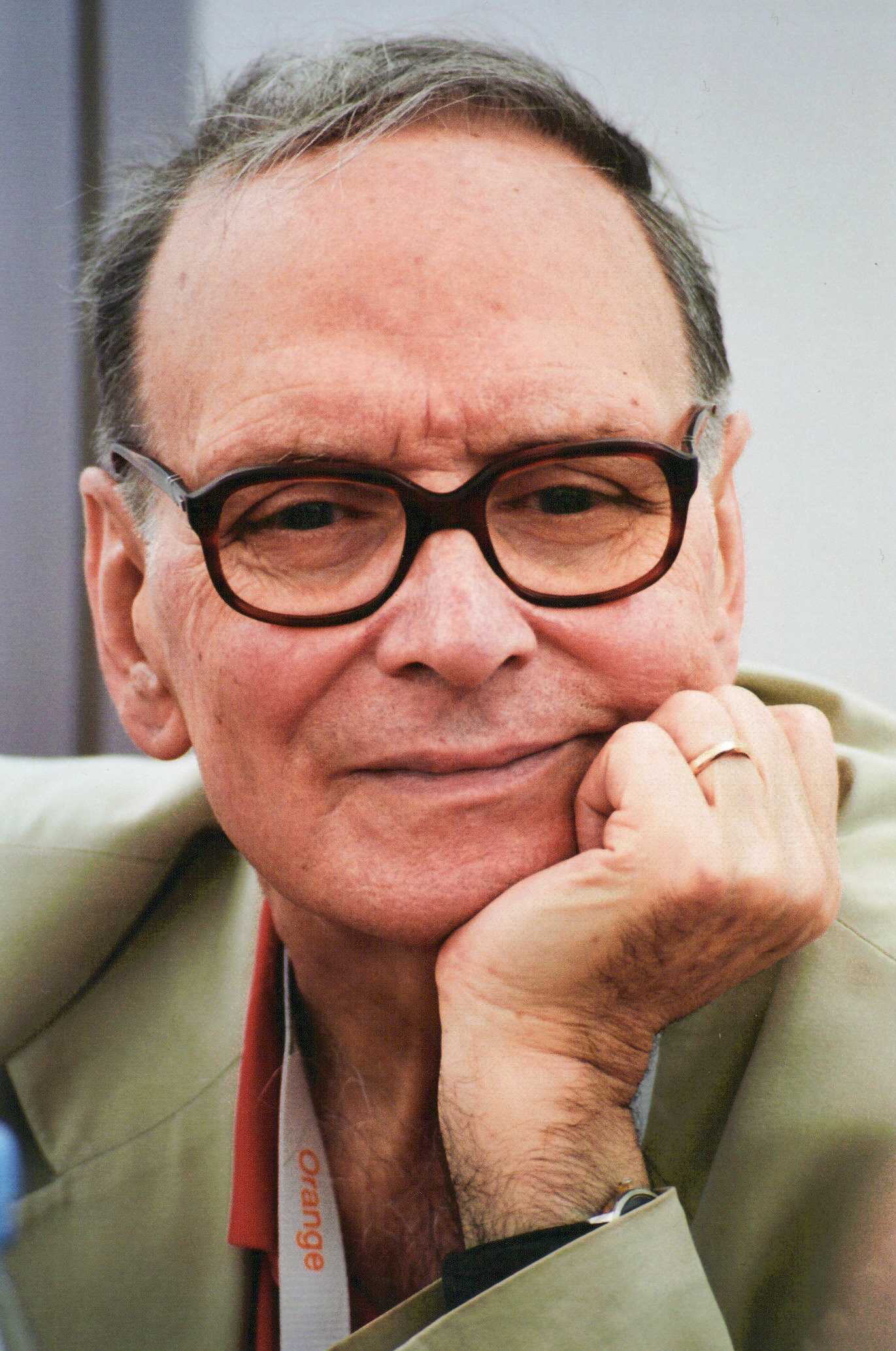
Background and career
Ennio Morricone (10 November 1928 – 6 July 2020) was an Italian composer, orchestrator, conductor, trumpeter, and pianist who wrote music in a wide range of styles. With more than 400 scores for cinema and television, as well as more than 100 classical works, Morricone is widely considered one of the greatest and most prolific film composers of all time. He received numerous accolades throughout his career, including two Academy Awards, three Grammy Awards, three Golden Globes, six BAFTAs, ten David di Donatello, eleven Nastro d'Argento, two European Film Awards, the Golden Lion Honorary Award, and the Polar Music Prize. His filmography includes more than 70 award-winning films, all of Sergio Leone's films from A Fistful of Dollars on, all of Giuseppe Tornatore's films since Cinema Paradiso, Dario Argento's Animal Trilogy, as well as The Battle of Algiers (1966), 1900 (1976), La Cage aux Folles (1978), Le Professionnel (1981), The Thing (1982), The Key (1983) by Tinto Brass and Tie Me Up! Tie Me Down! (1989). He received the Academy Award for Best Original Score nominations for Days of Heaven (1978), The Mission (1986), The Untouchables (1987), Bugsy (1991), Malèna (2000) and The Hateful Eight (2015), winning for the last. He won the Academy Honorary Award in 2007. His score to The Good, the Bad and the Ugly (1966) is regarded as one of the most influential soundtracks in history. It was inducted into the Grammy Hall of Fame in 2008. After playing the trumpet in jazz bands in the 1940s, Morricone became a studio arranger for RCA Victor and in 1955 started ghost writing for film and theatre. Throughout his career, he composed music for artists such as Paul Anka, Mina, Milva, Zucchero, and Andrea Bocelli. From 1960 to 1975, he gained international fame for composing music for Westerns and—with an estimated 10 million copies sold—Once Upon a Time in the West is one of the best-selling scores worldwide. From 1966 to 1980, he was a main member of Il Gruppo, one of the first experimental composers collectives. In 1969, he co-founded Forum Music Village, a prestigious recording studio. He continued to compose music for European productions, such as Marco Polo, La piovra, Nostromo, Fateless, Karol, and En mai, fais ce qu'il te plait. Morricone composed for Hollywood directors such as Don Siegel, Mike Nichols, Brian De Palma, Barry Levinson, William Friedkin, Oliver Stone, Warren Beatty, John Carpenter, and Quentin Tarantino. He has also worked with directors such as Bernardo Bertolucci, Mauro Bolognini, Tinto Brass, Giuliano Montaldo, Roland Joffé, Wolfgang Petersen, Roman Polanski, Henri Verneuil, Mario Bava, Lucio Fulci, Umberto Lenzi, Gillo Pontecorvo, and Pier Paolo Pasolini. His best-known compositions include "The Ecstasy of Gold", "Se telefonando", "Man with a Harmonica", "Here's to You", "Chi mai", "Gabriel's Oboe", and "E più ti penso". He has influenced many artists including Hans Zimmer, Danger Mouse, Dire Straits, Muse, Metallica, Fields of the Nephilim, and Radiohead. On May 10, 2016, Mondadori Libri published his official autobiography, Ennio Morricone. Inseguendo quel suono. La mia musica, la mia vita. Written in conversation with Alessandro De Rosa, the book has been reprinted several times in Italy, translated into the world's major languages, transcribed and published in English under the title Ennio Morricone: In His Own Words by Oxford University Press in 2019, and described by Morricone himself in the preface as "the best book ever written about me, the most authentic, the most detailed and well curated. The truest."
Morricone was born in Rome, the son of Libera Ridolfi and Mario Morricone, a musician. At the time of his birth, Italy was under fascist rule. Morricone had four siblings – Adriana, Aldo, Maria, and Franca – and lived in Trastevere in the centre of Rome. His father was a professional trumpeter who performed in light-music orchestras while his mother set up a small textile business. During his early schooldays, Morricone was also a classmate of his later collaborator Sergio Leone. Morricone's father taught him to read music and to play several instruments. He entered the Saint Cecilia Conservatory to take trumpet lessons under the guidance of Umberto Semproni. He formally entered the conservatory in 1940 at age 12, enrolling in a four-year harmony program that he completed within six months. He studied the trumpet, composition, and choral music under the direction of Goffredo Petrassi, to whom Morricone would later dedicate concert pieces. In 1941, Morricone was chosen among the students of the Saint Cecilia Conservatory to be a part of the Orchestra of the Opera, directed by Carlo Zecchi on the occasion of a tour of the Veneto region. He received his diploma in trumpet in 1946, continuing to work in classical composition and arrangement. Morricone received the Diploma in Instrumentation for Band Arrangement with a mark of 9/10 in 1952. His studies concluded at the Conservatory of Santa Cecilia in 1954 when he obtained a final 9.5/10 in his Diploma in Composition under Petrassi.
Morricone wrote his first compositions when he was six years old, and he was encouraged to develop his natural talents. In 1946, he composed "Il Mattino" ("The Morning") for voice and piano on a text by Fukuko, first in a group of seven "youth" Lieder. In the following years, he continued to write music for the theatre as well as classical music for voice and piano, such as "Imitazione", based on a text by Italian poet Giacomo Leopardi, "Intimità", based on a text by Olinto Dini, "Distacco I" and "Distacco II" with words by R. Gnoli, "Oboe Sommerso" for baritone and five instruments with words by poet Salvatore Quasimodo, and "Verrà la Morte", for alto and piano, based on a text by novelist Cesare Pavese. In 1953, Morricone was asked by Gorni Kramer and Lelio Luttazzi to write an arrangement for some medleys in an American style for a series of evening radio shows. Many of his orchestral and chamber compositions were written in 1954–1959: Musica per archi e pianoforte (1954), Invenzione, Canone e Ricercare per piano; Sestetto per flauto, oboe, fagotto, violino, viola, e violoncello (1955), Dodici Variazione per oboe, violoncello, e piano; Trio per clarinetto, corno, e violoncello; Variazione su un tema di Frescobaldi (1956); Quattro pezzi per chitarra (1957); Distanze per violino, violoncello, e piano; Musica per undici violini, Tre Studi per flauto, clarinetto, e fagotto (1958); and the Concerto per orchestra (1957), dedicated to his teacher Goffredo Petrassi. Morricone soon gained popularity by writing his first background music for radio dramas and quickly moved into film. Nevertheless, he continued to compose classical music later in his career. In 1995, he was commissioned to write the opera Partenope. The opera was first premiered on December 12, 2025, five years after Morricone's death.
Morricone's career as an arranger began in 1950, by arranging the piece Mamma Bianca (Narciso Parigi). On occasion of the "Anno Santo" (Holy Year), he arranged a long group of popular songs of devotion for radio broadcasting. In 1956, Morricone started to support his family by playing in a jazz band and arranging pop songs for the Italian broadcasting service RAI. He was hired by RAI in 1958 but quit his job on his first day at work when he was told that broadcasting of music composed by employees was forbidden by a company rule. Subsequently, Morricone became a top studio arranger at RCA Victor, working with Renato Rascel, Rita Pavone, Domenico Modugno, and Mario Lanza. Throughout his career, Morricone composed songs for several national and international jazz and pop artists, including Gianni Meccia (Il barattolo, 1960), Gianni Morandi (Go Kart Twist, 1962; Non son degno di te, 1964), Alberto Lionello (La donna che vale, 1959), Edoardo Vianello (Ornella, 1960; Cicciona cha-cha, 1960; Faccio finta di dormire, 1961; T'ho conosciuta, 1963; and also Pinne, fucine ed occhiali, I Watussi and Guarda come dondolo), Nora Orlandi (Arianna, 1960), Jimmy Fontana (Twist no. 9; Nicole, 1962), Rita Pavone (Come te non c'e' nessuno and Pel di carota from 1962, arranged by Luis Bacalov), Catherine Spaak (Penso a te; Questi vent'anni miei, 1964), Luigi Tenco (Quello che conta; Tra tanta gente; 1962), Gino Paoli (Nel corso from 1963, written by Morricone with Paoli), Renato Rascel (Scirocco, 1964), Paul Anka (Ogni Volta), Amii Stewart, Rosy Armen (L'Amore Gira), Milva (Ridevi, Metti Una Sera A Cena), Françoise Hardy (Je changerais d'avis, 1966), Mireille Mathieu (Mon ami de toujours; Pas vu, pas pris, 1971; J'oublie la pluie et le soleil, 1974), and Demis Roussos (I Like The World, 1970). In 1963, the composer co-wrote (with Roby Ferrante) the music for the composition "Ogni volta" ("Every Time"), a song that was performed by Paul Anka for the first time during the Festival di Sanremo in 1964. This song was arranged and conducted by Morricone and sold more than three million copies worldwide, including one million copies in Italy alone. Another success was his composition "Se telefonando". Performed by Mina, it was a track on Studio Uno 66, the 4th studio album by Mina. Morricone's sophisticated arrangement of "Se telefonando" was a combination of melodic trumpet lines, Hal Blaine–style drumming, a string set, a 1960s Europop female choir, and intensive subsonic-sounding trombones. The Italian Hitparade No. 7 song had eight transitions of tonality building tension throughout the chorus. During the following decades, the song was recorded by several performers in Italy and abroad including covers by Françoise Hardy and Iva Zanicchi (1966), Delta V (2005), Vanessa and the O's (2007), and Neil Hannon (2008). Françoise Hardy – Mon amie la rose site in the reader's poll conducted by the newspaper la Repubblica to celebrate Mina's 70th anniversary in 2010, 30,000 voters picked the track as the best song ever recorded by Mina. In 1987, Morricone co-wrote It Couldn't Happen Here with the Pet Shop Boys. Other compositions for international artists include: La metà di me and Immagina (1988) by Ruggero Raimondi, Libera l'amore (1989) performed by Zucchero, Love Affair (1994) by k.d. lang, Ha fatto un sogno (1997) by Antonello Venditti, Di Più (1997) by Tiziana Tosca Donati, Come un fiume tu (1998), Un Canto (1998) and Conradian (2006) by Andrea Bocelli, Ricordare (1998) and Salmo (2000) by Angelo Branduardi, and My heart and I (2001) by Sting.
After graduation in 1954, Morricone started to write and arrange music as a ghost writer for films credited to already well-known composers, while also arranging for many light music orchestras of the RAI television network, working especially with Armando Trovajoli, Alessandro Cicognini, and Carlo Savina. He occasionally adopted Anglicized pseudonyms, such as Dan Savio and Leo Nichols. In 1959, Morricone was the conductor (and uncredited co-composer) for Mario Nascimbene's score to Morte di un amico (Death of a Friend), an Italian drama directed by Franco Rossi. In the same year, he composed music for the theatre show Il lieto fine by Luciano Salce. 1961 marked his real film debut with Luciano Salce's The Fascist. In an interview with American composer Fred Karlin, Morricone discussed his beginnings, stating, "My first films were light comedies or costume movies that required simple musical scores that were easily created, a genre that I never completely abandoned even when I went on to much more important films with major directors". With The Fascist Morricone began a long-running collaboration with Luciano Salce. In 1962, Morricone composed the jazz-influenced score for Salce's comedy Crazy Desire. That year, Morricone also arranged Italian singer Edoardo Vianello's summer hit "Pinne, fucile, e occhiali", a cha-cha song, peppered with added water effects, unusual instrumental sounds and unexpected stops and starts. Morricone wrote works for the concert hall in a more avant-garde style. Some of these have been recorded, such as Ut, a trumpet concerto dedicated to Mauro Maur.
From 1964 up to their eventual disbandment in 1980, Morricone was part of Gruppo di Improvvisazione Nuova Consonanza (G.I.N.C.), a group of composers who performed and recorded avant-garde free improvisations. The Rome-based avant-garde ensemble was dedicated to the development of improvisation and new music methods. The ensemble functioned as a laboratory of sorts, working with anti-musical systems and sound techniques in an attempt to redefine the new music ensemble and explore "New Consonance". Known as "The Group" or "Il Gruppo", they released seven albums across the Deutsche Grammophon, RCA, and Cramps labels: Gruppo di Improvvisazione Nuova Consonanza (1966), The Private Sea of Dreams (1967), Improvisationen (1968), The Feedback (1970), Improvvisazioni a Formazioni Variate (1973), Nuova Consonanza (1975), and Musica su Schemi (1976). Perhaps the most famous of these is their album entitled The Feed-back, which combines free jazz and avant-garde classical music with funk; the album frequently is sampled by hip hop DJs and is considered to be one of the most collectable records in existence, often fetching more than $1,000 at auction.


