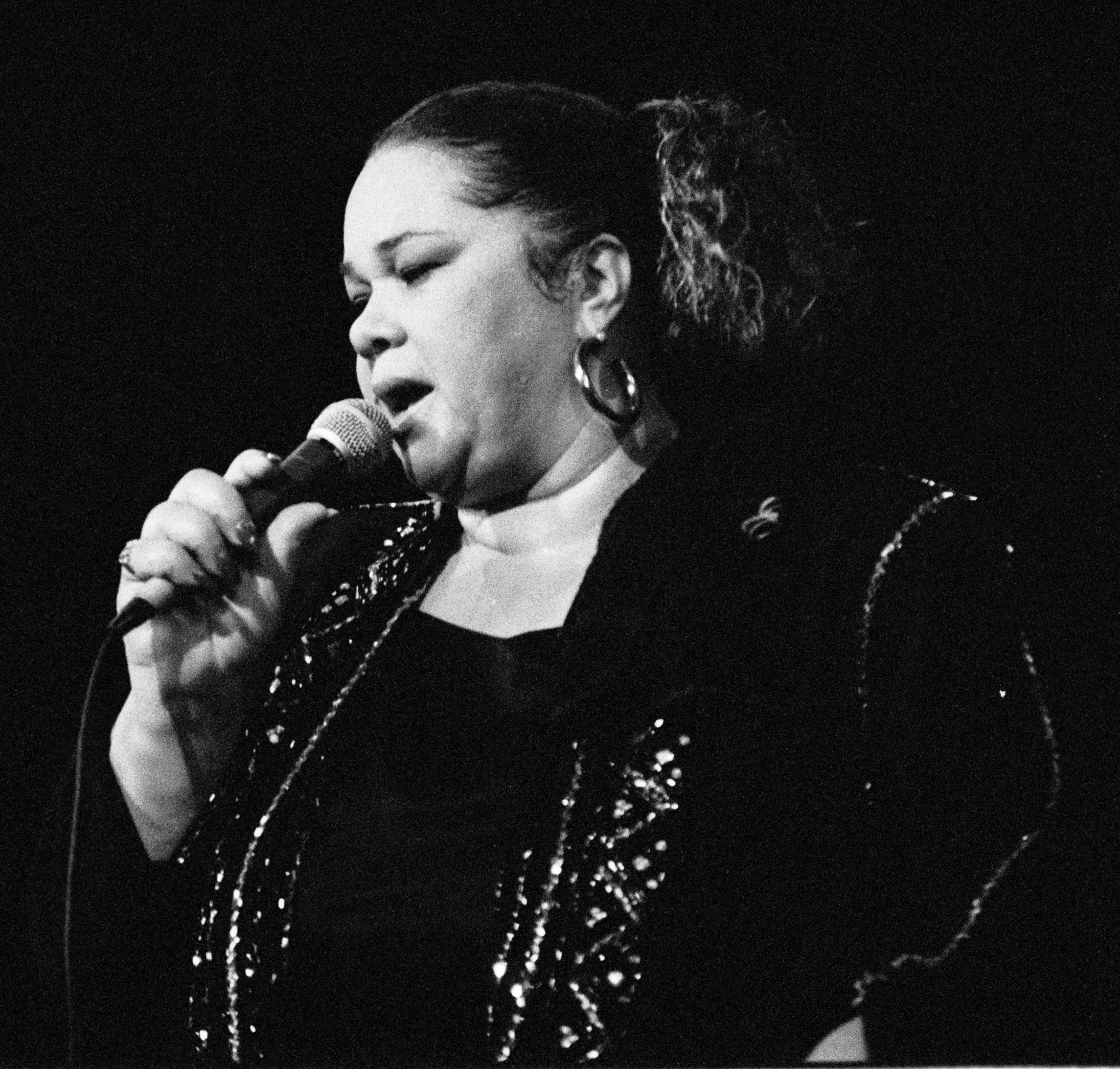
Background and career
Jamesetta Hawkins (January 25, 1938 – January 20, 2012), known professionally as Etta James, was an American singer and songwriter. Starting her career in 1954, James frequently performed in Nashville's R&B clubs, collectively known in the 1940s, 1950s and 1960s as the Chitlin' Circuit. She sang in various genres, including gospel, blues, jazz, R&B, rock and roll and soul and gained fame with hits such as "The Wallflower" (1955), "At Last" (1960), "Something's Got a Hold on Me" (1962), "Tell Mama" and "I'd Rather Go Blind" (both 1967). James faced a number of personal problems, including heroin addiction, severe physical abuse and incarceration, before making a musical comeback in the late 1980s with the album Seven Year Itch (1988). James's deep and earthy voice is considered to have bridged the gap between R&B and rock and roll. She won three Grammy Awards for her albums (2005 - Best Traditional Blues Album for Blues to the Bone; 2004 - Best Contemporary Blues Album for Let's Roll and 1995 - Best Jazz Vocal Performance, Female for Mystery Lady: Songs of Billie Holiday) and 17 Blues Music Awards. James was inducted into the Rock and Roll Hall of Fame in 1993, the Grammy Hall of Fame in 1999, and the Blues Hall of Fame in 2001. She also received the Grammy Lifetime Achievement Award in 2003. Rolling Stone magazine ranked James number 22 on its 2008 list of the "100 Greatest Singers of All Time"; she was also ranked number 62 in its list of the "100 Greatest Artists of All Time". Billboard magazine's 2015 list of the "35 Greatest R&B Artists of All Time" also included James, whose "gutsy, take-no-prisoner vocals colorfully interpreted everything from blues and R&B/soul to rock n’roll, jazz and gospel." The Rock and Roll Hall of Fame named her "one of the greatest voices of her century" and "forever the matriarch of blues."
James was born Jamesetta Hawkins on January 25, 1938, in Los Angeles, California, to Dorothy Hawkins, who was only 14 at the time. Although her father was never identified, James speculated that she was the daughter of pool player Rudolf "Minnesota Fats" Wanderone, whom she met briefly in 1987. Her mother was frequently absent from their apartment in Watts, conducting relationships with various men, and James lived with a series of foster parents, most notably "Sarge" and "Mama" Lu. James referred to her mother as "the Mystery Lady". Growing up, James was raised by relatives and friends, and she began regularly attending a Baptist church while in the care of her grandparents. James received her first professional vocal training at the age of five from James Earle Hines, musical director of the Echoes of Eden choir at the St. Paul Baptist Church in South-Central Los Angeles. She became a soloist in the choir despite her young age and performed with them on local radio stations. James quickly gained attention for having a strong voice for a child. Hines often punched her in the chest while she sang to force her voice to come from her gut. Sarge, like Hines, was also abusive. During drunken poker games at home, he would awaken James in the early morning hours and force her with beatings to sing for his friends. The trauma of her foster father forcing her to sing under these humiliating circumstances caused her to have difficulties with singing on demand throughout her career. In 1950, Mama Lu died, and James' biological mother took her to the Fillmore district of San Francisco. Within a couple of years, James began listening to doo-wop and was inspired to form a girl group, the Creolettes (so named for the members' light-skinned complexions). At age 14, James met musician Johnny Otis. Stories on how they met vary. In Otis' version, she came to his hotel after one of his performances in the city and persuaded him to audition her. Another story was that Otis spotted the Creolettes performing at a Los Angeles nightclub and sought for them to record his "answer song" to Hank Ballard's "Work with Me, Annie". Otis took the Creolettes under his wing and helped them sign to Modern Records, at which point they changed their name to Peaches. At this time, Otis also gave James her stage name, transposing "Jamesetta" (her given first name) into "Etta James." In 1954, James recorded and was credited as co-author for "The Wallflower" (a title change to the aforementioned song, "Work with Me, Annie"), which was released in early 1955. The original title of the song was actually "Roll with Me, Henry", but it had been changed to avoid censorship at the time (roll implying sexual activity). In February 1955, the song reached number one on the Hot Rhythm & Blues Tracks chart. Its success also gave the Peaches an opening spot on Little Richard's national tour. While James was on tour with Richard, pop singer Georgia Gibbs recorded a version of her song and released it under the again-altered title "Dance With Me, Henry." It became a crossover hit, reaching number one on the Billboard Hot 100, which angered James. After leaving the Peaches, James had another R&B hit with "Good Rockin' Daddy" but struggled with follow-ups. When her contract with Modern came up for renewal in 1960, James signed a contract with Chess Records instead, with which she would go on to become one of the label's earliest stars. Around this time, James became involved in a relationship with the singer Harvey Fuqua, the founder of the doo-wop group the Moonglows. Musician Bobby Murray toured with James for over 20 years. He wrote that James had her first hit single when she was 15 years old and went steady with B.B. King when she was 16. James believed that King's hit single "Sweet Sixteen" was about her. In early 1955, James and an aspiring singer, the 19-year-old Elvis Presley, then recording for Sun Studios and an avid fan of King's, shared a bill in a large club just outside Memphis. In her autobiography, James noted how impressed she was with the young singer's manners. James also recalled how happy he made her many years later when she found out that it was Presley who had moved her close friend Jackie Wilson from a substandard convalescent home to a more appropriate facility and, as she put it, paid all the expenses. Presley died a year later. Wilson went on to live for another 10 years in the care center Presley found for him.
James' first hit singles with Fuqua were "If I Can't Have You" and "Spoonful". Her first solo hit was the doo-wop–styled rhythm-and-blues song "All I Could Do Was Cry", which was a number two R&B hit. Chess Records co-founder Leonard Chess envisioned James as a classic ballad stylist who had potential to cross over to the pop charts and soon surrounded the singer with violins and other string instruments. The first string-laden ballad James recorded was "My Dearest Darling" in May 1960, which peaked in the top five of the R&B chart. James sang background vocals for her labelmate Chuck Berry on his "Back in the U.S.A." James' debut album, At Last!, was released in late 1960 and was noted for its varied selection of music, from jazz standards to blues to doo-wop and rhythm and blues (R&B). The album included the future classics "I Just Want to Make Love to You" and "A Sunday Kind of Love". In early 1961, James released what was to become her signature song, "At Last", a Glenn Miller tune, which reached number two on the R&B chart and number 47 on the Billboard Hot 100. Though the record was not as successful as expected, her rendition has become the best-known version of the song. James followed this with "Trust in Me", which also included string instruments. Later in 1960, James released a second studio album, The Second Time Around. The album took the same direction as her first, covering jazz and pop standards and with strings on many of the songs. It produced two hit singles, "Fool That I Am" and "Don't Cry Baby". James started adding gospel elements in her music the following year, releasing "Something's Got a Hold on Me", which peaked at number four on the R&B chart and was a Top 40 pop hit. That success was quickly followed by "Stop the Wedding", which reached number six on the R&B chart and also had gospel elements. In 1963, James had another major hit with "Pushover" and released the live album Etta James Rocks the House, recorded at the New Era Club in Nashville, Tennessee. After a couple of years of minor hits, James' career started to suffer after 1965. After a period of isolation, she returned to recording in 1967 and reemerged with more gutsy R&B numbers thanks to her recording at the legendary FAME Studios in Muscle Shoals, Alabama. These sessions yielded her comeback hit "Tell Mama", co-written by Clarence Carter, which reached number 10 on the R&B chart and number 23 for pop. An album of the same name was also released that year and included James' take on Otis Redding's "Security". The B-side of "Tell Mama" was "I'd Rather Go Blind", which became a blues classic and has been recorded by many other artists. In her autobiography, Rage to Survive, James wrote that she heard the song outlined by her friend Ellington "Fugi" Jordan when she visited him in prison. According to her account, James wrote the rest of the song with Jordan but for tax reasons gave her songwriting credit to her partner at the time, Billy Foster. Following this success, James became an in-demand concert performer, though she never again reached the heyday of her early to mid-1960s success. James' records continued to chart in the R&B Top 40 in the early 1970s, with singles such as "Losers Weepers" (1970) and "I Found a Love" (1972). Though James continued to record for Chess, she was devastated by the death of record executive Leonard Chess in 1969. James ventured into rock and funk with the release of her self-titled album in 1973, with production from the famed rock producer Gabriel Mekler, who had worked with Steppenwolf and Janis Joplin. Joplin had admired James and had covered "Tell Mama" in concert. James' 1973 album, exhibiting a mixture of musical styles, was nominated for a Grammy Award. However, the album did not produce any major hits, and neither did the follow-up album, Come a Little Closer, in 1974, though, like '73's Etta James before it, the album was also critically acclaimed. In 1975, James opened for comedian Richard Pryor at the Shubert Theatre in Los Angeles. She continued to record for Chess (now owned by All Platinum Records), releasing one more album in 1976, Etta Is Betta Than Evvah!. James' 1978 album Deep in the Night, produced by Jerry Wexler for Warner Bros., incorporated more rock-based music in her repertoire. That same year, James was the opening act for the Rolling Stones and performed at the Montreux Jazz Festival. However, she left Chess Records following this brief success and did not record for another 10 years while struggling with drug addiction and alcoholism.
During her hiatus from recording, James still performed on occasion through the early and mid-1980s, including two guest appearances at Grateful Dead concerts in December 1982, and was a guest on John Mayall's Blues Breakers 1982 reunion show in New Jersey. In 1984, she contacted David Wolper and asked to perform in the opening ceremony of the 1984 Summer Olympics, at which she sang "When the Saints Go Marching In". Three years later, James performed "Rock and Roll Music" with Chuck Berry in the documentary film Hail! Hail! Rock 'n' Roll. In 1989, James signed with Island Records and with them released the albums Seven Year Itch and Stickin' to My Guns, both of which were produced by Barry Beckett and recorded at FAME Studios. That same year, she was filmed in a concert at the Wiltern Theater in Los Angeles with Joe Walsh and Albert Collins for the film Jazzvisions: Jump the Blues Away. Many of the backing musicians were top-flight players from Los Angeles: Rick Rosas (bass), Michael Huey (drums), Ed Sanford (Hammond B3 organ), Kip Noble (piano) and Josh Sklair, James's longtime guitar player. James participated with the rap singer Def Jef on the song "Droppin' Rhymes on Drums", which mixed her jazz vocals with hip-hop. In 1992, James recorded the album The Right Time, produced by Jerry Wexler for Elektra Records. She was inducted into the Rock and Roll Hall of Fame the following year. James signed with Private Music Records in 1993 and recorded a Billie Holiday tribute album, Mystery Lady: Songs of Billie Holiday. The album set a trend of incorporating more jazz elements in James's music. The album won James her first Grammy Award, for Best Jazz Vocal Performance, Female, in 1994. The following year, her autobiography, Rage to Survive, co-written with David Ritz, was published. Also in 1995, she recorded the album Time After Time. A Christmas album, 12 Songs of Christmas, was released in 1998. By the mid-1990s, James's earlier music—by now considered classic—was being used in commercials, including "I Just Wanna Make Love to You", for example. After an excerpt of that song was featured in a Diet Coke advertising campaign in the UK, the song again charted, reaching the top 10 on the UK charts in 1996. By 1998, with the release of Life, Love & the Blues, James had added as backing musicians her own sons, Donto and Sametto, on drums and bass, respectively. They were part of her touring band. She continued recording for Private Music, which released the blues album Matriarch of the Blues in 2000, on which James returned to her R&B roots.
In 2001, James was inducted into the Blues Hall of Fame and the Rockabilly Hall of Fame, the latter for her contributions to the development of both rock and roll and rockabilly. Two years later, she received a Grammy Lifetime Achievement Award. On her 2004 release, Blue Gardenia, James returned to a jazz style. Her final album for Private Music, Let's Roll, released in 2005, won the Grammy Award for Best Contemporary Blues Album. In 2004, Rolling Stone magazine ranked her number 62 on its list of the 100 Greatest Artists of All Time. James performed at the top jazz festivals in the world, such as the Montreux Jazz Festival in 1977, 1989, 1990, and 1993. She performed nine times at the legendary Monterey Jazz Festival and five times at the San Francisco Jazz Festival. James performed at the Playboy Jazz Festival in 1990, 1997, 2004, and 2007. She performed six times at the North Sea Jazz Festival, in 1978, 1982, 1989, 1990, 1991 and 1993. James performed at the New Orleans Jazz & Heritage Festival in 2006 and 2009. She also often performed at free summer arts festivals throughout the United States.
In 2008, James was portrayed by singer Beyoncé in the film Cadillac Records, a fictional account of Chess Records, James' label for 18 years, about how label founder and producer Leonard Chess helped the careers of James and others. The film included "At Last," performed by Beyoncé. Beyoncé was invited to perform the song at Barack Obama's inaugural ball. In the following weeks James publicly complained that Beyoncé was “singing my song,” but later added that her critical remarks were meant to be received as a joke and stemmed from personal hurt over not having been invited to the sing the song herself for the Obama inauguration. It was later reported that Alzheimer's disease and "drug-induced dementia" had contributed to her negative comments about Knowles. In April 2009, at age 71, James made her final television appearance, performing "At Last" on the program Dancing with the Stars. The following month, James received the Soul/Blues Female Artist of the Year award from the Blues Foundation, the ninth time she won that award. James carried on touring but by 2010 had to cancel concert dates because of her gradually failing health; by this time, James was suffering from dementia and leukemia. In November 2011, she released her final album, The Dreamer, to critical acclaim. James announced her retirement at the time of its release. James's enduring relevance was affirmed in 2011 when the Swedish DJ Avicii achieved substantial chart success with the song "Levels", which samples her 1962 song "Something's Got a Hold on Me". The same sample was used by the east coast rapper Flo Rida in his 2011 hit single "Good Feeling". Both artists issued statements of condolence upon James's death. James's original classic music again charted after these 21st-century re-interpretations.


