Background and career
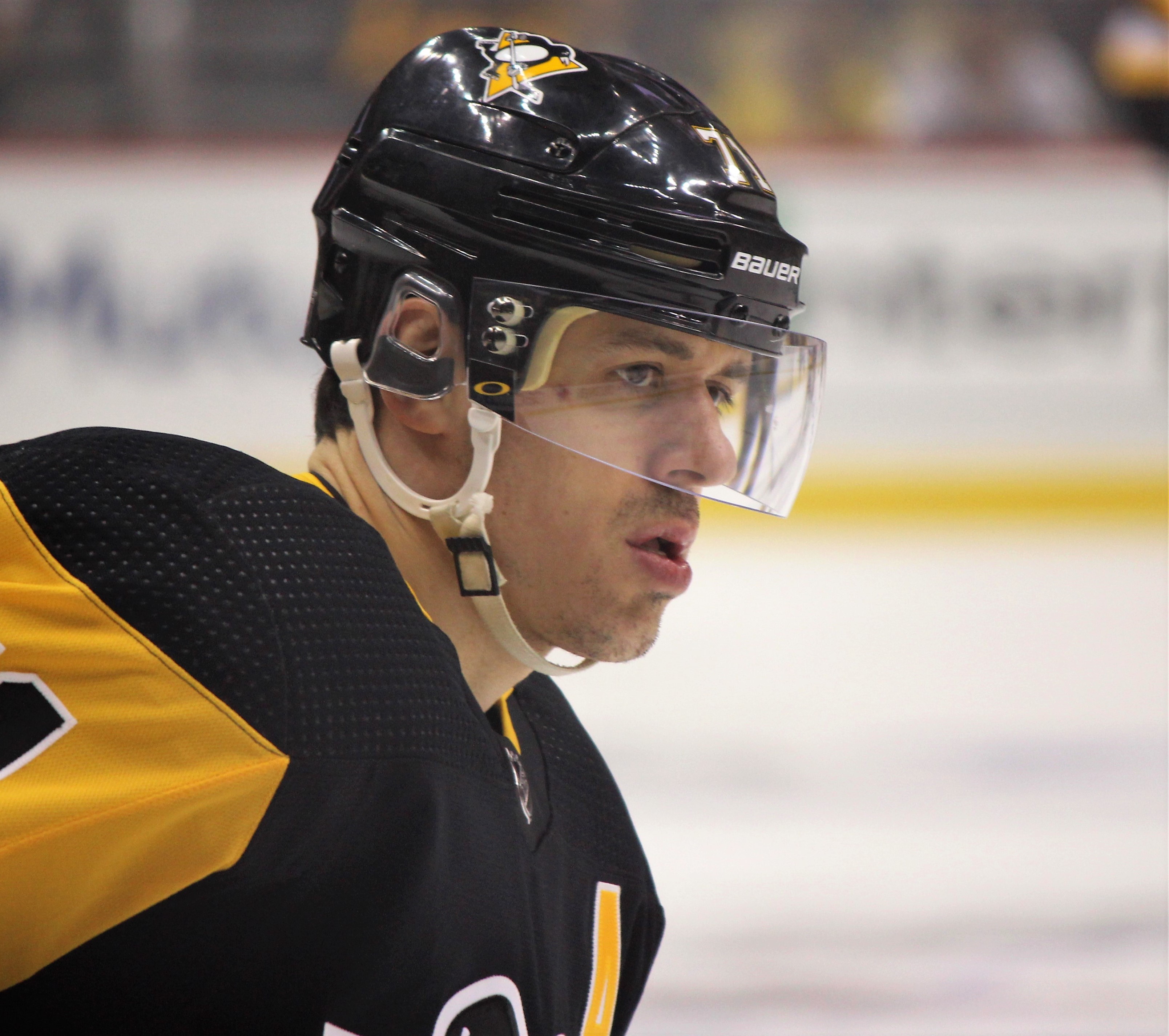
Evgeni Vladimirovich Malkin (Russian: Евге́ний Влади́мирович Ма́лкин, IPA: [jɪvˈɡʲenʲɪj ˈmalkʲɪn]; born 31 July 1986) is a Russian professional ice hockey player who is a centre and alternate captain for the Pittsburgh Penguins of the National Hockey League (NHL). Nicknamed "Geno", Malkin began his career with his hometown club Metallurg Magnitogorsk, playing for their junior and senior teams. He was then selected second overall in the 2004 NHL entry draft by the Pittsburgh Penguins, though an international transfer dispute delayed the start of his NHL career until 2006. Malkin is widely regarded as one of the greatest players of the modern NHL era and a quintessential piece of the Pittsburgh Penguins' salary cap era success. After his first season with the Penguins, Malkin was awarded the Calder Memorial Trophy as the NHL's best rookie. In his second season, he helped lead Pittsburgh to the 2008 Stanley Cup Final and was a runner-up for the Hart Memorial Trophy, awarded to the NHL's most valuable player during the regular season. The following season saw Malkin win the Art Ross Trophy, awarded to the points leader in the NHL and again placed second for the Hart Trophy. He and the Penguins again reached the Stanley Cup Final, winning the Stanley Cup championship this time around. Malkin was awarded the Conn Smythe Trophy as most valuable player of the playoffs. In 2012, Malkin was awarded the Hart Trophy and Ted Lindsay Award, awarded to the best player as voted on by the players, after winning the Art Ross Trophy for the second time; his 12-point lead was the largest margin of victory since 1999. Internationally, Malkin has competed for Russia in two IIHF World U18 Championships and three World Junior Championships, capturing one gold, two silvers and one bronze medal as a junior. In 2006, he was named tournament MVP. As a senior, he has played in four IIHF World Championships, winning gold twice and being named the tournament MVP for the 2012 event. Malkin has played for Russia in three Winter Olympic Games: Turin in 2006, Vancouver in 2010 and Sochi in 2014, respectively. In 2020, he was named to the IIHF All-Time Russia Team.
Malkin was born on 31 July 1986, in Magnitogorsk to Vladimir and Natalia Malkin. Vladimir worked for Magnitogorsk Iron and Steel Works, the largest iron and steel works in Russia and the city's dominant industry, and played in the Metallurg Magnitogorsk youth and club hockey system. Malkin has one brother, Denis, who is older by one year. Malkin began skating at age three, and joined his first organized hockey league two years later, as he showed an aptitude for the sport at an early age.
Malkin is a product of the Metallurg Magnitogorsk hockey program. Prior to being drafted, he made his Russian Superleague debut in the 2003–04 season as a 17-year-old. He also made his international debut for Russia during the 2003 U-18 World Championships, where he skated on the top line with Alexander Ovechkin. The team went on to claim the bronze medal.
After his first professional season in Russia, Malkin was drafted second overall (behind national teammate Alexander Ovechkin) in the 2004 NHL entry draft by the Pittsburgh Penguins. However, a transfer dispute between the NHL and the International Ice Hockey Federation (IIHF) delayed his Pittsburgh debut; though he would have stayed in Russia for what would have been his rookie season with the Penguins in any event due to the 2004–05 NHL lockout. On 7 August 2006, it appeared the 20-year-old Malkin had come to a compromise with Metallurg and signed a deal that would have kept him in Russia until May 2007. However, Malkin stated he signed the one-year contract not as a compromise, but because of the immense "psychological pressure" his former club exerted on him. Desiring to play in the NHL, he left Metallurg Magnitogorsk's training camp in Helsinki before it began on 12 August. It would later appear the team had taken Malkin's passport away to prevent him from leaving, but it was eventually given back to him, and Malkin was allowed to pass through Finnish customs. Meeting with his agent, J. P. Barry, the two quickly departed and waited for Malkin's visa clearance from the U.S. Embassy. In order to legally leave the team, on 15 August, Malkin invoked via fax a law allowing him to cancel his one-year contract by giving his employer two weeks' notice. Having untied himself of obligations in Russia, he was able to sign an entry-level contract with the Penguins on 5 September 2006. Following his first NHL game with Pittsburgh, on 19 October 2006, Malkin's former Russian hockey club filed an antitrust lawsuit against the NHL and the Penguins in the United States District Court for the Southern District of New York. The lawsuit claimed Malkin should not be permitted to play in the NHL because he is still under contract in Russia. The claim also sought unspecified damages as well. The motion for an injunction was denied on 15 November 2006, ensuring Malkin would continue to play in the NHL that season. The lawsuit was ultimately dismissed on its merits by the District Court on 1 February 2007.
In his first pre-season game with the Penguins, on 20 September 2006, Malkin collided with teammate John LeClair and dislocated his own shoulder, which forced him to miss the start of the season. Subsequently, his NHL debut would be delayed until 18 October, against the New Jersey Devils, in which he scored his first goal against Martin Brodeur. Malkin set a modern NHL record when he scored a goal in each of his first six games. No player had achieved this feat since the NHL's inaugural 1917–18 season, when Montreal Canadiens forward Joe Malone scored at least one goal in 14 consecutive games to start his NHL career (Malone, however, had played in the National Hockey Association, the predecessor league to the NHL). Malkin's streak was eventually stopped on 4 November in his seventh game by the San Jose Sharks. Playing on a team with another highly touted prospect, sophomore forward and generational talent Sidney Crosby, Malkin finished his rookie season with 33 goals, 52 assists and 85 points in 78 games played, leading all first-year players and capturing the Calder Memorial Trophy as the NHL's top rookie, the second Penguin to win the award after Mario Lemieux in 1985. Malkin was named alternate captain for the Penguins shortly after. When Malkin arrived in the United States, he spoke little English, but with the help of fellow Russian teammate Sergei Gonchar, he eventually started to give short, simple interviews in the language. Halfway into the 2007–08 season, his sophomore season in the NHL, Malkin recorded his first NHL hat-trick, against the Toronto Maple Leafs, on 3 January 2008. He earned another three-goal performance several games later, on 14 January, against the New York Rangers. Midway through the season, when more heralded teammate and captain Sidney Crosby went down with an ankle injury, Malkin seized the opportunity to lead the Penguins, scoring 44 points in the 28 games Crosby was absent. In total, Malkin completed the season second in NHL scoring with 106 points, six points behind Alexander Ovechkin of the Washington Capitals for the Art Ross Trophy. Malkin continued to dominate into the Stanley Cup playoffs as the Penguins made it to the 2008 Stanley Cup Final. He scored three points against the Presidents' Trophy-winning Detroit Red Wings in the finals, totalling 22 points overall (10 goals, 12 assists) in all 20 games, but the Penguins were defeated by Detroit in six games. Malkin's sophomore season culminated in a Hart Memorial Trophy nomination as NHL MVP—the award was given to Ovechkin—and First team All-Star honours.
On 2 July 2008, with one year left in his entry-level contract, he signed a five-year, $43.5 million contract extension with Pittsburgh. Malkin began the 2008–09 season by scoring his 200th NHL point with an assist to Sidney Crosby on 18 October 2008, in just the sixth game of the season against the Toronto Maple Leafs. The goal was also Crosby's 100th career goal and 300th career point. Crosby had a team trainer cut the puck in half so both players could commemorate the moment. Voted as a starter to the 2009 NHL All-Star Game later in the season, Malkin won the shooting accuracy segment of the Skills Competition, initially shooting four-for-four before beating Dany Heatley three-for-four in a tie-breaker. After having finished runner-up to Alexander Ovechkin the previous season for the Art Ross Trophy, Malkin captured the scoring championship with 113 points. He became the second Russian-born player to win it, after Ovechkin, and the fourth Penguin, after Mario Lemieux, Jaromír Jágr and Crosby. However, he would once again be runner-up to Ovechkin for the Hart Trophy, although this time garnering a few more first-place votes. In 2008, he had just one first-place vote (out of 134 votes) and 659 points to Ovechkin's 128 first-place votes and 1,313 points. In 2009, Malkin had 12 first-place votes (out of 133 votes) and 787 points to Ovechkin's 115 first-place votes and 1,264 points. On 12 June 2009, the Penguins won the Stanley Cup after defeating the Detroit Red Wings 2–1 in game seven of the Final. Malkin tallied 36 points (14 goals and 22 assists) to become the first player to lead both the regular season and playoffs in scoring since Mario Lemieux accomplished the feat in 1992. His 36 points were the highest playoff total of any player since Wayne Gretzky amassed 40 points in 1993. Malkin received the Conn Smythe Trophy as playoff MVP, becoming the first Russian-born player to do so. He is also just the second player in franchise history to win both the Art Ross and Conn Smythe trophies in the same year. The other Penguin to accomplish this feat was Hockey Hall of Famer and team co-owner/president Mario Lemieux (1992).
Sources
Net-worth figure: Celebrity Net Worth (October 2026), in USD. Biography and career facts: the person's Wikipedia article and linked reporting. Snapshot date for all StarWorth figures: 28 October 2026.


