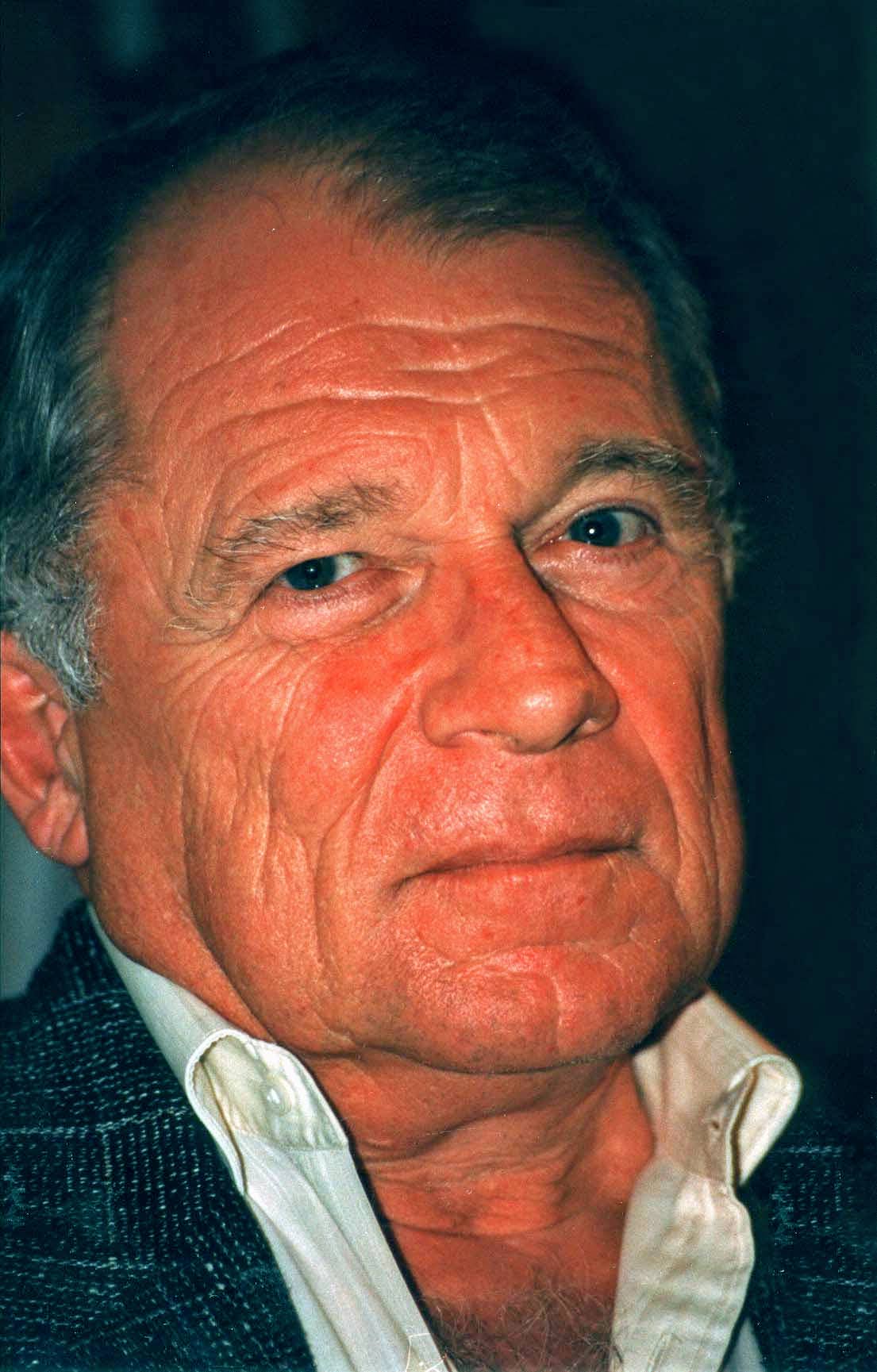
Background and career
Francis Lee Bailey Jr. (June 10, 1933 – June 3, 2021) was an American criminal defense attorney and author of The Defense Never Rests. Born in Waltham, Massachusetts, Bailey first came to nationwide attention for his involvement in the second murder trial of Sam Sheppard, a surgeon accused of murdering his wife. He later served as the attorney in a number of other high-profile cases, such as Albert DeSalvo, a suspect in the "Boston Strangler" murders, heiress Patty Hearst's trial for bank robberies committed during her involvement with the Symbionese Liberation Army, and U.S. Army Captain Ernest Medina for the My Lai Massacre. He was a member of the "Dream Team" in the trial of former football player O. J. Simpson, who was accused of murdering Nicole Brown Simpson and Ron Goldman. He is considered one of the greatest lawyers of the 20th century. For most of his career, Bailey was licensed in Florida and in Massachusetts, where he was respectively disbarred in 2001 and 2003 for misconduct while defending Claude Louis DuBoc, who had been accused of trafficking marijuana. Following his disbarment, he moved to Maine, where he ran a consulting firm. He later sat for the bar exam in the state of Maine. In 2013, he was denied a law license by the Maine Board of Bar Examiners, a decision Bailey appealed that same year where the appellate court overturned the initial license denial. The Board of Examiners appealed the appellate court decision, and in 2014 the original denial was upheld by the Maine Supreme Judicial Court.
Bailey was born June 10, 1933, in Waltham, Massachusetts. His mother, Grace (Mitchell), was a teacher and nursery school director, and his father, Francis Lee Bailey Sr., was an advertising salesman. His parents divorced when he was ten. Bailey attended Cardigan Mountain School and then Kimball Union Academy, where he graduated in 1950. He studied at Harvard College but dropped out in 1952 to join the United States Navy and later transferred to the Marine Corps. He was commissioned as an officer and, following flight training, received his naval aviator wings in 1954. He served as a jet fighter pilot, and then began to serve as a squadron legal officer at Cherry Point, North Carolina. He briefly returned to Harvard before being admitted to Boston University School of Law in 1957, which accepted his military experience in lieu of the requirement for students to have completed at least three years of undergraduate college courses. While attending Boston University, he achieved the highest grade point average in the school's history. He graduated with an LL.B. in 1960 and was ranked first in his class.
In 1954, Sam Sheppard was found guilty in the murder of his wife Marilyn in a case that was one of the inspirations for the television series The Fugitive (1963–1967). In the 1960s, Bailey, at the time a resident of Rocky River, Ohio, was hired by Sheppard's brother Stephen to help in Sheppard's appeal. In 1966, Bailey successfully argued before the U.S. Supreme Court that Sheppard had been denied due process, winning a re-trial. A not guilty verdict followed. This case established Bailey's reputation as a skilled defense attorney and was the first of many high-profile cases.
In 1964, Bailey defended Albert DeSalvo for a series of sexual assaults known as the "Green Man" or "Measuring Man" incidents. Bailey later said that DeSalvo confessed that he had also committed the "Boston Strangler" murders. DeSalvo was found guilty of the assaults, but was never tried for the murders.
Carl A. Coppolino was accused of the July 30, 1963, murder of retired Army Col. William Farber, his neighbor and the husband of Marjorie Farber, with whom Coppolino was having an affair. He was also accused of the August 28, 1965, murder of his wife, Carmela Coppolino. The prosecution claimed that Coppolino injected his victims with a paralyzing drug called succinylcholine chloride, which at the time was undetectable due to limited forensic technology. Bailey successfully defended Coppolino in the New Jersey case over the death of Farber in December 1966. However, Coppolino was convicted of murdering his wife in Florida. He was paroled after serving 12 years of his sentence.
Bailey attended Keeler Polygraph Institute in Chicago, where he became an expert in lie detector tests. It was in this capacity that he was enlisted by the defense in the case of George Edgerly, a mechanic charged with murdering his wife. When Edgerly's attorney was incapacitated by a heart attack, Bailey took over the defense. Edgerly—whose story was one of several that served as the basis for the television series and film The Fugitive—was acquitted. He was later convicted of a series of other crimes, including the murder of General Motors representative Frank Smith in 1974 and a rape which took place in 1975.