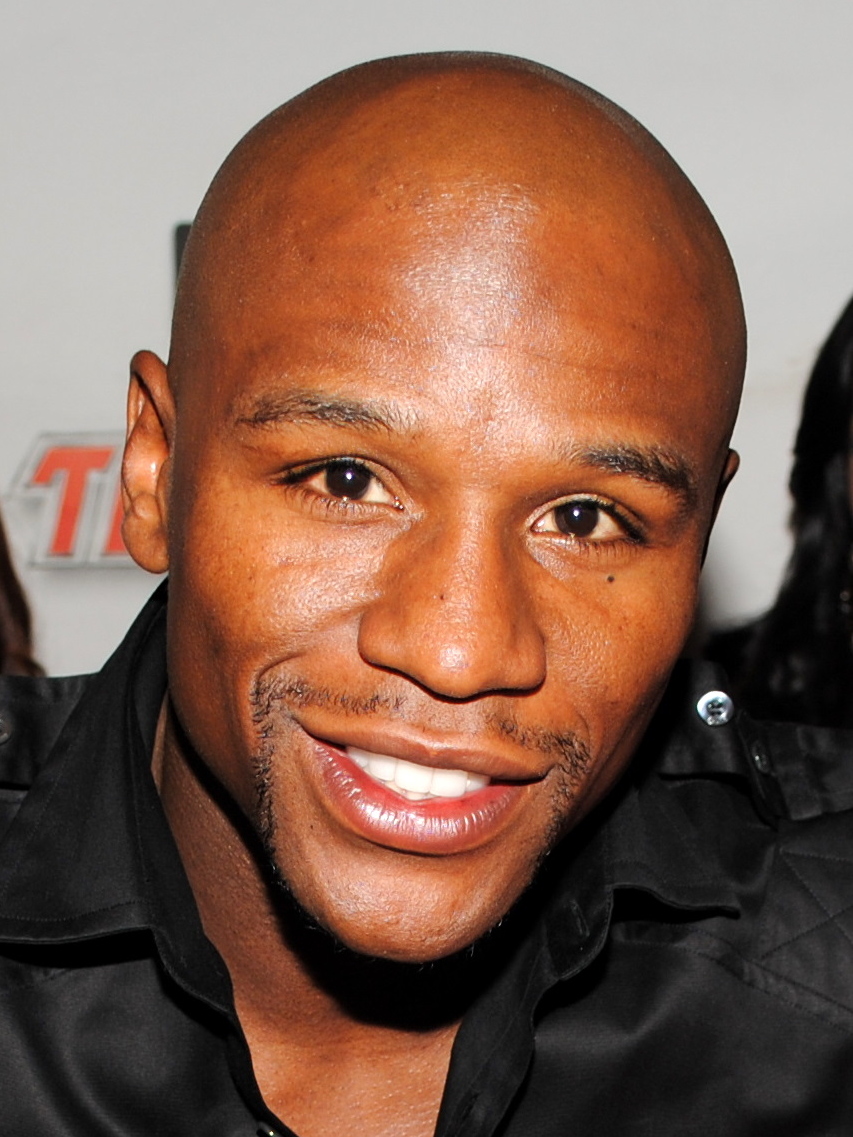
Background and career
Floyd Joy Mayweather Jr. (né Sinclair; born February 24, 1977) is an American professional boxer and boxing promoter. He is undefeated at 50–0. Mayweather won 15 major world championships spanning five weight classes from super featherweight to light middleweight. This includes the Ring magazine title in three weight classes. As an amateur, he won a bronze medal in the featherweight division at the 1996 Olympics, three U.S. Golden Gloves championships (at light flyweight, flyweight, and featherweight), and the U.S. national championship at featherweight. After retiring from professional boxing in August 2017, he transitioned to exhibition boxing. As of July 2025, BoxRec ranks him the third greatest boxer of all time, pound for pound. Mayweather was named "Fighter of the Decade" for the 2010s by the Boxing Writers Association of America (BWAA) and The Sporting News, a two-time winner of The Ring magazine's Fighter of the Year award (1998 and 2007), a three-time winner of the BWAA Fighter of the Year award (2007, 2013, and 2015), and a six-time winner of the Best Fighter ESPY Award (2007–2010, 2012–2014). In 2016, ESPN ranked him the greatest boxer, pound for pound, of the last 25 years; in 2024, they also ranked him the best boxer of the 21st century. In 2025, The Ring ranked him the greatest boxer, pound-for-pound, of the 21st century. He is referred to as one of the best defensive boxers in history: since the existence of CompuBox, Mayweather is the most accurate puncher among professional boxers, having the highest plus–minus ratio in recorded boxing history. He has a tied record with Joe Louis of 26 consecutive wins in world title fights. He also holds 24 wins (7 KOs) against former or current world titlists, and 8 wins (3 KOs) against International Boxing Hall of Fame inductees. He was inducted into the International Boxing Hall of Fame in the class of 2021.
Mayweather is one of the most lucrative pay-per-view attractions of all time, in any sport. He topped the Forbes and Sports Illustrated lists of the 50 highest-paid athletes of 2012 and 2013, and the Forbes list again in both 2014 and 2015, as the highest-paid athlete in the world. In 2006, he founded his own boxing promotional firm, Mayweather Promotions, after leaving Bob Arum's Top Rank. He has generated approximately 24 million PPV buys and $1.67 billion in revenue throughout his career. In 2018, he was the highest-paid athlete in the world, with total earnings, including endorsements, of $285 million, according to Forbes. In November, 2021, Mayweather was ranked by Sportico as the sixth highest-paid athlete of all time, with his income totaling an inflation-adjusted $1.2 billion; he stood at No. 10 when the ranking was updated in April, 2026, with his earnings estimated at inflation-adjusted $1.57 billion.
Mayweather was born Floyd Joy Sinclair on February 24, 1977, in Grand Rapids, Michigan, into a family of boxers. His father, Floyd Mayweather Sr., is a former welterweight contender who fought Hall of Famer Sugar Ray Leonard. His uncles Jeff and the late Roger Mayweather were professional boxers, with the latter—Floyd's former trainer—winning two world championships, as well as fighting Hall of Famers Julio César Chávez, Pernell Whitaker, and Kostya Tszyu. Mayweather was born with his mother's last name, but his last name would change to Mayweather shortly thereafter. His maternal grandfather was born in Kingston, Jamaica. He attended Ottawa Hills High School before dropping out. Boxing has been a part of Mayweather's life since his childhood and he never seriously considered any other profession. "I think my grandmother saw my potential first," he said. "When I was young, I told her, 'I think I should get a job.' She said, 'No, just keep boxing.'" During the 1980s, Mayweather lived in the Hiram Square neighborhood of New Brunswick, New Jersey, where his mother had relatives. He later said, "When I was about eight or nine, I lived in New Jersey with my mother and we were seven deep in one bedroom and sometimes we didn't have electricity. When people see what I have now, they have no idea of where I came from and how I didn't have anything growing up." It was common for the young Mayweather to come home from school and find used heroin needles in his front yard. His mother was addicted to drugs, and he had an aunt who died from AIDS because of her drug use. "People don't know the hell I've been through," he says. The most time that his father spent with him was taking him to the gym to train and work on his boxing, according to Mayweather. "I don't remember him ever taking me anywhere or doing anything that a father would do with a son, going to the park or to the movies or to get ice cream," he says. "I always thought that he liked his daughter [Floyd's older sister] better than he liked me because she never got whippings and I got whippings all the time." Mayweather's father contends that Floyd is not telling the truth about their early relationship. "Even though his daddy did sell drugs, I didn't deprive my son," the elder Mayweather says. "The drugs I sold, he was a part of it. He had plenty of food. He had the best clothes and I gave him money. He didn't want for anything. Anybody in Grand Rapids can tell you that I took care of my kids". Floyd Sr. says he did all of his hustling at night and spent his days with his son, taking him to the gym and training him to be a boxer. "If it wasn't for me he wouldn't be where he is today," he maintains. "I basically raised myself," Mayweather says. "My grandmother did what she could. When she got mad at me I'd go to my mom's house. My life was ups and downs." His father says he knows how much pain his incarceration caused his son, but insists he did the best he could. "I sent him to live with his grandmother," he says. "It wasn't like I left him with strangers." In the absence of his father, boxing became an outlet for Mayweather. As the elder Mayweather served his time, his son put all of his energy into boxing and dropped out of high school. "I knew that I was going to have to try to take care of my mom and I made the decision that school wasn't that important at the time and I was going to have to box to earn a living," he said.
Mayweather had an amateur record of 84 wins and 8 losses, and won national Golden Gloves championships in 1993 (at 106 lb), 1994 (at 114 lb), and 1996 (at 125 lb). He was nicknamed "Pretty Boy" by his amateur teammates because he had relatively few scars, a result of the defensive techniques that his father and uncle (Roger Mayweather) had taught him. In his orthodox defensive stance Mayweather often utilizes a variation of crab style, with the shoulder roll, an old-school boxing technique in which the right hand is held normally (or slightly higher than normal), the left hand is down around the midsection and the lead shoulder is raised high on the cheek in order to cover the chin and block punches. The right hand (as in the orthodox stance) is used as it normally would be: to block punches coming from the other side, such as left hooks. From this stance Mayweather blocks, slips and deflects most of his opponents' punches (even when cornered) by twisting left and right to the rhythm of their punches.
At the 1996 Olympics in Atlanta, Mayweather won a bronze medal by reaching the semi-finals of the featherweight (57-kg) division. In the first fight, Mayweather led 10–1 on points over Bakhtiyar Tileganov of Kazakhstan, before winning when the fight was stopped. In the second fight, Mayweather outpointed Artur Gevorgyan of Armenia 16–3. In the quarterfinals, the 19-year-old Mayweather narrowly defeated 22-year-old Lorenzo Aragon of Cuba in an all-action bout to win 12–11, becoming the first U.S. boxer to defeat a Cuban in 20 years. The last time this occurred was the 1976 Summer Olympics, when the U.S. Olympic boxing team captured five gold medals; among the recipients was Sugar Ray Leonard. In his semifinal bout against eventual silver medalist Serafim Todorov of Bulgaria, Mayweather lost by a controversial decision (similar to Roy Jones Jr.'s highly controversial decision loss to Park Si-hun at the 1988 Summer Olympics). Referee Hamad Hafaz Shouman of Egypt mistakenly raised Mayweather's hand (thinking he had won), while the decision was announced giving the bout to the Bulgarian. The U.S. team filed a protest over the Mayweather bout, claiming the judges were intimidated by Bulgaria's Emil Jetchev (head of the boxing officials) into favoring the Bulgarian Todorov by a 10–9 decision in the 125-pound semifinal bout. Three of Jetchev's countrymen were in gold medal bouts. Judge Bill Waeckerle (one of the four U.S. judges working the games for the International Amateur Boxing Federation) resigned as Olympic Games and federation judge after Mayweather lost the decision, which was loudly booed by the crowd at the Alexander Memorial Coliseum. "I refuse to be part of an organization that continues to conduct its officiating in this manner", Waeckerle wrote in his letter of resignation to federation president Anwar Chowdhry. In the official protest U.S. team manager Gerald Smith said Mayweather landed punches that were not counted, while Todorov was awarded points without landing a punch. "The judging was totally incompetent," Waeckerle said. The judges failed to impose a mandatory two-point deduction against Todorov after he was warned five times by the referee for slapping. "Everybody knows Floyd Mayweather is the gold-medal favorite at 57 kilograms," Mayweather said afterward. "In America, it's known as 125 pounds. You know and I know I wasn't getting hit. They say he's the world champion. Now you all know who the real world champion is." Featherweight Olympic qualification
Defeated William Jenkins RSC/TKO-3 Defeated James Baker RSCH/TKO-1 Lost to Augie Sanchez PTS (11–12) Defeated Carlos Navarro PTS (31–11) Defeated Augie Sanchez PTS (12–8) in the box-offs Defeated Augie Sanchez PTS (20–10) in the box-offs Olympic results


