Background and career
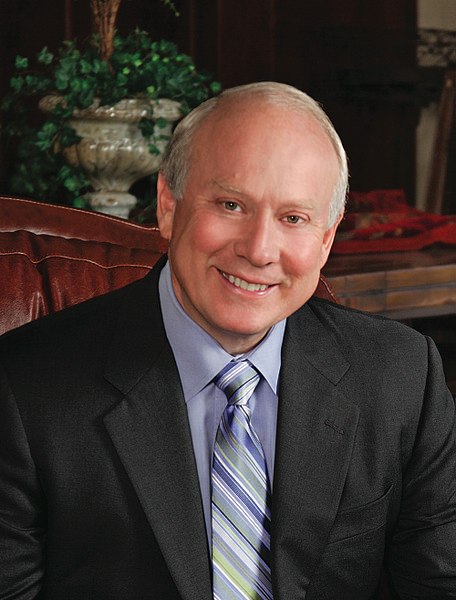
Frank Leonard VanderSloot (born August 14, 1948) is an American entrepreneur, radio network owner, rancher, and political campaign financier. He is the founder and former chief executive officer of Melaleuca, Inc. His other business interests include the Riverbend Ranch and Riverbend Communications. VanderSloot also serves on the board of directors and executive board of the U.S. Chamber of Commerce. In 2011, The Land Report listed him as the nation's 92nd largest landowner. In 2017, Forbes listed VanderSloot as the richest person in Idaho and the 302nd wealthiest American with a net worth of $2.7 billion. VanderSloot served as a national finance co-chair for Mitt Romney's presidential campaigns in 2008 and 2012. He contributed $1.1 million and helped to raise between $2 million and $5 million for Romney's 2012 campaign. He is a significant financial contributor to Republican presidential candidates and Idaho political campaigns. He has also paid for advertising in opposition to several Idaho Democratic political candidates. VanderSloot is the primary financier of the American Heritage Charter School in Idaho Falls.
VanderSloot was born on August 14, 1948, to Peter Francis (Frank) VanderSloot (1913–1982) and Margaret May Christensen Sindberg-Woodley VanderSloot (1915–2004). The family lived in Sheridan, Wyoming, and Hardin, Montana, before moving in 1949 to Cocolalla, Idaho, where they lived on a ranch. The elder VanderSloot worked as a painter for the Northern Pacific Railway. Frank VanderSloot graduated from Sandpoint High School in 1966. At the age of 16, he joined the Church of Jesus Christ of Latter-day Saints (LDS Church), and later studied at Brigham Young University in Provo, Utah, where he worked and lived as a cleaner at a laundromat. After two semesters, he left school to serve a two-and-a-half-year LDS Mission in the Netherlands. Following his mission, he earned an associate's degree in business at Ricks College in Rexburg, Idaho. He then returned to Brigham Young University, where he earned a bachelor's degree in marketing in 1972.
After graduating from college, VanderSloot worked for 91⁄2 years at Automatic Data Processing in three cities. He first worked in sales and marketing before moving to general management and operations. He left ADP to work as regional vice president at Cox Communications in Vancouver, Washington.
In September 1985, VanderSloot's brother-in-law Roger Ball and Roger's brother Allen Ball offered VanderSloot the helm of Oil of Melaleuca, Inc., a startup multi-level marketing business based in Idaho Falls. VanderSloot said "the company was a mess" when he arrived. According to Dan Popkey, "A supposed 80 percent corner on the tea tree market turned out to be 5 percent. The FDA came knocking, because salespeople were exaggerating medical claims. A multilevel model that lured people to buy $5,000 in inventory offended VanderSloot's sense of fairness." Oil of Melaleuca failed to achieve significant market share, and the partners shut down the company later in 1985. Half the legacy distributors from Oil of Melaleuca left after Melaleuca, Inc., was formed (below).
In 1985, VanderSloot founded the multi-level marketing company Melaleuca Inc, which sells nutritional supplements, cleaning supplies, and personal-care products, and he has been president and chief executive officer ever since. Melaleuca operates internationally, with U.S. operations centered in Idaho Falls, Idaho, and Knoxville, Tennessee. Customers buy directly from Melaleuca's website or retail locations and "independent marketing executives" receive commissions from Melaleuca for each purchase made by people they refer and by people their customers refer, through seven "referral generations". The company refers to this arrangement as "Consumer Direct Marketing", a term it has trademarked. According to a 2004 article by Phyllis Berman, Melaleuca's sales flattened in 1998, and VanderSloot "discovered that some senior directors were living off their residuals and doing little in the way of recruitment." This resulted in "a new policy that reduced payments to those who didn't either bring in new converts or help others do so." The company has large international operations, and 25 percent of its revenue comes from Taiwan, Korea, Japan, Australia, New Zealand, and the United Kingdom. Melaleuca reported gross sales in excess of one billion dollars in 2011 and $1.13 billion in 2012. In Idaho Falls, Melaleuca has a local workforce of about 2,000 employees. VanderSloot says that the company has a "business model for those people who want to supplement their income." However, according to the US Federal Trade Commission study on multi-level marketing companies, fewer than 0.29% of Melaleuca distributors make any profit and more than 99% of distributors lost money. The FTC report goes on to note that the odds of winning from a single spin of the wheel in a game of roulette in Las Vegas are "22 times as great as the odds of profiting after enrolling as a Melaleuca distributor". Melaleuca is a member of the United States Direct Selling Association, a trade association that engages in public relations and political lobbying on behalf of the multi-level marketing industry. In 2008, VanderSloot began a three-year term as one of the eight members of the Direct Selling Association's board of directors. In December 2009, VanderSloot and his wife contributed $10,000 to the Direct Selling Association's political action committee (PAC). Between 1991 and 1997, Melaleuca was investigated by Michigan regulators, the Idaho attorney general's office, and the U.S. Food and Drug Administration for various marketing violations. In 1991 Melaleuca received a cease-and-desist order for violating Michigan's anti–pyramid scheme laws. In 1992, Melaleuca signed a consent decree with the states of Michigan and Idaho agreeing to "not engage in the marketing and promotion of an illegal pyramid." In 1997, the U.S. Food and Drug Administration sent Melaleuca a warning letter for "false and misleading" claims about two of its supplements. In a paper on multi-level marketing, the FTC notes that "Melaleuca fails to disclose that approximately 99% of all participants lose money and therefore get further behind financially because of their participation". In June 2020, the FTC sent a warning letter to Melaleuca regarding false and deceptive earnings claims during the COVID-19 pandemic that were unsubstantiated and inconsistent with earlier FTC findings that less than 1% of Melaleuca distributors realize any profit with the vast majority losing money.
In 1993, VanderSloot founded Riverbend Ranch, one of the largest purebred ranches and largest commercial cattle operations in the United States. The ranch received 21 awards at the Utah State Fair between 1995 and 1997. The Ranch runs a genetics and breeding program and hosted the world's largest Angus bull sale in March 2012. According to Riverbend Ranch general manager David Brown, VanderSloot established its mission as "providing ranchers in the Intermountain West with the best genetics at an affordable price." Riverbend Ranch has operations in three other states, including Fort Ranch Quarter Horses, a horse ranch in Promontory, Utah.