Background and career
Gene Rayburn (born Eugene Peter Jeljenic; December 22, 1917 – November 29, 1999) was an American radio and television personality. He is best known as the host of various editions of the American television game show Match Game for over two decades.
Rayburn was born in Christopher, Illinois, the younger of two children of Croatian immigrants Marija "Mary" Hikec and Petar "Pero" Jeljenić . In an episode of Match Game ‘74, Rayburn spoke Croatian with a contestant and mentioned that his parents were born in what was then Yugoslavia. His father died when Rayburn was an infant. Mary moved her family to Chicago; it was there she met Milan Rubessa. She married Rubessa on November 10, 1919, and gave her son the name Eugene Rubessa (). He had an elder brother, Alfred, who was killed when Rayburn was a child and a younger half-brother, Milan Rubessa Jr. Rayburn graduated from Lindblom Technical High School and attended Knox College. He was senior class president at Lindblom and acted in the plays Robert of Sicily and Mrs. Wiggs of the Cabbage Patch. An aspiring actor and opera singer, Rayburn moved to New York City but was unable to find stage work. He found a job as a page and tour guide at NBC studios at 30 Rockefeller Plaza instead. After three years in that position, Rayburn began announcing at various radio stations, eventually landing back in New York at WNEW. He enlisted in the United States Army Air Forces and served in World War II. Gene chose the stage name "Rayburn" by randomly sticking his finger in the phone book.
Before appearing in television, Rayburn was an actor and radio performer. He had a morning drive time radio show in New York City, first with Jack Lescoulie (Anything Goes) and later with Dee Finch (Rayburn & Finch) on WNEW. Rayburn's pairings with Lescoulie and Finch helped to popularize the now-familiar morning drive radio format. At WNEW, he lobbied for playing of certain songs, resulting in chart popularity (e.g. "Music! Music! Music!" (recorded by Teresa Brewer)) and co-authored the lyrics of the song "Hop-Scotch Polka" with Carl Sigman (both 1949). When Rayburn left WNEW, Dee Finch continued the format with Gene Klavan. From 1961 through 1973, Rayburn served as the longest-tenured "communicator" (host) of NBC Radio's "Monitor (radio program)" weekend broadcast. He relinquished the position after resuming his "Match Game" hosting duties on CBS' version of the show in 1973. The new show was taped at CBS Television City in Los Angeles on alternate weekends, proving to be an insurmountable conflict with "Monitor", which originated at NBC's headquarters at 30 Rockefeller Plaza in New York.
Rayburn took the lead role in the Broadway musical Bye Bye Birdie when Dick Van Dyke left the production to star in The Dick Van Dyke Show. At one point in his stage career, Rayburn's stand-in was future Match Game panelist Charles Nelson Reilly.
Breaking into television as the original announcer on Steve Allen's Tonight, Rayburn began a long association with game show producers Mark Goodson and Bill Todman in 1953. He first appeared on Robert Q. Lewis's The Name's the Same; Rayburn frequently sat in for regular panelist Carl Reiner. In 1955, he took over as host of the summer replacement game show Make the Connection from original host Jim McKay (and appearing with his WNEW morning show successor Gene Klavan). From there he hosted shows such as Choose Up Sides, Dough Re Mi, Play Your Hunch, and the daytime version of Tic Tac Dough. On radio, Rayburn became one of the many hosts of the NBC program Monitor in 1961 and remained with the show until 1973. In an uncredited role (he reportedly did not want his name to appear), Rayburn played a TV interviewer in the movie It Happened to Jane (1959) starring Doris Day. Rayburn was also a frequent panelist in the 1960s and 1970s on What's My Line? and To Tell the Truth.
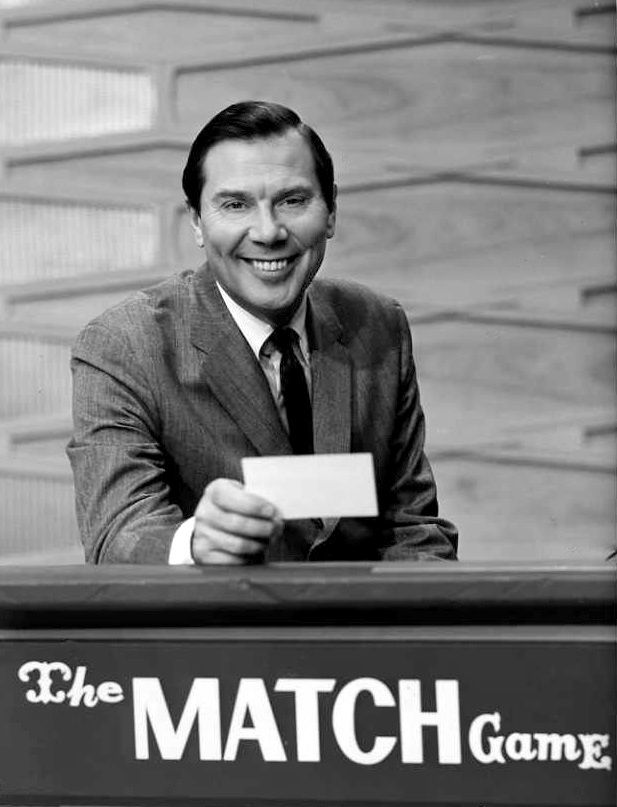
From 1962 to 1969, Rayburn hosted The Match Game. In the original version, which aired from New York on NBC, Rayburn read questions to two panels, each consisting of a celebrity and two audience members. The questions in the original game were ordinary, like "Name a kind of muffin," or "John loves his ____________." Rayburn usually played it straight, though he would make jokes as the situation warranted. Very few episodes have been preserved; only four are known to exist. The show was canceled in 1969 to make room for the topical, short-lived game show Letters to Laugh-In. Goodson-Todman revived Match Game in 1973 for CBS, this time as a California-based game show. Rayburn returned as host and introduced a new format in which two contestants tried to match the responses of six celebrities. Writer Dick DeBartolo, a veteran of the original show, created funnier and often risqué questions ("The big bad wolf said: I just came from a house where this old lady had the biggest ____________s I ever saw.")("After it was run over by a steamroller, Norman was able to slide his ____________ under the door.") Rayburn reveled in this freewheeling new approach and often indulged in funny voices, banter with the celebrities, and mock arguments with the technical crew. It soon became the highest-rated show on daytime television. From 1973 to 1977, Match Game was number one among all daytime network game shows—three of those years it was the highest rated of all daytime shows. The daytime revival of Match Game, which featured regular panelists Richard Dawson, Brett Somers, and Charles Nelson Reilly, ran until 1979 on CBS and another three years in first-run syndication. A concurrent nighttime version, Match Game PM, aired in syndication from 1975 to 1981. Rayburn was nominated three times for the Daytime Emmy Award for Outstanding Game Show Host. During the years when Match Game was taped in Los Angeles (1973–1982), Rayburn lived in Osterville, Massachusetts, on Cape Cod. He commuted to California every two weeks to tape 12 shows over the course of a weekend (five daytime shows and one nighttime show per taping day). In 1983, a year after the syndicated Match Game ended, the show was revived as part of the Match Game-Hollywood Squares Hour. Rayburn hosted the Match Game and "Super Match" segments and sat on the panel for the Hollywood Squares segment, which was hosted by Jon Bauman. This show lasted nine months on NBC. Rayburn, by most accounts, was disappointed with how the show turned out.


