Background and career
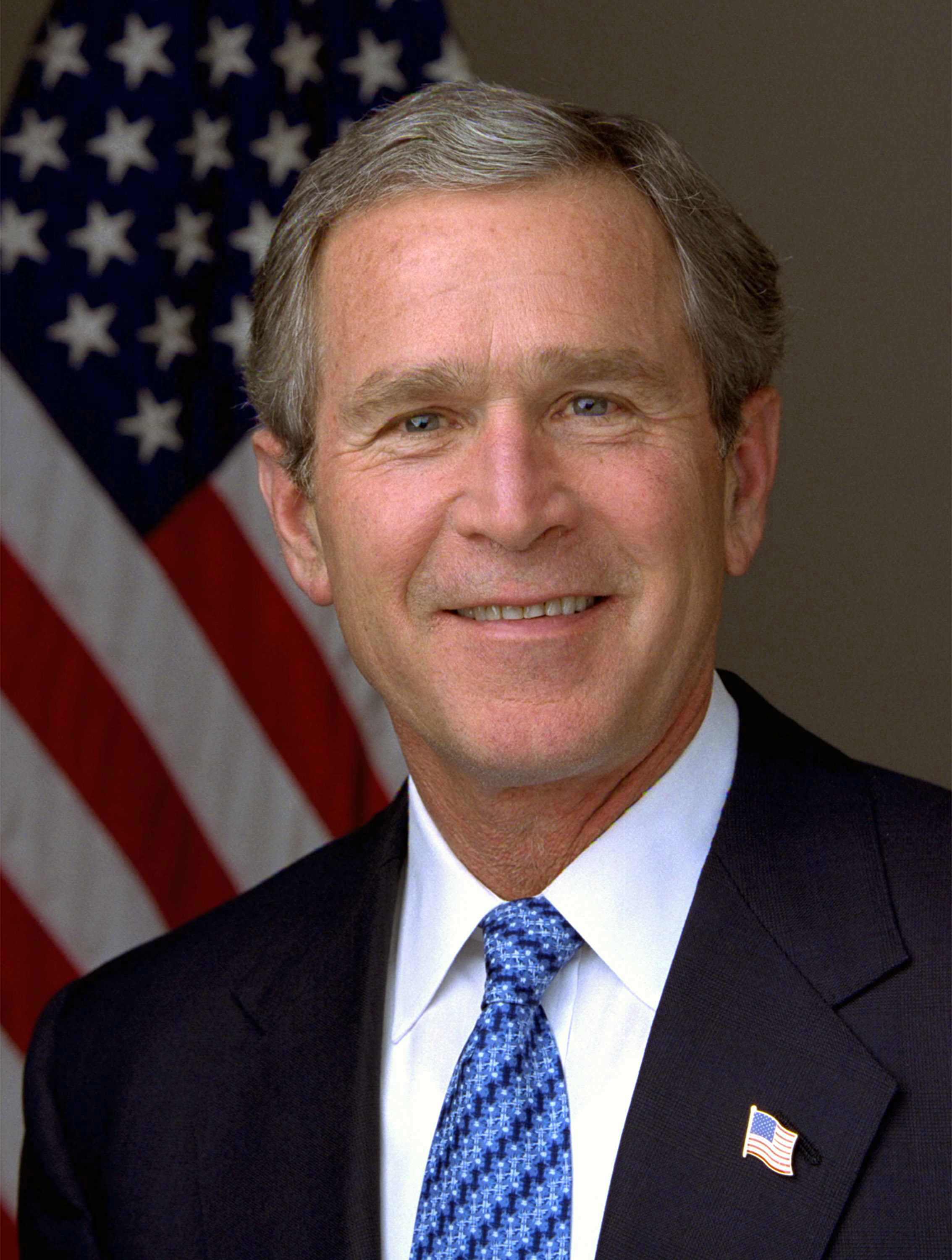
George Walker Bush (born July 6, 1946) is an American retired politician, businessman, and former U.S. Air Force officer who served as the 43rd president of the United States from 2001 to 2009. A member of the Republican Party, he previously served as the 46th governor of Texas from 1995 to 2000. He is the eldest son of George H. W. Bush, the 41st president. Born into the prominent Bush family in New Haven, Connecticut, Bush flew warplanes in the Texas Air National Guard in his twenties. He graduated from Harvard Business School in 1975, before going back to Texas and founding his own oil company. Bush married Laura Welch, an elementary school librarian, in 1977. They had two children: Barbara and Jenna. In 1989, Bush bought out the Major League Baseball team Texas Rangers, becoming its co-owner. He ran for governor of Texas in 1994, winning by a clear margin. As governor, Bush sponsored tort reform legislation, increased funding for education, set higher standards for schools, and reformed the criminal justice system. He also helped make Texas the leading producer of wind-generated electricity in the United States. In the 2000 presidential election, he defeated Democratic incumbent vice president Al Gore while losing the popular vote, following a narrow and contested Electoral College win that involved the Supreme Court decision Bush v. Gore. In his first term, Bush signed a major tax-cut program and an education-reform bill, the No Child Left Behind Act. He pushed for socially conservative efforts such as the Partial-Birth Abortion Ban Act, restrictions on same-sex marriage, and faith-based initiatives. He also initiated the President's Emergency Plan for AIDS Relief, in 2003, to address the global AIDS epidemic. The September 11 attacks during 2001 decisively reshaped his administration, resulting in the start of the war on terror and the creation of the Department of Homeland Security. Bush ordered the invasion of Afghanistan in an effort to overthrow the Taliban, destroy al-Qaeda, and capture Osama bin Laden. He signed the Patriot Act, expanding surveillance powers for suspected terrorists. He also ordered the 2003 invasion of Iraq to overthrow Saddam Hussein's regime, citing claims that it possessed weapons of mass destruction and had ties with al-Qaeda. Bush later signed the Medicare Modernization Act, which created Medicare Part D. Bush was re-elected in 2004, winning the popular vote against Democratic nominee John Kerry. During his second term, Bush negotiated various free trade agreements, appointed John Roberts and Samuel Alito to the Supreme Court, and sought major changes to Social Security and immigration laws, both of which ultimately failed in Congress. He was widely criticized for his administration's handling of Hurricane Katrina and revelations of torture against detainees at Abu Ghraib prison in Iraq. Amid his unpopularity, the Democrats regained control of Congress in the 2006 elections. In January 2007, Bush launched a surge of troops in Iraq. As his presidency came to a close, the country experienced a financial crisis, resulting in the Great Recession, prompting his administration and Congress to push through emergency economic measures aimed at stabilizing the financial system, including the Troubled Asset Relief Program. After his second term, Bush returned to Texas, where he has maintained a low public profile. At various points in his presidency, he was both among the most popular and among the least popular presidents in U.S. history. He received the highest recorded approval ratings in the wake of the September 11 attacks, and one of the lowest ratings during the 2008 financial crisis. Bush left office as one of the most unpopular U.S. presidents; however, public opinion of him has improved in his post-presidency. Scholars and historians generally rank Bush as a below-average president.
George Walker Bush was born on July 6, 1946, at Grace-New Haven Hospital in New Haven, Connecticut. He is the first child of George Herbert Walker Bush and Barbara Pierce, and was raised in Midland and Houston, Texas. His five siblings are Robin, Jeb, Neil, Marvin and Dorothy. Robin died from leukemia at the age of three in 1953. His paternal grandfather, Prescott Bush, was a U.S. senator from Connecticut. His father was Ronald Reagan's vice president from 1981 to 1989 and the 41st president of the United States from 1989 to 1993. Bush has distant English and German ancestry, along with more distant (over seven generations removed) Dutch, Welsh, Irish, French, and Scottish roots. Bush attended public schools in Midland, Texas, until the family moved to Houston after he had completed seventh grade. He then spent two years at The Kinkaid School, a college-preparatory school in Piney Point Village, Texas. Bush later attended Phillips Academy, a boarding school in Andover, Massachusetts, where he played baseball and was the head cheerleader during his senior year. He attended Yale University from 1964 to 1968, graduating with a Bachelor of Arts degree in history. During this time, he was a cheerleader and a member of the Delta Kappa Epsilon, serving as the president of the fraternity during his senior year. Bush became a member of the Skull and Bones society as a senior. Bush was a rugby union player and was on Yale's 1st XV. He characterized himself as an average student. His grade point average during his first three years at Yale was 77, and he had a similar average under a nonnumerical rating system in his final year. In the fall of 1973, Bush entered Harvard Business School. He graduated in 1975 with a Master of Business Administration. He is the only U.S. president to have earned that degree.
In May 1968, Bush joined the United States Air Force and was commissioned into the Texas Air National Guard. After two years of training in active-duty service, he was assigned to Houston, flying Convair F-102s with the 147th Reconnaissance Wing out of Ellington Field Joint Reserve Base. Critics, including former Democratic National Committee Chairman Terry McAuliffe, have alleged that Bush was favorably treated due to his father's political standing as a member of the House of Representatives, citing his selection as a pilot despite his low pilot aptitude test scores and his irregular attendance. In June 2005, the Department of Defense released all the records of Bush's Texas Air National Guard service, which remain in its official archives. In late 1972 and early 1973, he drilled with the 187th Fighter Wing of the Alabama Air National Guard. He had moved to Montgomery, Alabama, to work on the unsuccessful U.S. Senate campaign of Republican Winton M. Blount. In 1972, Bush was suspended from flying for failure to take a scheduled physical exam. He was honorably discharged from the Air Force Reserve on November 21, 1974. Bush remains the most recent president to have served in the military.
In 1977, Bush established Arbusto Energy, a small oil exploration company, which began operations in 1978. He later changed the name to Bush Exploration. In 1984, his company merged with the larger Spectrum 7, and Bush became chairman. The company was hurt by decreased oil prices, and it folded into Harken Energy Corporation, with Bush becoming a member of Harken's board of directors. Questions of possible insider trading involving Harken arose, but a Securities and Exchange Commission investigation concluded that the information Bush had at the time of his stock sale was not sufficient to constitute insider trading. In April 1989, Bush arranged for a group of investors to purchase a controlling interest in Major League Baseball's Texas Rangers for $89 million and invested $500,000 himself to start. He was then the managing general partner for five years. He actively led the team's projects and regularly attended its games, often choosing to sit in the open stands with fans. Bush's sale of his shares in the Rangers in 1998 brought him over $15 million from his initial $800,000 investment. In the early or mid 1990s, before his gubernatorial campaign, Bush briefly considered running for Commissioner of Baseball.
In 1978, Bush ran for the U.S. House of Representatives from Texas's 19th congressional district. The retiring member, George H. Mahon, had held the district for the Democratic Party since 1935. Bush's opponent, Kent Hance, portrayed him as out of touch with rural Texans, and Bush lost the election, receiving 46.8 percent of the vote to Hance's 53.2 percent. Bush and his family moved to Washington, D.C., in 1988 to work on his father's campaign for the U.S. presidency. He was a campaign advisor and liaison to the media, and assisted his father by campaigning across the country. In December 1991, Bush was one of seven people named by his father to run his father's 1992 presidential re-election campaign as a campaign advisor. The previous month, his father had asked him to tell White House chief of staff John H. Sununu to resign.
Bush declared his candidacy for the 1994 Texas gubernatorial election at the same time his brother Jeb sought the governorship in Florida. His campaign focused on four themes: welfare reform, tort reform, crime reduction, and education improvement. Bush's campaign advisers were Karen Hughes, Joe Allbaugh, and Karl Rove. After easily winning the Republican primary, Bush faced popular Democratic incumbent governor Ann Richards. In the course of the campaign, Bush pledged to sign a bill allowing Texans to obtain permits to carry concealed weapons. Richards had vetoed the bill, but Bush signed it into law after he became governor. According to The Atlantic, the race "featured a rumor that she was a lesbian, along with a rare instance of such a tactic's making it into the public record – when a regional chairman of the Bush campaign allowed himself, perhaps inadvertently, to be quoted criticizing Richards for 'appointing avowed homosexual activists' to state jobs". The Atlantic, and others, connected the lesbian rumor to Karl Rove, but Rove denied being involved. Bush won the general election with 53.5 percent of the vote against Richards' 45.9 percent. Bush used a budget surplus to push through Texas's largest tax cut, $2 billion. He extended government funding for organizations providing education on the dangers of alcohol and drug use and abuse, and helping to reduce domestic violence. His administration lowered the age at which juveniles can be sent to adult court for serious crimes to 14. Bush presided over 152 executions, more than any previous governor in modern American history; critics such as Helen Prejean argue that he failed to give serious consideration to clemency requests. Critics also contended that during his tenure, Texas ranked near the bottom in environmental evaluations. Supporters pointed to his efforts to raise the salaries of teachers and improve educational test scores. In 1999, Bush signed a law that required electric retailers to buy a certain amount of energy from renewable sources (RPS), which helped Texas eventually become the leading producer of wind-powered electricity in the U.S. In 1998, Bush won re-election with a record 68 percent of the vote. He became the first governor in Texas history to be elected to two consecutive four-year terms. During his second term, Bush promoted faith-based organizations and enjoyed high approval ratings, which ranged between 62 and 81 percent. He proclaimed June 10, 2000, to be Jesus Day in Texas, a day on which he urged all Texans to "answer the call to serve those in need". Throughout Bush's first term, he was the focus of national attention as a potential future presidential candidate. Following his re-election, speculation soared, and within a year he decided to seek the 2000 Republican presidential nomination.


