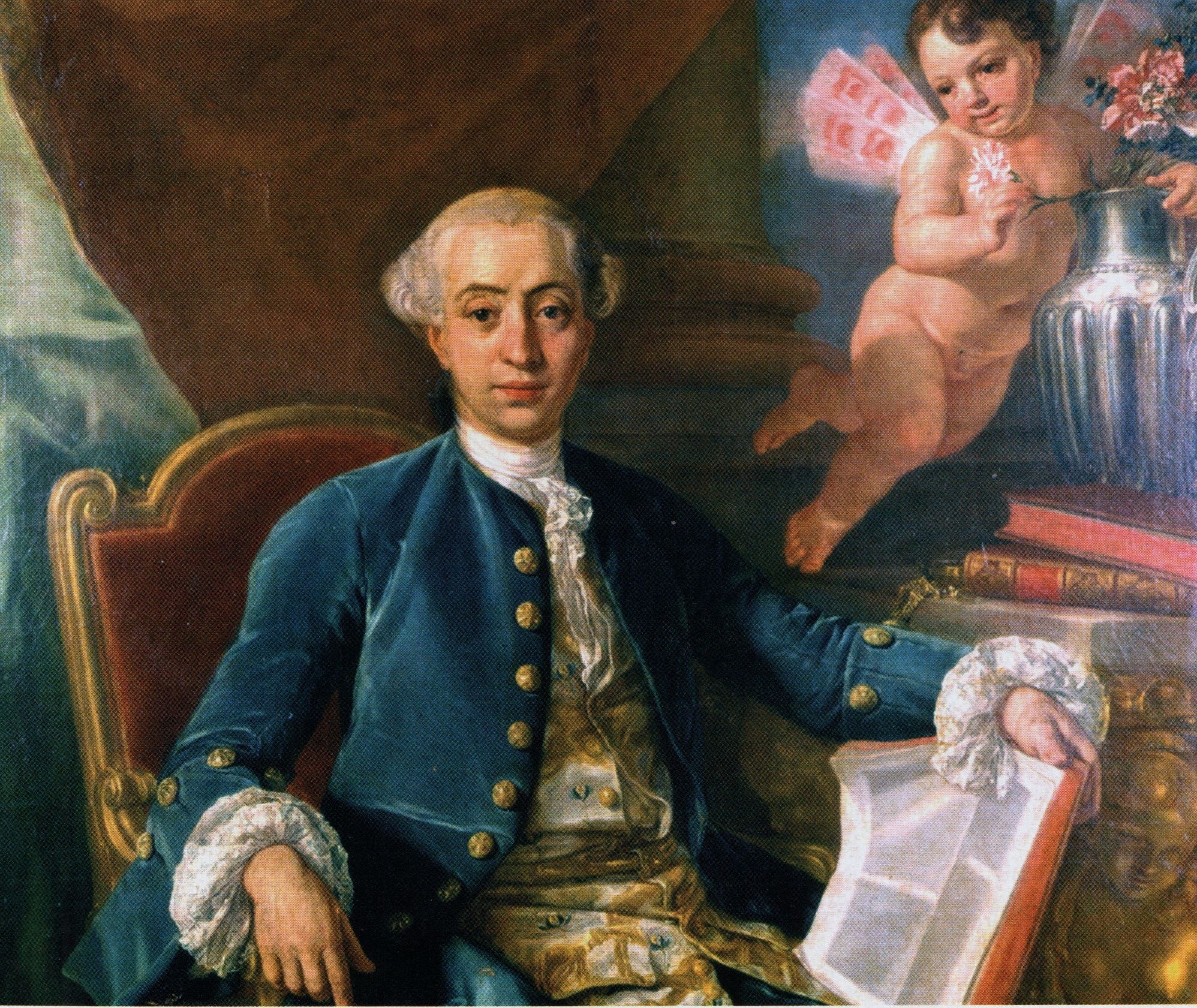
Background and career
Giacomo Girolamo Casanova (; Italian: [ˈdʒaːkomo dʒiˈrɔːlamo kazaˈnɔːva, kasa-]; 2 April 1725 – 4 June 1798) was an Italian adventurer and writer who was born in the Republic of Venice and travelled extensively throughout Europe. He is chiefly remembered for his autobiography, written in French and published posthumously as Histoire de ma vie ("The Story of My Life"). That work has come to be regarded as a unique and provocative source of information on the customs and norms of European social life in the 18th century. Born to a family of actors, Casanova studied law at the University of Padua and received minor orders in the Catholic Church with a view towards pursuing a career as a canon lawyer. However, he had no enthusiasm for the law or vocation for the church, and he soon abandoned those plans and launched instead upon an itinerant life as a gambler, violinist, confidence trickster, and man of letters. Throughout his life, Casanova obtained money and other advantages from various aristocratic patrons by pretending to possess alchemical, cabbalistic, and magical secret knowledge. Among other exploits, Casanova escaped from the Piombi prison, to which he had been confined by order of the Venetian Council of Ten for offenses against religion and morals, and later helped convince the authorities of the Kingdom of France to establish a state lottery as a source of revenue. Casanova, who often misrepresented himself as an aristocrat, used a variety of pseudonyms, including Baron or Count of Farussi (his mother's maiden name) and the invented title Chevalier de Seingalt (French pronunciation: [sɛ̃ɡɑl]). After he began writing in French, following his second exile from Venice, he often signed his works as "Jacques Casanova de Seingalt". In his autobiography, Casanova reports encounters with popes, cardinals, and monarchs, as well as with major intellectual and artistic figures such as Voltaire, Goethe, and Mozart. The most notorious aspect of Casanova's career are his many complicated sexual affairs with women, stretching from his early adolescence to his old age, which he described in detail in his autobiography. As a consequence of this, Casanova's name has become a byword for a male seducer and libertine, like "Lothario" or "Don Juan". He spent his final years in Bohemia, where he served as librarian to the household of Count Waldstein and resided at Dux Castle, where he wrote his autobiography.
Giacomo Girolamo Casanova was born in Venice in 1725 to actress Zanetta Farussi, wife of actor and dancer Gaetano Casanova. Giacomo was the first of six children, followed by Francesco Giuseppe (1727–1803), Giovanni Battista (1730–1795), Faustina Maddalena (1731–1736), Maria Maddalena Antonia Stella (1732–1800), and Gaetano Alvise (1734–1783). At the time of Casanova's birth, Venice was considered the pleasure capital of Europe. It was ruled by political and religious conservatives who tolerated social vices and encouraged tourism. The city was a standard stop on the Grand Tour undertaken by young men coming of age, especially members of the British aristocracy. Its Carnival, gambling houses, and courtesans attracted many visitors. This environment provided many of his formative experiences.
His grandmother, Marzia Baldissera, cared for him while his mother toured about Europe in the theater. His father died when he was eight. As a child, Casanova suffered nosebleeds, for which his grandmother sought help from a witch: "Leaving the gondola, we enter a hovel, where we find an old woman sitting on a pallet, with a black cat in her arms and five or six others around her." Though the unguent applied was ineffective, Casanova was fascinated by the incantation. Perhaps to remedy the nosebleeds (a physician blamed the density of Venice's air), Casanova, on his ninth birthday, was sent to a boarding house in Padua, on the mainland. For Casanova, the neglect by his parents was a bitter memory. "So they got rid of me," he proclaimed. Conditions at the boarding house were appalling, so he appealed to be placed under the care of Abbé Gozzi, his primary instructor, who tutored him in academic subjects, as well as the violin. Casanova moved in with the priest and his family and lived there through most of his teenage years. In the Gozzi household, Casanova first came into contact with the opposite sex, when Gozzi's younger sister Bettina fondled him at the age of 11. Bettina was "pretty, lighthearted, and a great reader of romances. ... The girl pleased me at once, though I had no idea why. It was she who little by little kindled in my heart the first sparks of a feeling which later became my ruling passion." Although she subsequently married, Casanova maintained a lifelong attachment to Bettina and the Gozzi family. Casanova boasts of having demonstrated from early on a quick wit, an intense appetite for knowledge, and a perpetually inquisitive mind. He entered the University of Padua at 12 and graduated at 17, in 1742, with a laurea in law (a discipline for which he later declared his "unconquerable aversion"). His guardian's hope was that he would become an ecclesiastical lawyer. Casanova had also studied moral philosophy, chemistry, and mathematics, and was keenly interested in medicine. ("I should have been allowed to do as I wished and become a physician, in which profession quackery is even more effective than it is in legal practice.") He frequently prescribed his own treatments for himself and friends. While attending the university, Casanova began to gamble and quickly got into debt, causing his recall to Venice by his grandmother, but the gambling habit became firmly established.
Back in Venice, Casanova started his clerical law career and was admitted as an abbé after being conferred minor orders by the Patriarch of Venice. He shuttled back and forth to Padua to continue his university studies. By now, he had become something of a dandy—tall and dark, his long hair powdered, scented, and elaborately curled. He quickly ingratiated himself with a patron (something he was to do all his life), 76-year-old Venetian senator Alvise Gasparo Malipiero, the owner of Palazzo Malipiero, close to Casanova's home in Venice. Malipiero moved in the best circles and taught young Casanova a great deal about good food and wine, and how to behave in society. However, Casanova was caught dallying with Malipiero's intended object of seduction, the actress Teresa Imer, and the senator drove both of them from his house. Casanova's growing curiosity about women led to his first complete sexual experience, with two sisters, Nanetta and Marton Savorgnan, then 14 and 16, who were distant relatives of the Grimanis. Casanova proclaimed that his life avocation was firmly established by this encounter.
Scandals tainted Casanova's brief church career. After his grandmother's death, Casanova entered a seminary for a short while, but was thrown out after being discovered in bed with a fellow seminarian. Soon his indebtedness landed him in prison for the first time. An attempt by his mother to secure him a position with Bishop Bernardo de Bernardis was rejected by Casanova after a very brief trial of conditions in the bishop's Calabrian see. Instead, he found employment as a scribe with the powerful Cardinal Acquaviva in Rome. On meeting Pope Benedict XIV, Casanova boldly asked for a dispensation to read the "forbidden books" and from eating fish (which he claimed inflamed his eyes). He also composed love letters for another cardinal. When Casanova became the scapegoat for a scandal involving a local pair of star-crossed lovers, Cardinal Acquaviva dismissed Casanova, thanking him for his sacrifice, but effectively ending his church career. In search of a new profession, Casanova bought a commission to become a military officer for the Republic of Venice. His first step was to look the part:
Reflecting that there was now little likelihood of my achieving fortune in my ecclesiastical career, I decided to dress as a soldier ... I inquire for a good tailor ... he brings me everything I need to impersonate a follower of Mars. I bought a long sword, and with my handsome cane in hand, a trim hat with a black cockade, with my hair cut in side whiskers and a long false pigtail, I set forth to impress the whole city.
Sources
Net-worth figure: Celebrity Net Worth (October 2026), in USD. Biography and career facts: the person's Wikipedia article and linked reporting. Snapshot date for all StarWorth figures: 28 October 2026.


