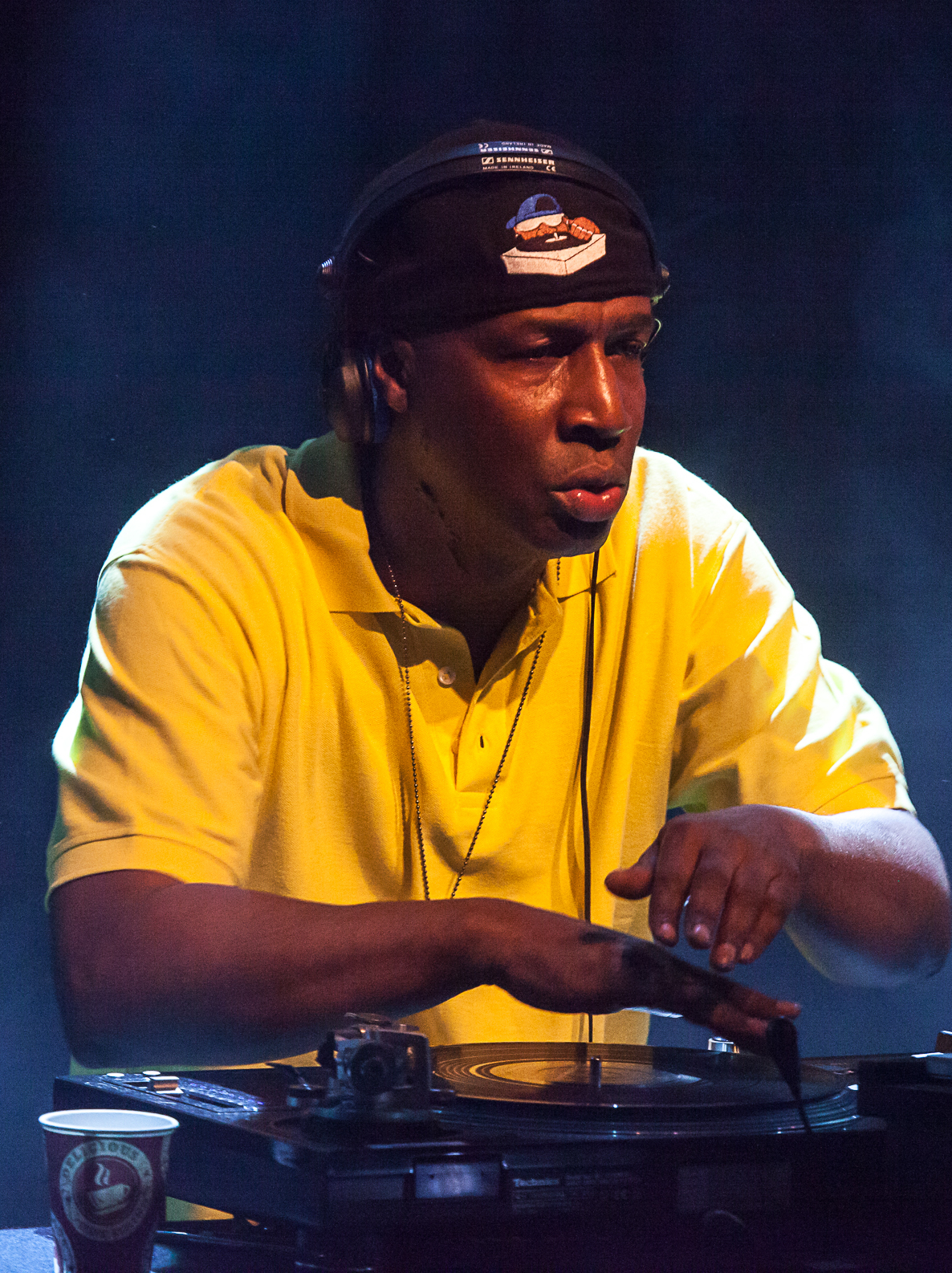
Background and career
Joseph Robert Saddler (born January 1, 1958), known by his stage name Grandmaster Flash, is an American DJ. He is the creator of a DJ technique called the Quick Mix Theory, which elongates a song's drum breaks through the use of switching and looping duplicate vinyl copies. This technique gave rappers and breakdancers an elongated bed of beats to speak over or dance to, respectively, and gave birth to record cutting and scratching. He also invented the slipmat, used on a turntable platter rather than the traditional rubber mat for easier record manipulation. He is the founder and creator of Grandmaster Flash and the Furious Five, the first rap group to be inducted into the Rock and Roll Hall of Fame in 2007. In 2019 he became the first hip hop artist to be honoured with the Polar Music Prize. On May 21, 2022, he acquired an honorary doctorate in Fine Arts from Buffalo State University. On June 1, 2023, he was awarded an honorary doctorate in music from Lehman College in the Bronx, NY. On August 4, 2023, Saddler was issued a proclamation from the city of New York stating that August 4 is Grandmaster Flash Day.
Saddler was born and raised in the Bronx, New York City. His father, Joseph Saddler Sr., was a track worker for the New York City Transit and his mother, Regina Saddler, was a stay-at-home seamstress. He attended Samuel Gompers High School, a public vocational school. There, he learned how to repair electronic equipment. Saddler's parents played an important role in his interest in music. His father was a fan of Caribbean and African American recordings. During his childhood, Saddler was fascinated by his father's record collection. In an interview, he reflected: "My father was a very heavy record collector.... I used to open his closets and just watch all the records he had. I used to get into trouble for touching his records, but I'd go right back and bother them." Saddler's early interest in DJing came from this fascination with his father's record collection as well as his mother's desire for him to educate himself in electronics. After high school, he became involved in the earliest New York DJ scene, attending parties set up by early luminaries like DJ Kool Herc and Disco King Mario. Saddler's uncle Sandy Saddler was a featherweight boxing champion.
When observing the differences between the smooth transitions of a disco DJ and the poorly-beat-matched transitions of early DJing, Grandmaster Flash took inspiration from the former to form a fingertip-to-vinyl and crossfader technique called the Quick Mix Theory. This technique was a mathematical way to cut, paste, repeat, and extend a very minuscule piece of an existing composition. This innovation took place in two places in the Bronx. The first location was his parents' house, 2730 Dewey Ave in the Throggs Neck Projects of the Bronx. The completion of the Quick Mix Theory was done at 927 Fox Street in the Hunts Point Area of the Bronx. The Quick Mix Theory gave birth to techniques such as cutting, scratching, and transforming.
Backspin technique (or quick-mix theory): Early New York party DJs came to understand that short drum breaks were popular with party audiences. Kool Herc began experimenting with the use of two identical tracks to extend the ‘break’, or instrumental section, resulting in what was known as ‘break-beat’. Grandmaster Flash perfected this technique where he could play the break on one record while searching for the same fragment of music on the other with the aid of his headphones. When the break finished on one turntable, he used his mixer to switch quickly to the other turntable, where the same beat was cued up and ready to play. Using the backspin technique (also referred to as beat juggling), the same short phrase of music could be looped indefinitely. In addition to Grandmaster Flash's on-time BPM-perfected technique, additional items were needed to pull this off. These items were felt and wax paper. The combination of these two materials cut into the size of a record and placed on the turntable (at that time referred to as a "wafer") allowed the record to move fluidly. The end result of that was the creation of what we today call the slipmat. Another item that played a key role in the successful implementation of the quick mix theory is the needle/stylus. He realized that the stylus came in two classes: elliptical, which sounded better but would not stay in the groove, and spherical. The spherical needle, although making the song sound worse, would stay inside the groove. This, in turn, allowed Flash to turn the vinyl counterclockwise to re-arrive at the top of the break.
Punch phrasing (or clock theory): This technique involved isolating very short segments of music, typically horn hits, and rhythmically punching them over the sustained beat using the mixer. Scratching: Although the invention of record scratching as a form of adding to the musical entertainment is generally credited to Grand Wizzard Theodore, Grandmaster Flash perfected the technique and brought it to new audiences. Scratching, along with punch phrasing, exhibited a unique aspect of party DJing: instead of passively spinning records, he manipulated them to create new music.
Grandmaster Flash played parties and collaborated with rappers such as Kurtis Blow and Lovebug Starski. In the late 1970s, he formed his own group. The original lineup consisted of Cowboy (Keef Cowboy), Melle Mel (Melvin Glover), and Kidd Creole (Nathaniel Glover), and the ensemble went by the name "Grandmaster Flash & the 3 MCs". Cowboy created the term hip hop. He created the term while teasing a friend who had just joined the U.S. Army, by scat singing the words "hip/hop/hip/hop" in a way that mimicked the rhythmic cadence of soldiers marching. Cowboy later worked the "hip hop" cadence into a part of his stage performance. Mel was the first rapper to call himself "MC" (Master of Ceremony). Two other rappers briefly joined, but they were replaced more permanently by Rahiem (Guy Todd Williams, previously in the Funky Four) and Scorpio (Eddie Morris, a.k.a. Mr. Ness) to make Grandmaster Flash and the Furious Five. Quickly gaining recognition for their skillful raps, Grandmaster Flash and the Furious Five pioneered MCing and freestyle battles. Some of the staple phrases in MCing have their origins in the early shows and recordings of the group. A 1977 documentary film, Simpson Street, includes a hip-hop party on the roof of Casita Maria in the Bronx, with Grandmaster Flash in attendance; this is the earliest known footage of the hip-hop scene. In 1978, the new group began performing regularly at Disco Fever in the Bronx, one of the first times a hip-hop group was given a weekly gig at a well-known venue. Grandmaster Flash and the Furious Five were signed to Bobby Robinson's Enjoy Records and in 1979 released their first single, "Superrappin'".
Sources
Net-worth figure: Celebrity Net Worth (October 2026), in USD. Biography and career facts: the person's Wikipedia article and linked reporting. Snapshot date for all StarWorth figures: 28 October 2026.


