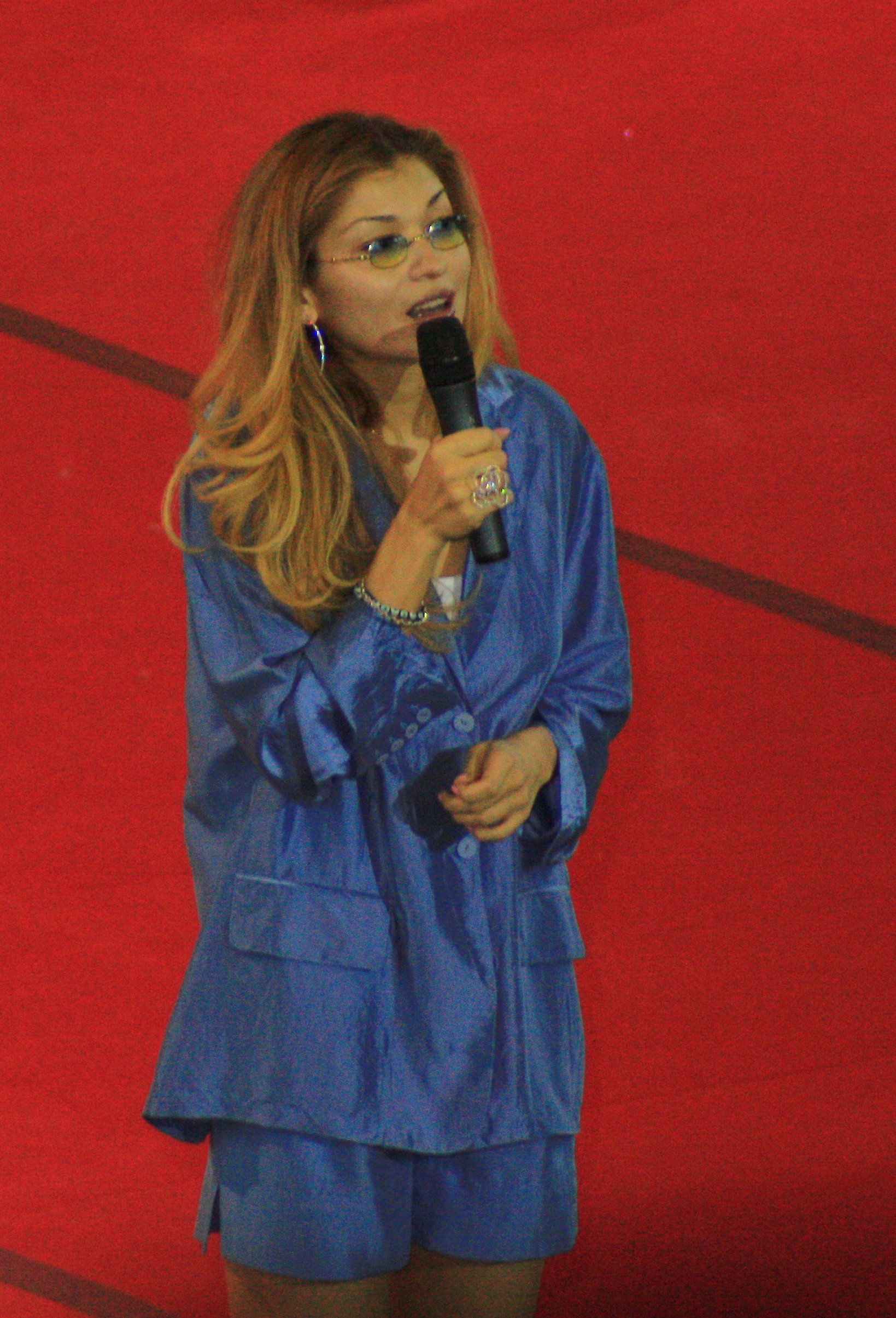
Background and career
Gulnara Islamovna Karimova (Cyrillic Uzbek: Гулнора Исломовна Каримова; born 8 July 1972) is an Uzbek former businesswoman and the elder daughter of Islam Karimov, the president of Uzbekistan from 1991 to his death in 2016. She wielded considerable influence in Uzbekistan owing to her business dealings and family connections. From 2013, due to a conflict with her father, she rapidly began to lose influence. Karimova was placed under house arrest in Tashkent, Uzbekistan in November 2014. She was questioned by Swiss prosecutors in December 2016 in a money-laundering investigation. In 2017, the U.S. Department of the Treasury banned United States entities from dealing with Karimova or any of her organisations or associates. In the same year, she was sentenced in Uzbekistan to 10 years in jail for fraud and money laundering. In 2018, the sentence was commuted to five years of house arrest. In March 2019, she was sent to prison for allegedly violating the terms of her house arrest.
Karimova graduated from the Youth Mathematic Academy in Tashkent in 1988. In 1987, she interned at the State Committee of Uzbekistan on Statistics. From 1989 to 1994, she attended Tashkent State University, where she obtained a bachelor's degree from the International Economics department. During her second year, she worked as a translator at the Chamber of Commerce and Industry of the Republic of Uzbekistan. In 1992, she completed a course of jewellery design in New York's Fashion Institute of Technology. Between 1994 and 1996, she was enrolled at Institute of Economy at the Uzbekistan Academy of Science where she pursued a master's degree. During 1994-1995, she was an intern-teacher at the political science department of the University of World Economy and Diplomacy in Tashkent. Between 1998 and 2000, Karimova studied at Harvard University, where she was awarded a master's degree in regional studies. At the same time, she was enrolled at the University of World Economy and Diplomacy in Tashkent, where in 2001, was "awarded" a PhD in political science. Since 2009, she has held a chair of political science at the UWED. She also holds a Bachelor of Arts in telecommunications which she received in 2006, from Tashkent University of Informational Technologies.
From 1995 to 1996, she worked at the Ministry of Foreign Affairs of Uzbekistan. In 1998, and from 2000 to 2003, Karimova was counselor at Uzbekistan's Mission to the United Nations. From 2003 until 2005, she was minister-counselor at the Uzbek embassy in Moscow, and was adviser to the minister of foreign affairs from 2005 to 2008. In February 2008, she was appointed deputy foreign minister for international cooperation in cultural and humanitarian affairs. In September of the same year, she was named Permanent Representative of Uzbekistan to the United Nations and other international organizations in Geneva, and took up the post in December 2008. In January 2010, she was named Uzbek Ambassador to Spain. In 2012, Karimova was honoured with the "Silk Road and Humanitarian Cooperation" Award of the Shanghai Cooperation Organization. In 2005, Karimova established the Centre for Political Studies. She is the founder of the Forum of Culture and Arts of Uzbekistan Foundation, and chair of its board of trustees. She has been involved with several other non-governmental organizations in Uzbekistan.
According to US diplomats in Uzbekistan, Karimova "bullied her way into gaining a slice of virtually every lucrative business" in the country and is viewed as a "robber baron". In 2009, the Swiss magazine Bilanz described her as one of the 10 richest women in the country. In March 2014, the Swiss Prosecutor's Office announced that it had extended a money laundering investigation to include Karimova. The probe was launched in 2012. Karimova denied her involvement in mentioned cases, stating: "I have never considered the opportunities of doing business in Switzerland... These references are insinuations of my opponents. My name has been mentioned earlier several times in relations to companies such as Zeromax in Zug, Interspan, Oxus Gold, Wimm-Bill-Dann of Russia, Carlsberg and many others". Working though the Kleptocracy Asset Recovery Initiative, the U.S. Department of Justice seized $850 million (~$1.12 billion in 2025) in 2016 that had been "funneled through corrupt deals" by Karimova. She is also under investigation in Uzbekistan on charges of corruption, although she denies any wrongdoing. Karimova has also been accused of using UK companies to buy real estate around the world with funds she received through bribery and corruption according to a study by Freedom For Eurasia. According to the study, accounting firms acting on behalf of Karimova purchased 14 properties around the world including in the UK, Switzerland, France, Dubai, and Hong Kong.
In 2006, Karimova released her first music video, singing a song called "Unutma Meni" (Don't Forget Me) under the stage name "Googoosha", apparently her father's nickname for her. She also performed in a later music video, singing a duet of "Besame Mucho" with Julio Iglesias. In December 2012, Googoosha released a duet with French actor Gérard Depardieu. During his visit to Uzbekistan, the French actor agreed to star in an Uzbek film. Karimova wrote a screenplay for The Theft of the White Cocoon, a story about the origin of the famed Central Asian silk, and set in the 5th and 6th centuries. Googoosha's first single, "Round Run", was released in April 2012, with various remixes by DJ White Shadow, Razor N Guido of USA and Max Fadeev of Russia. In June 2012, Karimova released her self-titled debut album in the US and other countries on iTunes. The album was also expected to be released in Asia, Russia, and a number of other European countries. However, early reviews by critics panned the debut album, thus indefinitely halting its release in those markets.
In its annual edition of a collection of poems of 2024, the German publishing company Brentano-Gesellschaft in Frankfurt am Main published Gulnara Karimova’s poem “The World is a Flow of Flashes and Glimpses.”


