Background and career
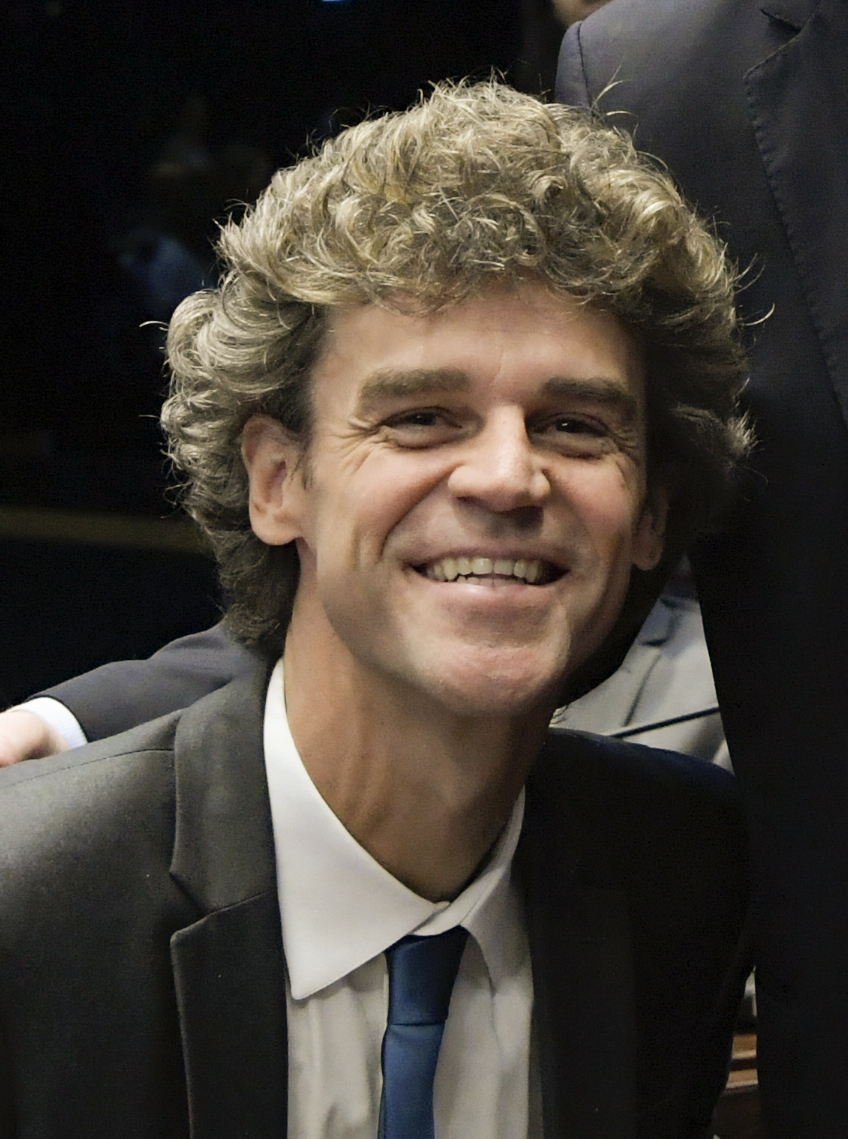
Gustavo "Guga" Kuerten (Portuguese: [ɡusˈtavu ˈkiʁtẽ]; born 10 September 1976) is a Brazilian former professional tennis player. He was ranked as the world No. 1 in men's singles by the Association of Tennis Professionals for 43 weeks, including as the year-end No. 1 in 2000. Kuerten won 20 ATP Tour-level singles titles, including three majors at the French Open in 1997, 2000, and 2001, as well as the 2000 Tennis Masters Cup. He also won eight doubles titles. Kuerten is widely regarded as the best Brazilian tennis player of all time and is often mentioned as one of the country's biggest sportsmen ever, alongside Pelé, Ayrton Senna, Anderson Silva and others.
He was inducted into the International Tennis Hall of Fame in 2012. In 2016, Kuerten was a torch bearer for the Rio Olympics.
As a junior player in South America, Kuerten won many of the most important tournaments in the region. He often played in an age group above his. After two years as a professional, Kuerten rose to the position of No. 2 player in Brazil, behind Fernando Meligeni, and he had his then highest point by helping the Brazil Davis Cup team defeat Austria in 1996 and reach the competition's first division, the World Group. Following his unexpected victory in the 1997 French Open – which was not only his maiden ATP Tour victory but also the first time he had reached a professional ranking final – Kuerten had a difficult year and a half, adjusting to his sudden fame and the pressure of being expected to win. 1998 was the worst year in his career that was not related to injuries. The pressure for him to become an "ambassador" for tennis in Brazil was made evident after his early defeat to a then unknown Marat Safin in the 1998 French Open: the entire body of Brazilian journalists that had been dispatched to Paris to cover the event immediately returned home, leaving the rest of the tournament unaccounted for in Brazil. Like many South American players, his favorite court surface is clay. He won three Grand Slam titles, all of them at the French Open, played on the red clay courts of Roland Garros. He won these titles in 1997, 2000 and 2001. In every one of the three French Open victories he defeated Russia's Yevgeny Kafelnikov in the quarterfinals and two top 10 players on his way to the title. Kuerten became the world No. 1 player in 2000. Kuerten won at least one title a year between 1997 and 2004. The streak came to an end in 2005, when injuries and below-average performances kept him from winning tournaments. He was also a regular participant for Brazil in the Davis Cup.
Fresh from winning a Challenger title, Kuerten unexpectedly won the 1997 French Open, the first Brazilian to win a Grand Slam singles title since Maria Bueno at the 1966 U.S. Open. The tournament was only his third grand slam, setting a record for any player in the open era, tied with Mats Wilander. He remains the only player to win a Challenger and a Grand Slam in consecutive weeks. Victories over former champions of the previous four French Opens – Thomas Muster (1995) in the third round in five sets, Yevgeny Kafelnikov (1996) in the quarterfinals in five sets and Sergi Bruguera (1993, 1994) in the final – make him the third-lowest ranked Grand Slam Champion (ranked 66th), and his victory led to him entering the Association of Tennis Professionals top 20. Only Mark Edmondson (ranked 212th) and Goran Ivanišević (ranked 125th) were ranked lower than Kuerten when winning a Grand Slam singles title. He received his French Open trophy from former champions Björn Borg and Guillermo Vilas. When called to the stage to receive the winner's trophy, Kuerten reverently bowed a few times to his childhood idol Borg, who was waiting at the top of the stairs to shake his hand. Later, during the ceremony, Vilas whispered something in Kuerten's ear that caused him to laugh during the speech of the chairman of the event. Kuerten later refused to reveal what it was that Vilas had said, claiming it would be inelegant to do so, but journalists that were equipped with powerful lenses were able to read Vilas's lips, and it was revealed that he had said in Spanish something like: "Get ready kid, it's going to rain women on your lap!".
He established himself as the leading clay court player of his generation in 1999, and he became one of three South Americans to complete the year in the top 10 in all the history of the ATP rankings. In April he won the Monte-Carlo Masters beating the Chilean Marcelo Ríos. In May he won the Rome Masters, beating Patrick Rafter in the final. In June he reached the quarterfinals at the French Open, losing to unseeded eventual runner-up Andriy Medvedev. At Wimbledon, he became the first Brazilian to reach the quarterfinals since Thomaz Koch in 1968. He was defeated by Andre Agassi in the quarterfinals, but had lost just one set until that stage. In July, he defeated Sébastien Grosjean 9–7 in the fifth set of the 1999 Davis Cup quarterfinal between Brazil and France. That match lasted 4 hours and 43 minutes. He also became the first Brazilian to qualify for the ATP Tennis Masters Cup, today known as the Nitto ATP Finals, winning a match but failing to get past round robin.
After another solid clay court swing, Kuerten won his second French Open title by defeating Magnus Norman (who had beaten him a few weeks earlier in the final of the Rome Masters) on his 11th match point. Kuerten became the first South American to finish the year as World No. 1 in the history of the ATP rankings (since 1973). It was a close contest with young up-and-comer Marat Safin at the year's last event, the Tennis Masters Cup (in its first year under that name) in Lisbon, Portugal, with one loss meaning that Safin would have been No. 1. Despite Safin having 4 chances to finish the year as world No. 1, Kuerten defied all odds and finished the year at No. 1 by beating Pete Sampras and Andre Agassi in back-to-back matches on an indoor hard court. He broke an eight-year hold of players from the U.S. on the year-end No. 1 position. He also became the first South American to finish in Top 5 in consecutive years since Guillermo Vilas of Argentina in 1977–78.



