Background and career
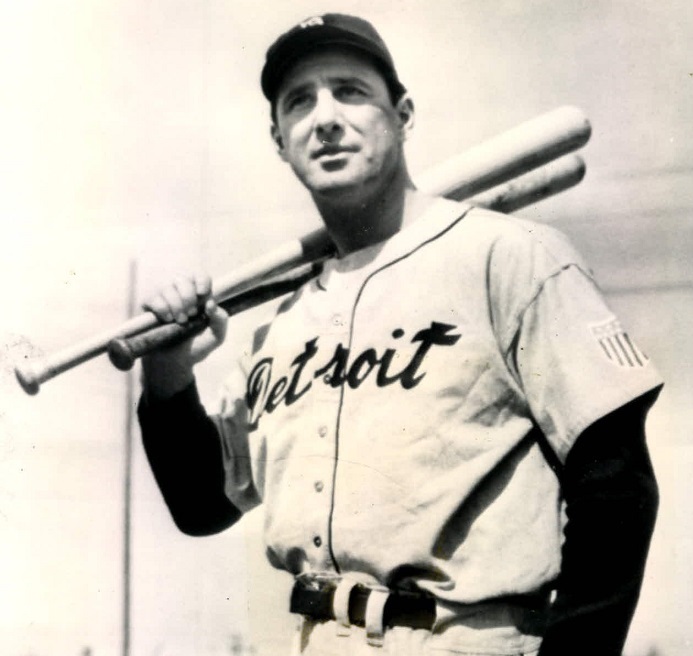
Henry Benjamin Greenberg (January 1, 1911 – September 4, 1986), nicknamed "Hammerin' Hank", "Hankus Pankus", and "the Hebrew Hammer", was an American professional baseball player and team executive. He played in Major League Baseball (MLB), primarily for the Detroit Tigers as a first baseman in the 1930s and 1940s. A member of the Baseball Hall of Fame and a two-time Most Valuable Player (MVP) Award winner, he was one of the premier power hitters of his generation and is widely considered one of the greatest sluggers in baseball history. Greenberg played the first twelve of his 13 major league seasons for Detroit; with the Tigers, he was an All-Star for four seasons and was named the American League (AL) Most Valuable Player in 1935 and 1940. He had a batting average over .300 in eight seasons, and won two World Series championships with the Tigers (1935 and 1945). He was the AL home run leader four times and his 58 home runs for the Tigers in 1938 equaled Jimmie Foxx's 1932 mark for the most in one season by anyone other than Babe Ruth, and tied Foxx for the most home runs between Ruth's record 60 in 1927 and Roger Maris' record 61 in 1961. Greenberg was the first major league player to hit 25 or more home runs in a season in each league, and remains the AL record-holder for most runs batted in in a single season by a right-handed batter. When the United States joined World War II, Greenberg was the first major leaguer to join the armed forces; he spent 47 months in military service, more than any other major league player, all of which took place during what would have been prime years in his major league career. Like many players who served in WWII, his career statistics suffered because of the war and would have certainly been higher had he not served in the armed services during wartime. In 1947, Greenberg signed a contract for a record $85,000 salary before being sold to the Pittsburgh Pirates, where he played his final MLB season that year. After retiring from playing, Greenberg continued to work in baseball as a team executive for the Cleveland Indians and Chicago White Sox. Greenberg was the first Jewish superstar in American team sports. He attracted national attention in 1934 in the middle of a pennant race when he grappled with the decision of whether or not to play baseball on the Jewish High Holy Days; after consultation with his rabbi, he decided to play on Rosh Hashanah, but refused to play on Yom Kippur, instead spending the day at the synagogue. Having endured his share of antisemitic abuse in his career, Greenberg was one of the few opposing players to publicly welcome African-American player Jackie Robinson to the major leagues in 1947.
Greenberg was born on January 1, 1911, in Greenwich Village, New York City, to Romanian Jewish immigrant parents from Bucharest, Sarah (née Schwartz) (1881–1951) and David Greenberg (1883–1969). He was the third of four children and had two brothers, Ben (1906–1994) and Joe (1915–2001), and a sister, Lillian (1907–1989). His parents had originally wanted to name him "Hyman"; however, the name on his birth certificate was erroneously listed as "Henry". The family owned a successful cloth-shrinking plant in New York. Eventually, they moved from Greenwich Village to the Bronx where Greenberg attended James Monroe High School. There, Greenberg was an outstanding all-around athlete and was bestowed with the long-standing nickname of "Bruggy" by his basketball coach. His preferred sport was baseball, and his preferred position was first base. However, his best sport was basketball and he helped the high school basketball team win the city championship. Greenberg also excelled at soccer and track and field. In 1929, the 18-year-old 6 ft 4 in (1.93 m) Greenberg was recruited by the New York Yankees, who already had Lou Gehrig at first base. As first base was already taken on the Yankee team, Greenberg turned down the Yankees' offer and instead attended New York University on an athletic scholarship; there, he was a member of Sigma Alpha Mu. During this time, he also had a tryout with the New York Giants; Giants manager John McGraw, however, was not impressed by the first baseman. Hence, after his freshman year ended, Greenberg signed with the Detroit Tigers for $9,000 ($173,000 today).
Greenberg played minor league baseball for three years. He played 17 games in 1930 for the Hartford Senators of the Eastern League before playing the remainder of the year with the Raleigh Capitals of the Piedmont League, hitting .314 with 19 home runs. In 1931, he played for the Evansville Hubs in the Illinois–Indiana–Iowa League, hitting .318 with 15 home runs and 85 runs batted in. In 1932, the Beaumont Exporters in the Texas League, he hit 39 homers with 131 RBIs, winning the league's Most Valuable Player award, and leading Beaumont to the Texas League title.
On September 14, 1930, Greenberg made his major league debut as a pinch hitter against the New York Yankees. It was the only game he appeared in that year but, as a result, made him the youngest player (19) to appear in the major leagues in 1930. It was another three years before he rejoined the majors. In 1933, for the Tigers, Greenberg hit .301 with 87 runs batted in. At the same time, he was third in the league in strikeouts (78). In 1934, his second season in the majors, Greenberg hit .339 and helped the Tigers reach their first World Series in 25 years. He led the league in doubles, with 63 (the fourth-highest all-time in a single season), and extra-base hits (96). Additionally, he was third in the AL in slugging percentage (.600) – behind Jimmie Foxx and Lou Gehrig, but ahead of Babe Ruth – and in RBIs (139), sixth in batting average (.339), seventh in home runs (26), and ninth in on-base percentage (.404).
Late in the 1934 season, he announced that he would not play on September 10, which was Rosh Hashanah, the Jewish New Year, or on September 19, the Day of Atonement, Yom Kippur. Detroit fans grumbled at the decision, however, with one reportedly saying, "Rosh Hashanah comes every year but the Tigers haven't won the pennant since 1909." As a result, Greenberg did considerable soul-searching, and discussed the matter with his rabbi and his father; finally he relented and agreed to play on Rosh Hashanah, but stuck with his decision not to play on Yom Kippur. Dramatically, Greenberg hit two home runs in a 2–1 Tigers victory over the Red Sox on Rosh Hashanah. The next day, the Detroit Free Press ran the Hebrew lettering for "Happy New Year" across its front page. Columnist and poet Edgar A. Guest expressed the general opinion in a poem titled "Came Yom Kippur: Speaking of Greenberg", in which he used the Irish (and thus Catholic) names Murphy and Mulroney. The poem, published in the Detroit Free Press, ends with the lines:
The Detroit press was not so kind regarding the Yom Kippur decision, nor were many fans, but Greenberg in his autobiography recalled that he received a standing ovation from congregants at Congregation Shaarey Zedek when he arrived. With Greenberg absent from the lineup, the Tigers lost to the New York Yankees 5–2. They went on to face the St. Louis Cardinals in the 1934 World Series, losing in seven games against the "Gashouse Gang". In 1935, Greenberg led the league in RBIs (168), total bases (389), and extra base hits (98), tied Foxx for the AL title in home runs (36), was 2nd in the league in doubles (46), slugging percentage (.628), was 3rd in the league in triples (16), and in runs scored (121), 6th in on-base percentage (.411) and walks (87), and was 7th in batting average (.328). He was unanimously voted as the Most Valuable Player in the American League. By the All-Star break that season, Greenberg had hit 25 home runs and set an MLB record (still standing) of 103 RBIs, but was not selected to the AL All-Star roster; one reason was that AL manager Mickey Cochrane had put himself on the All-Star roster despite eventually not playing in the game. That season, Greenberg led the Tigers to another pennant. However, during Game 2, he sprained his wrist and was sidelined for the remainder of the series as the Tigers won their first World Series title. In April 1936, Greenberg re-injured his wrist in a collision with Jake Powell of the Washington Senators and did not play the remainder of the season. He finished the season with 16 hits, 1 home run, and 15 RBIs in 12 games. In 1937, Greenberg recovered from his injury and was voted to the AL All-Star roster, but did not play. On September 19, 1937, he hit the first home run into the center-field bleachers at Yankee Stadium. He led the AL by driving in 184 runs (third all-time, behind Hack Wilson in 1930 and Lou Gehrig in 1931), and in extra-base hits (103), while batting .337 with 200 hits. He was second in the league in home runs (40), doubles (49), total bases (397), slugging percentage (.668), and walks (102), third in on-base percentage (.436), and seventh in batting average (.337). Greenberg came in third in the vote for MVP, behind teammate Charlie Gehringer and Joe DiMaggio.


