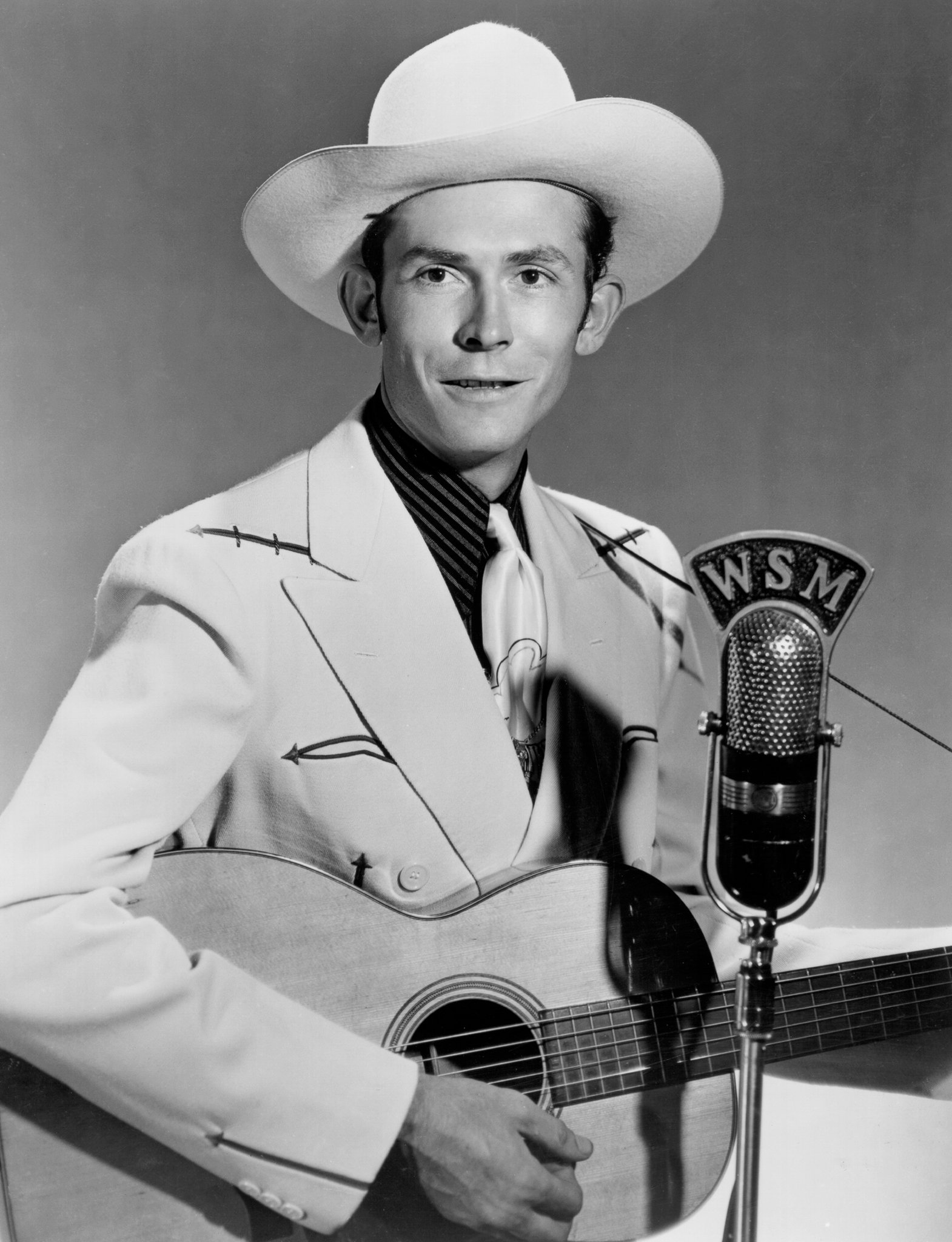
Background and career
Hiram "Hank" Williams (September 17, 1923 – January 1, 1953) was an American singer, songwriter, and musician. An early pioneer of country music, he is regarded as one of the most significant and influential musicians of the 20th century. Williams recorded 55 singles that reached the top 10 of the Billboard Country & Western Best Sellers chart, 5 of which were released posthumously, and 12 of which reached No. 1. Born and raised in Alabama, Williams learned guitar from blues musician Rufus Payne. Both Payne and Roy Acuff significantly influenced his musical style. After winning an amateur talent contest, Williams began his professional career in Montgomery in the late 1930s playing on local radio stations and at area venues such as school houses, movie theaters, and bars. He formed the Drifting Cowboys backup band, which was managed by his mother, and dropped out of school to devote his time to his career. Because his alcoholism made him unreliable, he was fired and rehired several times by radio station WSFA. Williams also had trouble replacing several of his band members who were drafted during World War II. In 1944, Williams married Audrey Sheppard, who competed with his mother to control his career. After recording "Never Again" and "Honky Tonkin'" with Sterling Records, he signed a contract with MGM Records. He released the hit single "Move It On Over" in 1947 and joined the Louisiana Hayride radio program. The next year he released a cover of "Lovesick Blues", which quickly reached number one on Billboard's Top Country & Western singles chart and propelled him to stardom on the Grand Ole Opry. Although unable to read or notate music to any significant degree, he wrote such iconic hits as "Your Cheatin' Heart", "Hey, Good Lookin'", and "I'm So Lonesome I Could Cry". During his final years, he struggled with back pain and substance abuse, exacerbating the strain on his relationships with Audrey and the Grand Ole Opry. Williams died on New Year's Day 1953 at the age of 29, his heart failing in the back seat of a car near Oak Hill, West Virginia, en route to a concert in Canton, Ohio. Despite his relatively brief career, he is one of the most celebrated and influential musicians of the 20th century, especially in country music. Many artists have covered his songs and he has influenced Chuck Berry, Elvis Presley, Waylon Jennings, Johnny Cash, Bob Dylan, and the Rolling Stones, among others. He was inducted into the Country Music Hall of Fame in 1961, the Songwriters Hall of Fame in 1970, the Rock and Roll Hall of Fame in 1987, the Native American Music Awards Hall of Fame in 1999, and gained a star on the Hollywood Walk of Fame. In 2010, he was posthumously awarded a Pulitzer Prize Special Citation for his "craftsmanship as a songwriter who expressed universal feelings with poignant simplicity and played a pivotal role in transforming country music into a major musical and cultural force in American life." His life and career were dramatized in the 1964 biopic Your Cheatin' Heart and the 2015 biopic I Saw the Light.
Hiram Williams was born on September 17, 1923, in the rural community of Mount Olive in Butler County, Alabama. His name was misspelled as "Hiriam" on his birth certificate, which was prepared and signed when he was 10 years old. He was the third child of Jessie Lilliebelle "Lillie" (née Skipper; 1898–1955) and Elonzo Huble "Lon" Williams (1891–1970). Williams was of English and Welsh ancestry. Elonzo's family came from south and central Alabama, and his father fought during the American Civil War, first on the Confederate side, and then with the Union after he was captured. Elonzo was a railroad engineer for the W. T. Smith lumber company and was drafted during World War I, serving from July 1918 to June 1919. He suffered severe injuries after falling from a truck, breaking his collarbone, and receiving a severe blow to the head. The Williams' first child, Ernest Huble Williams, died two days after his birth on July 5, 1921. A daughter, Irene, was born a year later. Williams was born with spina bifida occulta, a birth defect of the spinal column that caused him lifelong pain and became a major factor in his later alcohol and drug abuse. At the age of three, Williams sat with his mother as she played the organ at the Mount Olive Baptist Church. Lillie also joined singing the hymns that influenced the singer's later compositions. Williams received his first musical instrument, a harmonica, at the age of six. As a child, he was nicknamed "Harm" by his family and "Herky" or "Skeets" by his friends. Williams's father frequently relocated for work, and as a result the family lived in several southern Alabama towns. In 1930, when Williams was seven years old, Elonzo began experiencing facial paralysis. After being evaluated at a Veterans' Administration clinic in Pensacola, Florida, doctors determined that he had a brain aneurysm, and Elonzo was sent to the VA Medical Center in Alexandria, Louisiana. He remained hospitalized for eight years and was mostly absent throughout Williams's childhood. From that point on, Lillie assumed responsibility for the family. In the fall of 1933, Williams was sent to live with his aunt and uncle, Walter and Alice McNeil, in Fountain, Alabama. Their daughter, Opal, went in exchange to live with Lillie to attend school in Georgiana, Alabama. Williams learned to play basic guitar chords from his aunt and listened to music that was played at dances and in area churches. The following year, the Williams family moved to Greenville, Alabama, where Lillie opened a boarding house next to the local cotton gin. The family later returned with Opal McNeil to Georgiana, where Lillie took several side jobs to support the family despite the bleak economic climate of the Great Depression. She worked in a cannery and served as a night-shift nurse in the local hospital. Their first house burned down, and the family lost their possessions. They moved to Rose Street on the other side of town, into a house which Williams's mother soon turned into another boarding house. The house had a small garden in which they grew diverse crops that Williams and his sister Irene sold around Georgiana. At a chance meeting in Georgiana, Williams's sister Irene met U.S. Representative J. Lister Hill while Hill was campaigning across Alabama. She told Hill that her mother was interested in talking to him about her problems. With Hill's help, the family began collecting Elonzo's disability pension. Despite his medical condition, the family managed fairly well financially throughout the Great Depression.
There are several versions of how Williams got his first guitar. While several prominent Georgiana residents later claimed to have bought it for him, his mother said she bought it for him and that she arranged for his first lessons. Williams told Ralph Gleason, who at the time was writing a weekly music column in the San Francisco Chronicle, "When I was about eight years old, I got my first git-tar. A second-hand $3.50 git-tar my mother bought me." Gawky and shy, Williams attached himself to Rufus "Tee-Tot" Payne, a street performer whom Williams followed around town. Payne gave Williams guitar lessons in exchange for money or meals prepared by Lillie. Payne's basic musical style was blues; he repeatedly stressed the importance of maintaining good rhythm and time, and he added the showmanship of stoops, bows, laughs and cries to his performances. Later on, Williams recorded "My Bucket's Got a Hole in It", one of the songs Payne had taught him. Williams was also influenced by country acts such as Roy Acuff. In 1937, Williams got into a fight with his physical education teacher about exercises the coach wanted him to do. His mother subsequently demanded that the school board terminate the coach; when they refused, the family moved to Montgomery, Alabama. Payne and Williams lost touch, though Payne also eventually moved to Montgomery, where he died in poverty in 1939. Williams later credited him as the provider of the only musical training he ever had.
In July 1937, the Williams and McNeils opened a boarding house on South Perry Street in downtown Montgomery. It was at this time that Williams decided to change his name informally from Hiram to Hank. During the same year, he participated in a talent show at the Empire Theater and won the first prize of US$15 (equivalent to $300 in 2025) singing his first original song "WPA Blues". Williams wrote the lyrics and used the tune of Riley Puckett's "Dissatisfied". He never learned to read music; instead he based his compositions in storytelling and personal experience. After school and on weekends, Williams sang and played his Silvertone guitar on the sidewalk in front of the WSFA radio studio. His recent win at the Empire Theater and the street performances caught the attention of WSFA producers who occasionally invited him to perform on air with Dad Crysel's band. In August 1938, Elonzo Williams was temporarily released from the hospital. He showed up unannounced at the family's home in Montgomery. Lillie was unwilling to let him reclaim his position as the head of the household. Elonzo stayed to celebrate his son's birthday in September before he returned to the medical center in Louisiana. Williams's successful radio appearances fueled his entry into a music career, and he started his own band for show dates, the Drifting Cowboys. The original members were guitarist Braxton Schuffert, fiddler Freddie Beach, and upright bass player and comedian Smith "Hezzy" Adair. Originally billed as "Hank and Hezzy and the Drifting Cowboys", they frequently appeared as fill-ins at the local dancehall, Thigpen's Log Cabin, just out of Georgiana. The band traveled throughout central and southern Alabama performing in clubs and at private gatherings. Lillie Williams became the Drifting Cowboys' manager. Williams dropped out of school in October 1939 so that he and the Drifting Cowboys could work full-time. Lillie Williams began booking show dates, negotiating prices and driving them to some of their shows. Now free to travel without deference to Williams's schooling, the band could tour as far away as western Georgia and the Florida Panhandle. The band started playing in theaters before the screening of films and later they played in honky-tonks. Williams's alcohol use started to become a problem during the tours; on occasion he spent a large part of the show revenues on alcohol. Meanwhile, between tour schedules, Williams returned to Montgomery to host his radio show.
The American entry into World War II in 1941 marked the beginning of hard times for Williams. While he was medically disqualified from military service after falling from a bull during a rodeo in Texas and suffering a back injury, his band members were all drafted to serve. Many of their replacements quit the band due to Williams's worsening alcoholism, and in August 1942 WSFA fired him for "habitual drunkenness". Backstage during one of his concerts, Williams met Roy Acuff, who warned him of the dangers of alcohol, saying, "You've got a million-dollar voice, son, but a ten-cent brain." He started a job as a shipfitter's helper for the Alabama Drydock and Shipbuilding Company at Mobile in 1942, working there off and on for about a year and a half during the war. He also worked briefly at Kaiser Shipyards in Portland, Oregon, apparently lured by the free tickets, free accommodations, free training, and good wages offered by the company. In 1943, Williams met Audrey Sheppard at a medicine show in Banks, Alabama. According to Sheppard, she and Williams lived in a hotel in Mobile while they worked together at the shipyard for a short while. Sheppard told Williams that she wanted to help him regain his radio show, and that they should move to Montgomery and start a band. The couple were married in 1944 at a Texaco gas station in Andalusia, Alabama, by a justice of the peace. The marriage was technically invalid, since Sheppard's divorce from her previous husband did not comply with the legally required 60-day reconciliation period. In 1945, back in Montgomery, Williams returned to WSFA radio. He attempted to expand his repertoire by writing original songs, and he published his first songbook, Original Songs of Hank Williams, containing "I'm Not Coming Home Anymore" and several more original songs, nine in all, including one not written by him, "A Tramp on the Street". With Williams beginning to be recognized as a songwriter, Sheppard became his manager and occasionally sang and substituted on guitar when a band member did not make the show. On September 14, 1946, Williams auditioned for Nashville's Grand Ole Opry at the recommendation of Ernest Tubb, but was rejected. After the failure of his audition, Williams and Audrey attempted to interest the recently formed music publishing firm Acuff-Rose Music. They approached Fred Rose, the president of the company, during one of his daily ping-pong games at WSM radio studios. Audrey asked Rose if her husband could sing a song for him at that moment, Rose agreed, and perceived that Williams had much promise as a songwriter. Rose signed Williams to a six-song contract, and leveraged this deal to sign Williams with Sterling Records. On December 11, 1946, in his first recording session, Williams recorded "Wealth Won't Save Your Soul", "Calling You", "Never Again (Will I Knock on Your Door)", and "When God Comes and Gathers His Jewels", which was misprinted as "When God Comes and Fathers His Jewels". The Sterling releases of Williams's songs became successful, and Rose decided to find a larger label for future releases. The producer then approached the newly formed recording division of the Loews Corporation, MGM Records.
Williams signed with MGM Records in 1947 and released "Move It on Over", which became a country hit. In 1948, he moved to Shreveport, Louisiana, and joined the Louisiana Hayride, a radio show broadcast on KWKH that brought him into living rooms all over the Southeastern United States, appearing in weekend shows. As part of the arrangement, Williams got a program on the station and bookings through the Hayride's artist service to perform across western Louisiana and eastern Texas, always returning on Saturdays for the show's weekly broadcast. After a few more moderate hits, in 1949 he released his version of the 1922 Cliff Friend and Irving Mills song "Lovesick Blues", made popular by Rex Griffin. Williams's version was a hit; the song stayed at number one on the Billboard charts for four consecutive months. Following the success of the releases of "Lovesick Blues" and "Wedding Bells", Williams signed a management contract with Oscar Davis. Davis then booked the singer on a Grand Ole Opry package show, and he later negotiated Williams's induction into the musical troupe. On June 11, 1949, Williams made his debut at the Grand Ole Opry, where he received six encores. He brought together Bob McNett (guitar), Hillous Butrum (bass), Jerry Rivers (fiddle) and Don Helms (steel guitar) to form the most famous version of the Drifting Cowboys. That year Audrey Williams gave birth to Randall Hank Williams (Hank Williams Jr.). During 1949, he joined the Grand Ole Opry's first European tour, performing in military bases in Germany and Austria. Williams had five songs that ranked in the top five Billboard Hot Country Singles that year: "Wedding Bells", "Mind Your Own Business", "You're Gonna Change (Or I'm Gonna Leave)", "My Bucket's Got a Hole in It", and "Lovesick Blues", which reached No. 1.


