Background and career
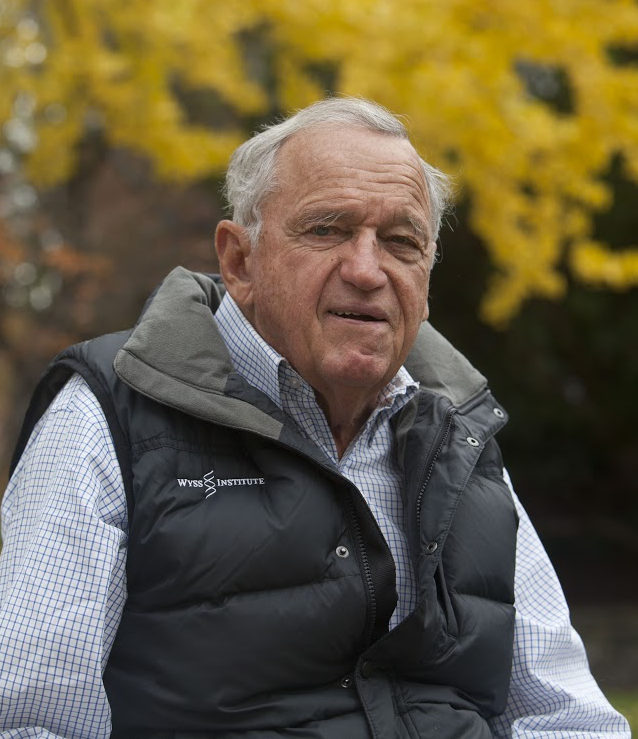
Johann Georg "Hansjörg" Wyss (Swiss Standard German pronunciation: [ˈhɑnsˌjœrɡ ˈʋiːs]; born 19 September 1935) is a Swiss billionaire businessman and donor to politically liberal and environmental causes in the United States. He is the founder and former president and chairman of Synthes, a medical device manufacturer. His Wyss Foundation has nearly $2 billion in assets. As of 2025, Forbes estimated his net worth at US$4.8 billion, while Bloomberg estimated $12.7 billion. Having donated hundreds of millions of dollars to environmental causes, he has more recently increased his donations to groups promoting progressive causes. In 2024, Wyss additionally donated $100 million to the City of Berne which bequeathed honorary citizenship on him. In the United States, Wyss is a major donor to organizations aligned with the Democratic Party. Wyss's political giving has come under scrutiny since foreign nationals without permanent residency in the United States are prohibited from donating directly to federal political candidates or political action committees. He is the co-owner of Premier League football club Chelsea. He is one of the anchor shareholders of Lalique Group, with Müller Handels AG Schweiz, Dharampal Satyapal Limited, Hansjörg Wyss and Claudio Denz, they hold 42.67% of Lalique Group shares. In 2019, Hansjörg Wyss and Swiss entrepreneur Silvio Denz acquired the historic Glenturret Distillery in Scotland.
Wyss was born in Bern, Switzerland, on 19 September 1935. His father was a salesman and his mother a homemaker. He was brought up in a flat with two sisters. After receiving a master's degree in civil and structural engineering from the Swiss Federal Institute of Technology Zurich in 1959, Wyss earned an MBA from Harvard Business School in 1965. Following that, he worked in various positions in the textile industry, including as a factory engineer and project manager for Chrysler in Pakistan, Turkey and the Philippines. Wyss also worked in the steel industry in Brussels, Belgium. During his time working in that industry, Wyss ran a side business selling airplanes. Through one sale, he met a surgeon who had co-founded Swiss medical device manufacturer Synthes. After that meeting, Wyss spent two years learning about the medical device industry. He then founded and became president of Synthes USA in 1977.
In 1977, Wyss founded and became president of Synthes USA, the U.S. division of the Switzerland-based Synthes, a medical device manufacturer making internal screws and plates for broken bones. He founded the company after meeting Martin Allgoewer, the founder of AO Foundation, and obtaining permission to sell the organization's devices in the Americas. In an early initiative, Wyss opened a Synthes USA manufacturing plant in Colorado. Prior to that, another Swiss company manufactured Synthes' devices and exported them to the U.S. Under Wyss' control, the U.S. division expanded its sales team and trained surgeons how to use its products. Wyss served as Synthes' worldwide CEO and chairman until his resignation as CEO in 2007. He maintained his post as company chairman until Johnson & Johnson acquired Synthes in 2012. During his tenure, Wyss said discussions of new products made up one-third of board meetings. A manager assigned to the Norian project testified before a grand jury that "for somebody who is at his level and his level of success, I would say he [Wyss] has a surprising amount of contact with what's going on". Staff recalled meetings in which he intensively probed their projects. In 2009, top executives at Synthes were indicted by U.S. Attorneys for Eastern Pennsylvania for using an untested calcium-phosphate-based bone cement on human patients without authorization from the Food and Drug Administration. Use of the bone cement resulted in the deaths of three people. Wyss was not indicted, but four top executives of Synthes were convicted and sentenced to prison terms. In 2012, Wyss sold the company for $19.7 billion in cash and stock to Johnson & Johnson. According to Bloomberg, he received 97.4 million shares in Johnson & Johnson and $3.2 billion cash from the deal.
According to Forbes, Wyss is "among the most philanthropic people in the world". Between 2004 and 2008, Businessweek estimated that Wyss personally donated nearly US$277 million. His giving increased subsequent to the sale of Synthes in 2012. In 2013, he signed The Giving Pledge, agreeing to give away the majority of his fortune. The assets of his charitable foundations equal nearly $2 billion. He has made major donations to environmental and scientific causes, as well as progressive organizations, including the Center for Budget and Policy Priorities, Health Leads and the Constitutional Accountability Center. In 2019, Wyss promised to donate 20 million Swiss francs to the Bern Art Museum. He made it a condition that the Hodlerstrasse, on which the museum is located, be free of cars.
As of 2015, Wyss and the Wyss Foundation had donated more than $350 million to environmental protection, including conservation of national forests and other public lands in the Western United States. In October 2018, Wyss published an article in The New York Times stating that he was contributing $1 billion to environmental causes. Wyss has said that he became passionate about the American West and land preservation after visiting the U.S. in 1958 as a student and taking a summer job as a surveyor with the Colorado Highway Department. In 1998, he created the Wyss Foundation. The objective of the foundation was to establish and sponsor informal partnerships between non-governmental organizations and the United States government, in order to place large swathes of land under permanent protection in the American West. The organization sponsors the Wyss Scholars Program for graduate-level education in conservation. The landscape protection strategies of the foundation have included assisting the purchase of mineral leases from oil and gas companies. Other causes the Wyss Foundation supports include river restorations, ocean conservation in Peru and Canada, anti-poaching efforts in Africa and environmental journalism. In 2017, the organization announced a charitable commitment of $65 million to African Parks, a conservation nonprofit overseeing ten parks in seven African nations, to help create new protected areas in Africa. In 2010, Wyss gave The Nature Conservancy $35 million to purchase 310,000 acres in Montana as part of one of the largest private conservation purchases in the United States. In 2013, he donated $4.25 million to The Trust for Public Land for the purchase of oil and gas leases in Wyoming to prevent development in the Hoback Basin. In 2016, Wyss made another donation to the Trust for Public Land that resulted in the expansion of Saguaro National Park in Arizona by 300 acres, including a mile and a half of Rincon Creek. Wyss is involved with The Wilderness Society and Rails-to-Trails. He serves on the boards of the Southern Utah Wilderness Alliance, the Center for American Progress, and the Grand Canyon Trust. Wyss has donated more than $6 million to the Center for American Progress. In 2011, Wyss won the Robert Marshall Award from The Wilderness Society for his conservation work. In January 2015, the conservative U.S. news site The Daily Caller accused John Podesta, who was at the time an advisor on environmental issues to the Obama administration, of an alleged ethics violation for pushing the advocacy agenda of a former employer because, previously, he had received $87,000 as a consulting fee for work he did in 2013 for the HJW Foundation (a Wyss organization that later was merged with the Wyss Foundation). According to the High Country News, "nothing ever came of the accusations". In 2018, Wyss donated $1 billion to the Wyss Campaign for Nature, aiming to conserve 30% of the world's land and oceans by 2030.
In 2007, he received the Harvard Business School Alumni Achievement Award, and in the fall of 2008, it was announced that Wyss donated the largest single endowment from one source in the history of Harvard, when he gave $125 million to found a multidisciplinary institute, the Wyss Institute for Biologically Inspired Engineering at Harvard University. In 2012–13, he announced the creation of the Campus Biotech and of its Wyss Center for Bio- and Neuro-engineering in Geneva, Switzerland. In 2014, Wyss donated $120 million to the Swiss Federal Institute of Technology Zurich and the University of Zurich for the Wyss Translational Center Zurich. In 2019, Wyss donated a further $131 million to Harvard Business School to support the Wyss Institute. In 2020, Wyss donated CHF 100 million to support the Wyss Academy for Nature at the University of Bern.


