Background and career
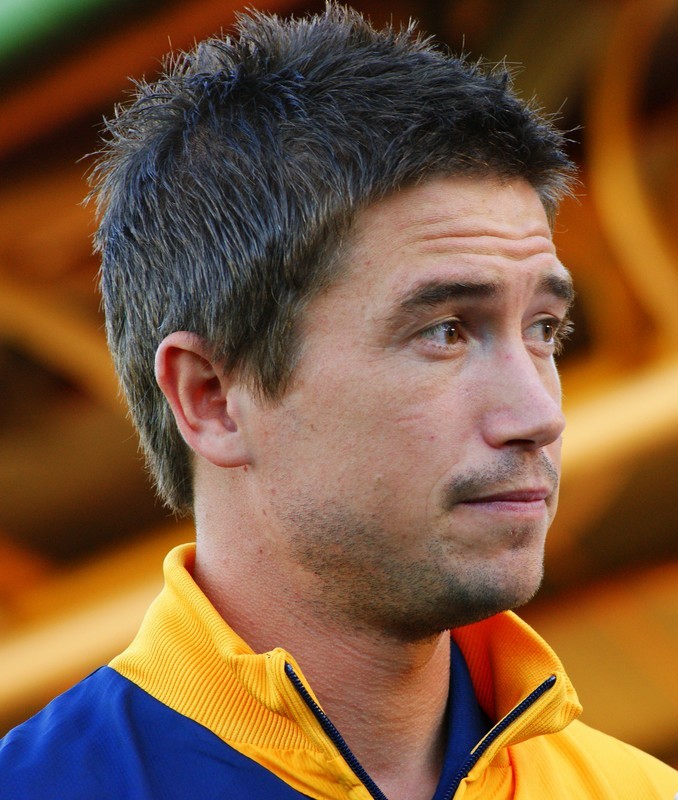
Harry Kewell (born 22 September 1978) is an Australian soccer manager and former professional player who is currently the head coach of V.League 1 club Hanoi FC. As a domestic player, Kewell represented Leeds United, Liverpool, Galatasaray, Melbourne Victory, Al-Gharafa, and Melbourne Heart. While at Leeds, he was named the PFA Young Player of the Year in 2000. Internationally, he received 58 caps and scored 17 goals while playing for Australia. A left winger also capable of playing as an attacking midfielder or second striker, he is often regarded by the media as "Australia's finest soccer export", despite his career being blighted by injury. In 2012, Kewell was named Australia's greatest soccer player in a vote by fans, players, and the media. Kewell scored a crucial goal against Croatia that took Australia through to the knockout stages of the 2006 FIFA World Cup, only the Australian national team's second World Cup appearance. He is a member of the Executive Committee of the Australian Professional Footballers' Association. Kewell also holds a British passport through his father's heritage. Former Middlesbrough midfielder-turned-pundit Robbie Mustoe named Kewell as one of the greatest players he had faced but questioned his consistency and attitude following his initial injuries. Former German international Michael Ballack has also highlighted both Kewell's ability and his inconsistency. Kewell represented Australia at the 1995 FIFA U-17 World Championship, the 1997 FIFA Confederations Cup (where Australia finished as runners-up), the 2004 OFC Nations Cup (which Australia claimed for the fourth time), the 2006 FIFA World Cup, the 2007 AFC Asian Cup, the 2010 FIFA World Cup, and the 2011 AFC Asian Cup (where Australia finished as runners-up). Kewell is the only Australian man to have played in a UEFA Champions League final, featuring in the Liverpool squad that won the 2005 UEFA Champions League final.
Harry Kewell was born on 22 September 1978 in Sydney, New South Wales, to an English father, Rod, and an Australian mother, Helen. Growing up, Kewell supported Liverpool in English football's First Division. He received his early education at Smithfield Public School and St. Johns Park High School before transferring to Westfield Sports High School. Before his teenage years, he played junior football for Smithfield Hotspurs (now Fairfield Hotspurs) before switching to Marconi Fairfield.
At age 14, Kewell travelled to Thailand, Italy, and England with the successful Marconi under-14 team that had recently won the state titles. The team played matches against the junior team of Milan as well as apprenticeship sides in England. This was Kewell's first time out of the country, providing his first taste of football in Europe; he also attended a Premier League match for the first time as a spectator. At age 15, Kewell was offered the opportunity to travel back to England and trial with Premiership club Leeds United for a period of four weeks as part of the Big Brother Movement in Australia. Kewell travelled to England with his future Socceroo teammate Brett Emerton. Both were successful during their trials at Leeds; however, only Kewell was able to take up the club's offer due to his father's English heritage, which satisfied the visa requirements.
Kewell played for three seasons in the Leeds United youth team. His first match for the youth squad was against Sunderland in 1995, and he scored his first hat-trick against Rotherham on 7 December 1996. Kewell made his first-team debut at age 17 in a 1–0 home defeat against Middlesbrough on 30 March 1996. In 1997, Kewell was part of the Leeds youth team that won the 1996–97 FA Youth Cup final in a 3–1 aggregate victory over Crystal Palace. His first senior goal for Leeds came in October 1997 during a 3–1 League Cup victory over Stoke City. Around that time, he was flatmates with Leeds goalkeeper Nicky Byrne, who later became a member of the boy band Westlife. Kewell was sent off in the 1999–2000 UEFA Cup semi-final between Leeds United and Galatasaray. Playing mostly in a left-midfield role and in attack, Kewell emerged as a star among a group of highly promising youngsters, eventually playing alongside fellow Australian Mark Viduka. Following his highly successful 1999–2000 season at Leeds, during which he won the PFA Young Player of the Year award and was selected for the PFA Team of the Year, Italian giants Internazionale bid £25 million for Kewell. Leeds rejected the offer, citing his value to the team. A high point of this period came when Kewell helped Leeds reach the semi-final of the 2000–01 UEFA Champions League. The club, however, began to suffer financial difficulties. By the 2002–03 season, Leeds had sold many of their best players, and Kewell's efforts in front of goal merely delayed the club's eventual relegation from the Premiership. His performances at Leeds gained him international recognition, and over eight years, he scored 45 goals in more than 180 appearances for the club. Kewell left Leeds under acrimonious circumstances. In an interview with the BBC shortly before his move to Liverpool, Kewell strongly criticised the club's staff, stating that the medical team had exacerbated his injuries and that his teammates had ostracised him.
Having rejected more financially enticing offers from Milan, Chelsea, Manchester United, Arsenal, and Barcelona, Kewell moved to the club he supported as a boy, Liverpool, for the start of the 2003–04 season. Kewell was handed the famous number seven shirt, surrendered by Vladimír Šmicer. Kewell's transfer was controversial; in July 2003, former England captain Gary Lineker alleged in an article that a significant portion (£2 million of the £5 million fee) went to Kewell's unregistered agent, Bernie Mandic, to ensure he ended up at Anfield. Kewell subsequently sued Lineker in 2005 for defamation of character, but with the jury unable to agree on a verdict, the parties settled out of court. Kewell made his debut for Liverpool in the opening game of the 2003–04 Premier League season, a 2–1 home loss to Chelsea on 17 August 2003. He scored his first goal for Liverpool in a 3–0 away win over great rivals Everton in the Merseyside derby with a powerful first-time strike. Kewell finished his first season at Anfield tied for second in scoring with Emile Heskey (seven goals), nine behind Michael Owen, Liverpool's top goalscorer for the 2003–04 Premier League season. Kewell also finished as Liverpool's top scorer in the 2003–04 UEFA Cup, netting against Olimpija Ljubljana, Steaua București, and Levski Sofia, bringing his season total to ten goals. Kewell's 2004–05 season started poorly; due to injury problems, he failed to score in his first 14 matches. He finally scored in round 15 of the Premier League during a 1–1 away draw against Aston Villa. It was his only Premier League goal of the season, marking one of his least productive campaigns. Despite his struggles, Kewell started and played in the 2005 League Cup final and the 2005 Champions League final. On 25 May 2005, Kewell became the first Australian to win the UEFA Champions League, playing in Liverpool's penalty shoot-out victory over Milan in the final. (Craig Johnston, who was born in South Africa but raised in Australia, had previously won the predecessor tournament, the European Cup). Kewell was controversially selected by manager Rafael Benítez ahead of defensive midfielder Dietmar Hamann, signalling the club's intent to attack from the outset. The gamble proved unsuccessful, and an injured Kewell was substituted early in the first half with a torn abductor muscle. Liverpool were losing 1–0 at the time, and Kewell was booed off the pitch by Liverpool fans, many of whom suggested he had faked the injury. It emerged during the summer of 2005 that Kewell had played throughout the season with an undiagnosed sports hernia, also known as Gilmore's groin. His record as the only Australian to win a major UEFA tournament stood until 18 May 2022, when Ajdin Hrustic became the second Australian to win a UEFA competition courtesy of Eintracht Frankfurt's victory over Rangers F.C. in the 2022 UEFA Europa League final. In November 2005, after recovering from the injury sustained during the final, Kewell spoke to the official Liverpool website, expressing a strong desire to repay his manager, Rafael Benítez, for showing confidence in him by fielding him in the Champions League final. He thanked his wife and friends for their support during his recovery. He also reiterated the severity of the injury that had forced him off in the final, stating that his doubters were misguided to question it. Kewell's form in the 2005–06 FA Premier League season demonstrated his true capability, as he contributed numerous goals and assists. This supported his assertion that his prior struggles resulted from poor health rather than apathy. He scored his first league goal at Anfield in over two years when Liverpool beat Tottenham Hotspur 1–0 in January. He was also the lone scorer in a 1–0 home victory over Manchester City and added the final goal in a 3–1 win against derby rivals Everton less than a month later. Kewell was among Liverpool's best performers in their 2–1 FA Cup semi-final victory over Chelsea. Kewell played in the 2006 FA Cup final, only to be substituted in the 48th minute due to abdominal pains (the supporters' reaction was much more sympathetic than it had been during the previous year's Champions League final). Liverpool later confirmed he had torn a groin muscle but expected him to be fit for the 2006 FIFA World Cup. On 30 April 2007, Kewell made his comeback after almost a year out of club football. He came on as a 55th-minute substitute for Liverpool Reserves in a "mini-derby" against Everton Reserves. On 5 May 2007, he came on as a substitute in the second half of Liverpool's match against Fulham at Craven Cottage, having not played for the first team since his substitution in the 2006 FA Cup final. On 13 May 2007, Kewell came on as a substitute in the second half against Charlton Athletic in the last match of the Premier League season, where he scored his final goal for the club. Speculation about his selection for Liverpool's upcoming Champions League final in Athens became largely positive following his excellent performance against Charlton. He provided a cross for Dirk Kuyt to assist a Xabi Alonso goal and scored a penalty in the 90th minute. He played in the Champions League final in Athens, appearing as a second-half substitute for Boudewijn Zenden; however, Liverpool lost the final 2–1 to Milan. Sidelined by yet another injury for the first month of the 2007–08 season, Kewell faced an uncertain future at Liverpool. He returned as a substitute in Liverpool's League Cup victory over Cardiff City on 31 October, coming on in the 71st minute. He then came on as a substitute in the Premier League and Champions League against Blackburn Rovers and Beşiktaş, respectively. Kewell delivered a strong performance in an impressive 4–0 away victory over Marseille, setting up goals for Fernando Torres and Dirk Kuyt to help secure qualification for the Champions League knockout phase. After his return, Liverpool manager Rafael Benítez stated on the club's website and to other media members that a new contract for Kewell to continue his career at Anfield was not out of the question. Many believed that if Kewell could stay injury-free until the season's end, he would be offered the chance to remain with the club. Kewell struggled to break into the team following Liverpool's FA Cup defeat to Barnsley. His chances of securing a new contract were further hindered when, in search of match fitness, he travelled to play for his national team against Singapore. He returned to England with a groin strain, leaving him less time to prove himself worthy of a new deal. His first goal of the 2007–08 season was for the Liverpool reserve team in their 2–0 win over rivals Manchester United. Because of his injuries, his future at Liverpool was uncertain. In May 2008, Liverpool revealed they would not offer Kewell a new contract.
On 5 July 2008, reigning Turkish Süper Lig champions Galatasaray signed Kewell to a two-year contract, presenting him with the number 19 shirt. Upon signing, Kewell said, "I wanted to move on and this is the best way. I can't wait to get started, it's just what I'm looking forward to, a new challenge." His transfer to Galatasaray provoked strong criticism from fans and teammates of his former club, Leeds United, as he had been a Leeds player when two of their fans were murdered in attacks before a UEFA Cup semi-final against Galatasaray in Istanbul in April 2000. Kewell responded in an open letter, stating, "I chose the No 19 shirt when I signed for Galatasaray SK as a sign of respect for Leeds because that was the number I got when I first became a regular member of the Leeds United starting XI. I felt that it might be a way to demonstrate that I had not forgotten where it all started and I was hoping that in a small way it would help the healing process of the tragedy that occurred on 5 April 2000. To blame the Galatasaray club for the tragedy in Istanbul is simply wrong and discriminatory." Kewell made his debut for Galatasaray in the Turkish Super Cup, where he came on as a 66th-minute substitute. Just 20 seconds later, he scored his first goal for Galatasaray with his first touch in a 2–1 win over Kayserispor, later providing the assist for the second goal. His second goal for the club came in the first league match of the season against Denizlispor, which Galatasaray won 4–1. On 23 October 2008, Kewell scored the only goal in Galatasaray's UEFA Cup win over Olympiacos. One week later, Kewell played in Galatasaray's first Turkish Cup match, a 1–1 draw with Ankaraspor. On 2 November 2008, Kewell scored his fourth league goal in Galatasaray's home win over Gaziantepspor, after a week of overwhelming speculation in the Turkish media regarding an injury. Following medical consultations in Australia, it was announced on 12 December 2008 that Kewell would need surgery to repair an inguinal hernia, and the operation took place on 15 December 2008. Of the nine matches that Kewell had scored in before his injury, Galatasaray had won them all, including two UEFA Cup matches, six Süper Lig matches, and a Turkish Super Cup match. In a UEFA Cup round of 32 match against Bordeaux, Kewell scored from 35 metres out, bringing the score to 2–1. Galatasaray won the match and advanced to the round of 16. On 12 March 2009, during the UEFA Cup round of 16 match against Hamburger SV, Kewell had to play as a centre-back for 40 minutes after the sending off of teammate Emre Aşık, but managed to fulfill the role adequately despite playing out of position. In the second leg of the round of 16 clash, he again played as a centre-back, scoring a penalty while doing so.



