Background and career
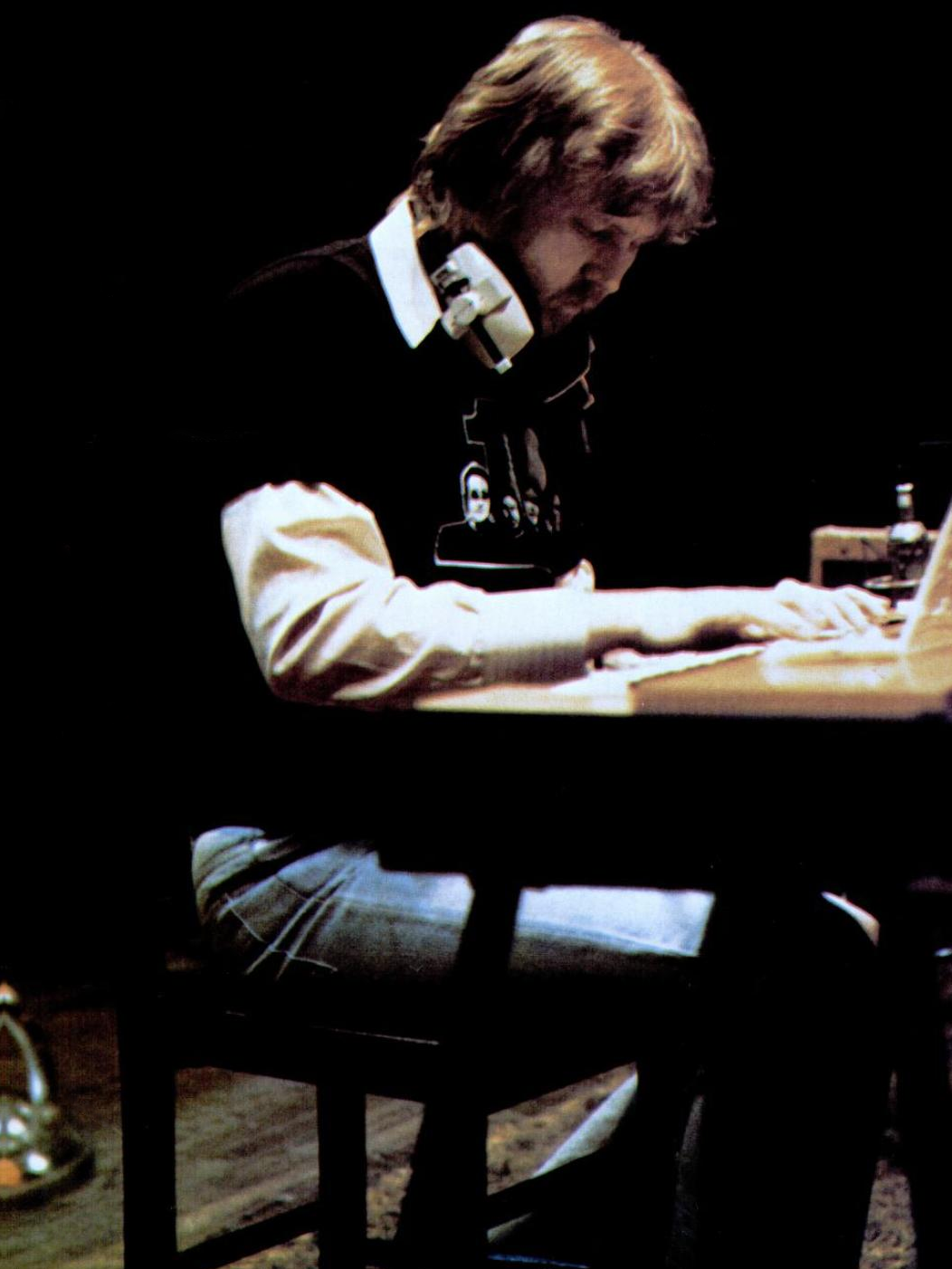
Harold Edward Nilsson III (June 15, 1941 – January 15, 1994), usually credited as Harry Nilsson, sometimes credited as Nilsson, was an American singer and songwriter known for his versatile tenor range, pioneering use of vocal overdubbing, explorations of the Great American Songbook, and Caribbean fusion sounds. He was one of the few major pop-rock artists to achieve significant commercial success without touring or performing large-scale public concerts. Born in Brooklyn, Nilsson moved to Los Angeles as a teenager to escape his family's poor financial situation and, starting in 1962, pursued songwriting while working as a computer programmer at a bank. He debuted on RCA Victor with the 1967 album Pandemonium Shadow Show, which began a creative partnership with arranger George Tipton that lasted until 1971. His albums over this period included Nilsson Sings Newman, a collaboration with Randy Newman, and The Point!, an original children's story. Between 1968 and 1974, nine of his singles reached the U.S. or UK top 40, including the top 10 hits "Everybody's Talkin'", "Without You", and "Coconut"; other artists enjoyed success with his songs "One" and "The Puppy Song". His albums Nilsson Schmilsson and Son of Schmilsson, produced under Richard Perry, were certified gold by the RIAA, indicating over 500,000 units sold each. In the early to mid-1970s, Nilsson was affected by periods of substance abuse and erratic behavior; his voice degraded markedly after A Little Touch of Schmilsson in the Night, which preceded the popular trend of standards albums by a decade. Sometimes called "the American Beatle", he formed close friendships with John Lennon, who produced his album Pussy Cats, and Ringo Starr, together sharing a core studio ensemble, record appearances, and membership in the Hollywood Vampires drinking club. His recording output diminished following his final RCA album, Knnillssonn and, after providing songs to the musical film Popeye, he increasingly referred to himself as "a retired musician". Responding to Lennon's 1980 murder, he focused on gun control activism and subsequently recorded sporadically. He died of heart failure in 1994 before he was able to finish his last album, Papa's Got a Brown New Robe. Nilsson received two Grammy Awards (for "Everybody's Talkin'" and "Without You") and was voted number 62 in Rolling Stone's 2015 list of the "100 Greatest Songwriters of All Time", where he was described as "a pioneer of the Los Angeles studio sound" and "a crucial bridge" between 1960s psychedelia and the 1970s singer-songwriter era. He is credited with creating the first remix album (Aerial Pandemonium Ballet) and mashup song ("You Can't Do That"), as well as influencing a movement of indie rock musicians through his songwriting and the defiant attitude he projected. His songs have featured prominently in many film and television soundtracks since the 1990s.
Nilsson was born on June 15, 1941, in the Bedford–Stuyvesant neighborhood of Brooklyn in New York City. His paternal great-grandfather, a Swede who later immigrated to, and became naturalized in, the United States, created an act known as an "aerial ballet" (which is the title of one of Nilsson's albums). His mother, Elizabeth (née Martin) Nilsson, was known as "Bette" to the family. She was born in 1920 in New York to Charles Augustus Martin and Florence Madeline (née Stotz) Martin. Bette had a brother, John, and a sister, Mary. Her parents were the cornerstones of her son's young life. While his maternal grandmother played piano, his maternal grandfather, Charlie Martin, supported the family in a tiny railroad apartment on Jefferson Avenue in Brooklyn. His father, Harry Edward Nilsson Jr., abandoned the family when Nilsson was three years old. An autobiographical reference to this is found in the opening to Nilsson's song "1941":
Nilsson's "Daddy's Song" also refers to this period in Nilsson's childhood. He grew up with his mother and a younger half-sister. His younger brother, Drake Nilsson, was left with friends during their moves between Southern California and New York, sometimes living with a succession of relatives and his stepfather. His uncle, a mechanic in San Bernardino, California, helped Nilsson improve his vocal and musical abilities. In addition to his brother and a half-sister through his mother, he also had three half-sisters and one half-brother through his father. Due to his family's poverty, Nilsson worked from an early age, including a job at the Paramount Theatre in Los Angeles. When the cinema closed in 1960, he applied for a job at a bank, falsely claiming on his application that he was a high school graduate (he had completed only through ninth grade). He had an aptitude for computers, which were starting to be used at banks at the time. He later performed so well in his role that the bank retained him even after they discovered he had lied about his education. He worked on bank computers at night and, in the daytime, pursued his songwriting and singing careers.
By 1958, Nilsson followed popular music, especially rhythm and blues artists like Ray Charles. He had performed while he was working at the Paramount, forming a vocal duo with his friend Jerry Smith and singing close harmonies in the style of the Everly Brothers. The manager of a hangout Nilsson frequented gave him a plastic ukulele, which he learned to play, and he later learned to play the guitar and piano. In the 2006 documentary Who Is Harry Nilsson (And Why Is Everybody Talkin' About Him)?, Nilsson recalled that when he could not remember lyrics or parts of the melodies to popular songs, he created his own, which led to writing original songs. His uncle's singing lessons, along with Nilsson's natural talent, helped him when he got a job singing demos for songwriter Scott Turner in 1962. Turner paid Nilsson five dollars for each track they recorded. (When Nilsson became famous, Turner decided to release these early recordings, and contacted Nilsson to work out a fair payment. Nilsson replied that he had already been paid – five dollars a track.) In 1963, Nilsson had some early success as a songwriter, working with John Marascalco on a song for Little Richard. Upon hearing Nilsson sing, Little Richard reportedly remarked: "My! You sing good for a white boy!" Marascalco also financed some independent singles by Nilsson. One, "Baa Baa Blacksheep", was released under the pseudonym "Bo Pete" to some small local airplay. Another recording, "Donna, I Understand", convinced Mercury Records to offer Nilsson a contract, and release recordings by him under the name "Johnny Niles". By 1964, Nilsson worked with Phil Spector, writing three songs with him. He also established a relationship with songwriter and publisher Perry Botkin Jr., who began to find a market for Nilsson's songs. Botkin also gave Nilsson a key to his office, providing another place to write after hours. Through his association with Botkin, Nilsson met and became friends with musician, composer and arranger George Tipton, who at the time was working for Botkin as a music copyist. In 1964, Tipton invested his life savings – $2,500 – to finance the recording of four Nilsson songs, which he also arranged. They were able to sell the completed recordings to the Tower label, a recently established subsidiary of Capitol Records, and the tracks were subsequently included on Nilsson's debut album. The fruitful association between Nilsson and Tipton continued after Nilsson signed with RCA Victor. Tipton went on to create the arrangements for nearly all of Nilsson's RCA recordings between 1967 and 1971, but their association ended in the 1970s when the two fell out for unknown reasons. Nilsson's recording contract was picked up by Tower Records, which in 1966 released the first singles actually credited to him by name, as well as the debut album Spotlight on Nilsson. None of Nilsson's Tower releases charted or gained much critical attention, although his songs were being recorded by Glen Campbell, Fred Astaire, The Shangri-Las, The Yardbirds, and others. Despite his growing success, Nilsson remained on the night shift at the bank.
Nilsson signed with RCA Victor in 1966 and released an album the following year, Pandemonium Shadow Show, which was a critical success. Music industry insiders were impressed both with the songwriting and with Nilsson's pure-toned, multi-octave vocals. One such insider was Beatles press officer Derek Taylor, who bought an entire box of copies of the album to share this new sound with others. With a major-label release, and continued songwriting success (most notably with the Monkees, who recorded Nilsson's "Cuddly Toy" after meeting him through their producer Chip Douglas), Nilsson finally felt secure enough in the music business to quit his job with the bank. Monkees member Micky Dolenz maintained a close friendship until Nilsson's death in 1994. Some of the albums from Derek Taylor's box eventually ended up with the Beatles themselves, who quickly became Nilsson fans. This may have been helped by the track "You Can't Do That", in which Nilsson covered the John Lennon penned tune – and also worked references to 17 other Beatles tunes in the mix, usually by quoting snippets of Beatles lyrics in the multi-layered backing vocals. When John Lennon and Paul McCartney held a press conference in 1968 to announce the formation of the Apple Corps, Lennon was asked to name his favorite American artist. He replied, "Nilsson". McCartney was then asked to name his favorite American group. He replied, "Nilsson". "You Can't Do That" was Nilsson's first hit as a performer; though it stalled at No. 122 on the US charts, it hit the top 10 in Canada. When RCA had asked if there was anything special he wanted as a signing premium, Nilsson asked for his own office at RCA, being used to working out of one. In the weeks after the Beatles' Apple press conference, Nilsson's office phone began ringing constantly, with offers and requests for interviews and inquiries about his performing schedule. Nilsson usually answered the calls himself, surprising the callers, and answered questions candidly. (He recalled years later the flow of a typical conversation: "When did you play last?" "I didn't." "Where have you played before?" "I haven't." "When will you be playing next?" "I don't.") Nilsson acquired a manager, who steered him into a handful of TV guest appearances, and a brief run of stage performances in Europe set up by RCA. He disliked the experiences he had, though, and decided to stick to the recording studio. He later admitted this was a huge mistake on his part. John Lennon called and praised Pandemonium Shadow Show, which he had listened to in a 36-hour marathon. Paul McCartney called the following day, also expressing his admiration. Eventually a message came, inviting him to London to meet the Beatles, watch them at work, and possibly sign with Apple. Pandemonium Shadow Show was followed in 1968 by Aerial Ballet, an album that included Nilsson's rendition of Fred Neil's song "Everybody's Talkin'". A minor US hit at the time of release (and a top 40 hit in Canada), the song became more popular a year later when it was featured in the film Midnight Cowboy, and it earned Nilsson his first Grammy Award. The song also became Nilsson's first US top 10 hit, reaching No. 6, and his first Canadian #1. Aerial Ballet also contained Nilsson's version of his composition "One", which was later taken to the top 5 of the US charts by Three Dog Night and also successfully covered in Australia by John Farnham. The album Aerial Ballet also inspired the band Aerosmith's name. In an interview, Aerosmith drummer Joey Kramer explained that Harry Nilsson's Aerial Ballet album helped spark the name. Kramer recalled, "I was listening to an album at the time, by Harry Nilsson, called Aerial Ballet. We were listening to this record and I started really getting off on the lyrics. We started kicking around this word 'aerial,' and 'aerial' eventually came into 'aero' – I don't know how that happened." He continued, "And it was like Aeromind, Aerostar, Aero-this, Aero-that; and somebody said 'smith' – Aerosmith? Wow!" Nilsson was commissioned at this time to write and perform the theme song for the ABC television series The Courtship of Eddie's Father. The result, "Best Friend", was very popular, but Nilsson never released the song on record; the original version of the song (titled "Girlfriend") was recorded during the making of Aerial Ballet but not included on that LP, and it eventually appeared on the 1995 Personal Best anthology, and as a bonus track on a later release of Aerial Ballet. Late in 1968, the Monkees' notorious experimental film Head premiered, featuring a memorable song-and-dance sequence with Davy Jones and Toni Basil performing Nilsson's composition "Daddy's Song". (This is followed by Frank Zappa's cameo as "The Critic", who dismisses the 1920s-style tune as "pretty white".) With the success of Nilsson's RCA recordings, Tower re-issued or re-packaged many of their early Nilsson recordings in various formats. All of these reissues failed to chart, including a 1969 single "Good Times". This track, however, was resurrected as a duet with Micky Dolenz for the 2016 Monkees' album of the same name by adding additional parts to an unused Monkees backing track recorded in 1968.
Nilsson's next album, Harry (1969), was his first to hit the charts, and also provided a Top 40 single with "I Guess the Lord Must Be in New York City" (written as a contender for the theme to Midnight Cowboy), used in the Sophia Loren movie La Mortadella (1971) (US title: Lady Liberty). While the album still presented Nilsson as primarily a songwriter, his astute choice of cover material included, this time, a song by then-little-known composer Randy Newman, "Simon Smith and the Amazing Dancing Bear". Nilsson was so impressed with Newman's talent that he devoted his entire next album to Newman compositions, with Newman himself playing piano behind Nilsson's multi-tracked vocals. The result, Nilsson Sings Newman (1970), was commercially disappointing but was named Record of the Year by Stereo Review magazine and provided momentum to Newman's career. The self-produced Nilsson Sings Newman also marked the end of his collaboration with RCA staff producer Rick Jarrard, who recounted in the documentary Who is Harry Nilsson? that the partnership was terminated by a telegram from Nilsson, who abruptly informed Jarrard that he wanted to work with other producers, and the two never met or spoke again. Jarrard states in the documentary that he never found out why Nilsson had decided to terminate their professional relationship. Nilsson's next project was an animated film, The Point!, created with animation director Fred Wolf, and broadcast on ABC television on February 2, 1971, as an "ABC Movie of the Week". Nilsson's self-produced album of songs from The Point! was well received and it spawned a top 40 single, "Me and My Arrow". Later that year, Nilsson went to England with producer Richard Perry to record what became the most successful album of his career, Nilsson Schmilsson, which yielded three stylistically different hit singles. The first was a cover of Badfinger's song "Without You" (by British songwriters Pete Ham and Tom Evans), featuring a highly emotional arrangement and soaring vocals to match – recorded, according to Perry, in a single take. It was alleged, by Harry himself, that, upon hitting the highest note of the song, he burst a large haemorrhoid. The performance earned him his second Grammy Award. The second single was "Coconut", a novelty calypso number featuring four characters (the narrator, the brother, the sister, and the doctor) all sung (at Perry's suggestion) in different voices by Nilsson. The song is best remembered for its chorus lyric ("Put de lime in de coconut, and drink 'em both up"). Also notable is that the entire song is played using one chord, C7. The third single, "Jump into the Fire", was raucous rock and roll, including a drum solo by Derek and the Dominos' Jim Gordon and a detuned bass part by Herbie Flowers. Nilsson followed quickly with Son of Schmilsson (1972), released while its predecessor was still on the charts. Besides the problem of competing with himself, Nilsson was by then ignoring most of Perry's production advice, and his decision to give free rein to his bawdiness and bluntness on this release alienated some of his earlier, more conservative fan base. With lyrics like "I sang my balls off for you, baby", "Roll the world over / And give her a kiss and a feel", and the notorious "You're breakin' my heart / You're tearin' it apart / So fuck you" (a reference to his ongoing divorce), Nilsson had traveled far afield from his earlier work. The album nevertheless reached No. 12 on the Billboard 200, and the single "Spaceman" was a Top 40 hit in October 1972. The follow-up single "Remember (Christmas)", however, stalled at No. 53. A third single, the tongue-in-cheek C&W send up "Joy", was issued on RCA's country imprint Green and credited to Buck Earle, but it failed to chart. Nilsson was known as a "singer-composer who is heard but not seen", as he did not perform in concerts or shows. Prior to agreeing to be featured on an episode of director and producer's Stanley Dorfman's In Concert series for the BBC, Nilsson had appeared only once, for a few moments, on television in Britain and once in America. Nilsson's record producer, Richard Perry, referenced his lack of live performing in the book 'The Record Producers' by BBC Books, saying "He did do the In Concert series on BBC television with Stanley Dorfman, which was very popular at the time. His show was very interesting and innovative with a lot of new technology, multiple images and things like that, but I think any artist, with very few exceptions and none that I can really think of, can immeasurably enhance his career by appearing in front of the public. At some point, the public needs to reach out and touch the artist, experience and feel them in person."