Background and career
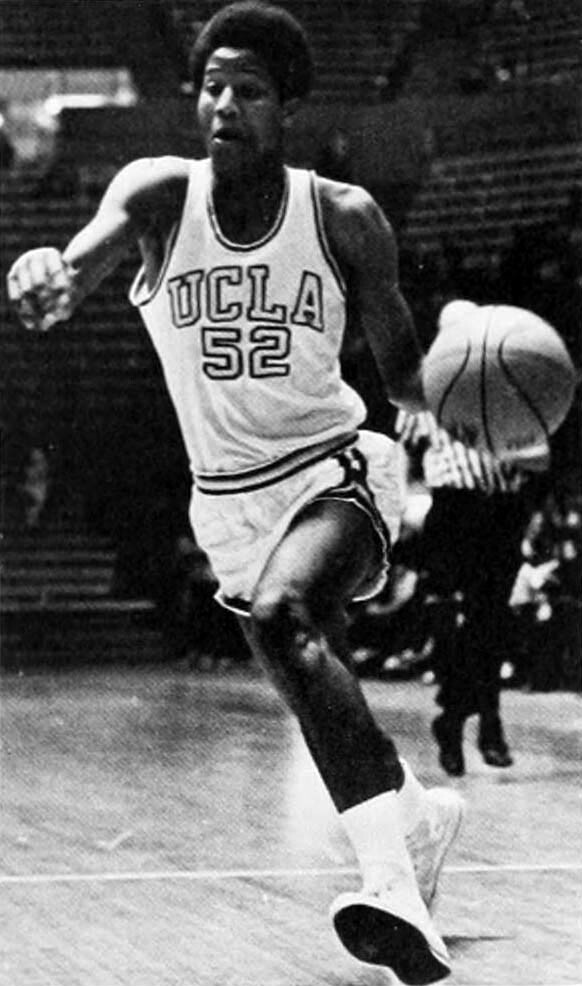
Jamaal Abdul-Lateef (born Jackson Keith Wilkes, May 2, 1953), better known as Jamaal Wilkes, is an American former basketball player who was a small forward in the National Basketball Association (NBA). A three-time NBA All-Star, he won four NBA championships with the Golden State Warriors and Los Angeles Lakers. Nicknamed "Silk", he was inducted into the Naismith Memorial Basketball Hall of Fame. Wilkes played college basketball for the UCLA Bruins. He was a two-time consensus first-team All-American and won two NCAA championships under coach John Wooden. He was selected in the first round of the 1974 NBA draft by Golden State. In his first season with the Warriors, he was named the NBA Rookie of the Year and helped the team win a league title. Wilkes won three more NBA championships with the Lakers during their Showtime era. He briefly played with the Los Angeles Clippers before retiring from playing. His jersey No. 52 was retired by both the Bruins and the Lakers. Wilkes played the titular role of Cornbread in the 1975 coming-of-age feature film Cornbread, Earl and Me.
Jackson Keith Wilkes was born in Berkeley, California. He was one of five children of L. Leander Wilkes, a Baptist minister, and Thelma (Benson) Wilkes. At the time, his parents had two daughters. Their oldest son died of crib death at 13 months when Thelma was four months pregnant with Wilkes. The death led Leander, who worked at the Oakland Naval Base, to enter the ministry. Because he did not like the nickname Jackie, Wilkes went by Keith. His family had brief stays in Pine Bluff, Arkansas, and Dayton, Ohio, before he grew up in Ventura, California, having moved there in the second grade when his father became the pastor at Olivet Baptist Church in 1959. Wilkes attended Washington Elementary School and Cabrillo Middle School. He skipped the fifth grade. His older sister Naomi skipped two grades. A tomboy, she played basketball and helped Wilkes learn the game. She went to Stanford University at age 16. As a junior at Ventura High School in 1969, Wilkes earned his second all-league selection in the Channel League and was named the league's player of the year. Over the summer, his father became pastor of the Second Baptist Church in Santa Barbara, and the family moved there prior to his senior year. Wilkes was Ventura High's incoming student body president, and his parents allowed him to stay in Ventura. However, he decided right before the school year began that he did not want to be apart from his family. His decision to move was controversial, but his Ventura coach, Bob Swanson, supported him. "If he was my kid I would have done the same thing", said Swanson. "He was a 16-year-old kid. He belonged with his family." Starring for Santa Barbara High School with fellow future NBA player Don Ford, Wilkes led the Dons to 26 consecutive wins, and reached the playoff semifinals during the 1969–70 season. Wilkes was voted the California Interscholastic Federation Class AAAA Player of the Year by the Helms Foundation. He was named a prep All-American by Parade, Scholastic Magazines, and Sunkist–Coach and Athlete.
In his first year at the University of California, Los Angeles, Wilkes averaged a team-high 20.0 points per game on their freshman team, who went 20–0 and outscored their opponents by almost 39 points per game. The squad included Greg Lee (17.9) and Bill Walton (18.1, 16 rebounds, 68.6 field goal percentage). A group of UCLA students typically watched the freshman practice at Pauley Pavilion. One day, one of the regulars, UCLA band member Oliver Trigg, was impressed by a move that Wilkes made. At dinner, he came up to the team, which was eating dinner together at the dormitory dining hall, and gushed that Wilkes' move was "smooth as silk". The players started teasing Wilkes and calling him "Silk".
In Wilkes' sophomore year in 1971–72, Bruins' broadcaster Dick Enberg heard a couple of teammates calling him "Silk", and began using it on the air. The UCLA varsity team entered the season with a streak of five consecutive national championships, having finished the previous season winning their last 15 games. Departed from that team were Sidney Wicks, Curtis Rowe, and Steve Patterson, who won three straight NCAA titles together. Wilkes and fellow sophomores Walton and Lee entered the starting lineup, joining the only returning starter, Henry Bibby, and Larry Farmer. The Bruins scored over 100 points in their first seven games, en route to a perfect 30–0 season, winning by an average of 30.3 points per game. Wilkes averaged 8.2 rebounds per game, his college career high, and was a second-team All-Pacific-8 selection. In a close title game, UCLA won 81–76 over Florida State. Only one team had finished as close as six points against the Bruins. The Seminoles' Reggie Royals was assigned to defend Wilkes but was asked to drop back to help guard Walton. Wilkes had a season-high 23 points on 11-of-16 shooting and added 10 rebounds, while Walton earned the first of his two Final Four Most Outstanding Players with 24 points and 20 rebounds. They were both named to the all-tournament team. Wilkes averaged 14.8 points and was named a consensus first-team All-American in 1972–73, when UCLA again finished 30–0. On January 27, 1973, they defeated Notre Dame for their 61st consecutive win, breaking San Francisco's record. The Bruins won the championship final over Memphis State behind Walton's 44 points on 21-for-22 shooting. The only other teammate scoring in double figures, Wilkes had 16 points along with seven rebounds. UCLA entered the 1973–74 season with a winning streak of 75. They extended their record to 88 before losing 71–70 to Notre Dame, with the Bruins missing five shots in the closing 20 seconds. UCLA advanced to the 1974 NCAA tournament semifinals, when they lost 80–77 in overtime to NC State. Wilkes ended his senior year with a career-high 16.7 points per game, and was a unanimous selection for the All-America first team. He was also unanimously voted to the All-Pac-8 first team for the second straight year. In three years, Wilkes' teams compiled an 86–4 record, with all four losses from his senior year. He was one of the Bruins' most consistent players, averaging 15.0 points and 7.4 rebounds per game with a field goal percentage of 51.4. A three-time first-team Academic All-American (1972–1974), Wilkes graduated from UCLA in 1974 with a BA in economics.
Wilkes was selected by the Golden State Warriors in the first round of the 1974 NBA draft with the 11th overall pick. Afterwards, he was filming a movie, "Cornbread, Earl and Me", and neglected training. He arrived at rookie camp out of shape and was disappointed in himself that he was unprepared. Before long, he was at the gym and martial arts classes to improve his conditioning. Prior to his first season in 1974–75, few people had championship expectations for the Warriors. Wilkes became a starter after only eight games, replacing incumbent Derrek Dickey. Paired with Rick Barry at small forward, the slim, 6-foot-6-inch (1.98 m) Wilkes played power forward. He averaged 14.2 points per game, ranked second on the Warriors behind Barry (30.6), and was also second on the team in rebounding with 8.2 per game. He was named the NBA Rookie of the Year. "[Wilkes] knows he must play the boards, and goes up against the [Paul] Silases and [Spencer] Haywoods each night. He's not flashy. But he gets the job done", said Barry. Teammate Bill Bridges added that Wilkes "is so intelligent and fundamentally sound. He makes contributions even when he's not scoring. He's already a complete player". In the playoffs, Wilkes averaged 15.0 points and was praised for his defense against Chicago's Bob Love and Elvin Hayes of Washington, who Golden State swept in the 1975 NBA Finals. The following season in 1975–76, he was named to his first NBA All-Star Game. He ranked second on the Warriors in rebounding (8.8) again, and he was voted for the first of two consecutive NBA All-Defensive Second Team selections. Wilkes' scoring average improved to 17.8 in the regular season and 15.9 in the postseason, as Golden State advanced to the Western Conference finals, which they lost in seven games. After three years with Golden State, averaging 16.5 points and 8.2 rebounds per game, Wilkes signed with the Los Angeles Lakers as a free agent. According to Wilkes, then-Warriors general manager Dick Vertlieb had reneged on his promise to renegotiate their contract if Wilkes had a good rookie showing; Vertlieb denied making such an agreement. Wilkes reportedly took less money by signing with the Lakers. He said "money isn't everything" and that he "needed a change of scenery, a fresh start". Returning to Southern California, where he grew up and went to college, weighed heavily in his decision. He was upset that some Bay Area sportswriters portrayed him as a deserter for playing out his option and signing with their in-state Pacific Division rival.
The Lakers were coming off a league-high 53-win season, but had been eliminated 4–0 in the Western Conference finals by the eventual NBA champion Portland Trail Blazers. Wilkes was the top-rate forward that Lakers head coach Jerry West coveted. Wilkes' career with the Lakers began solidly in 1977–78, but a broken finger and other injuries limited him, and he was out much of the second half of the season, finishing with 51 games played and averaging 12.9 points. An anonymous team official accused him of malingering, and Lakers fans thought he was overrated. He bounced back the following season with his best pro season to date, averaging 18.6 points per game and shooting 50.4%. For a five-season span from 1978 through 1983, he was the Lakers' second-leading scorer behind Kareem Abdul-Jabbar. Wilkes was a free agent leading up to the 1979–80 season, and new Lakers owner Jerry Buss made it a priority to re-sign him. Los Angeles traded 6-foot-4-inch (1.93 m) Adrian Dantley to Utah for 6-foot-9-inch (2.06 m) Spencer Haywood, the Lakers' first bona-fide power forward since Wilkes joined the team, freeing him to move to small forward and relieved from guarding players as much as five inches (13 cm) and 50 pounds (23 kg) bigger. Wilkes had been playing power forward his entire NBA career. He re-signed to a reported long-term deal at $600,000 per year. The Lakers also added Magic Johnson that year, drafting him with the first overall pick. Head coach Jack McKinney was injured midseason in a bicycle accident and was replaced by assistant Paul Westhead. Released from the rigors of playing power forward, Wilkes blossomed with the Lakers' fast break, averaging 20 points per game and shooting 53.5% that season. He helped the Showtime Lakers win three NBA championships (1980, 1982, 1985). One of the most memorable games of his career was the series-clinching Game 6 of the 1980 NBA Finals against the Philadelphia 76ers; Wilkes had a career-high 37 points and 10 rebounds, but was overshadowed by the rookie Johnson, who started at center in place of an injured Abdul-Jabbar and finished with 42 points, 15 rebounds, and seven assists. "Jamaal Wilkes had an unbelievable game", said Johnson in 2011. "Everybody talked about my 42 [points], but it was also his [37-point effort]." Wilkes had his best offensive season in 1980–81, when he averaged 22.6 points, which ranked 11th in the NBA, shot 52.6% and played in the 1981 NBA All-Star Game. However, the Lakers were eliminated in the first round of the playoffs by Houston in a best-of-three series. Soon before the start of training camp in 1981–82, Wilkes' eight-day-old daughter died, his second child to die as a baby. He started the season slowly, culminating with a 1-for-10 shooting performance in a 128–102 loss to San Antonio on November 10, 1982. He seriously considered quitting basketball. On November 18, Johnson demanded to be traded, but Buss instead fired Westhead, who was replaced by assistant Pat Riley. Wilkes recovered to average 21.1 points and shoot 52.5% as Los Angeles advanced to the 1982 NBA Finals, where they faced Philadelphia again. He scored a team-high 27 points in game 6 as the Lakers won the series 4–2. In 1982, Wilkes signed a long-term contract extension with the Lakers. They selected James Worthy with the first overall pick of the 1982 NBA draft, which they acquired from a trade made three years before. Although Wilkes was still in his prime, the Lakers valued Worthy's potential to play either forward position and backup Kurt Rambis at power forward. Wilkes received his third All-Star selection in 1983. In 1983–84, Wilkes missed seven regular season games and the first seven games of the playoffs due to a gastrointestinal virus. After initially missing three games in late February 1984, he returned to play for a month before being sidelined for another four games. In the five previous seasons since 1978–79, he had missed just three games out of 410 and twice led the team in minutes played. Wilkes finished the regular season averaging 17.3 points, and led the team in scoring 18 times, but none after February 28, as the infection began taking its toll. With persistent headaches, stomach cramps and cold chills, he thought he had the flu at first. Antibiotics from team doctors failed to make him better, prompting him to visit his own physician, who linked his condition to a parasite. Upon returning in the playoffs on May 8 against Dallas, Wilkes received a standing ovation from the Forum crowd. Out of shape after the layoff, he saw limited play and averaged only 4.5 points in 14 games while shooting just 40%. He had entered the postseason with a streak of 58 consecutive games scoring 10+ points in the playoffs. Meanwhile, Worthy shined at small forward and was a key for the Lakers while starting in the finals against the Boston Celtics. After hearing his name in trade rumors during the offseason, Wilkes began the 1984–85 season starting at forward along with Worthy. After the Lakers began the season with a 3–5 record, Wilkes lost his starting spot to Larry Spriggs. His play eventually improved, peaking with a season-high 24 points in a win over Portland on January 29, 1985. Three days later against New York at the Forum on February 1, ligaments in his left knee were torn when the Knicks' Ernie Grunfeld ran into him, and Wilkes missed the final 40 games of the regular season and the entire playoffs. He finished with then-career-lows of 42 games played and 8.3 points per game, but the Lakers won the 1985 NBA Finals over the Celtics with Worthy as one of their leaders. Wilkes' leg atrophied, and he had to learn to walk again. After he played in the Southern California Summer Pro League and rehabilitated his knee, the Lakers waived him on August 28, 1985, with three years and $2.4 million remaining on his guaranteed contract. The team attributed the move to the NBA salary cap, freeing him to negotiate with any team without his Lakers' salary affecting that team. Wilkes also became expendable after they drafted A. C. Green.
Sources
Net-worth figure: Celebrity Net Worth (October 2026), in USD. Biography and career facts: the person's Wikipedia article and linked reporting. Snapshot date for all StarWorth figures: 28 October 2026.


