Background and career
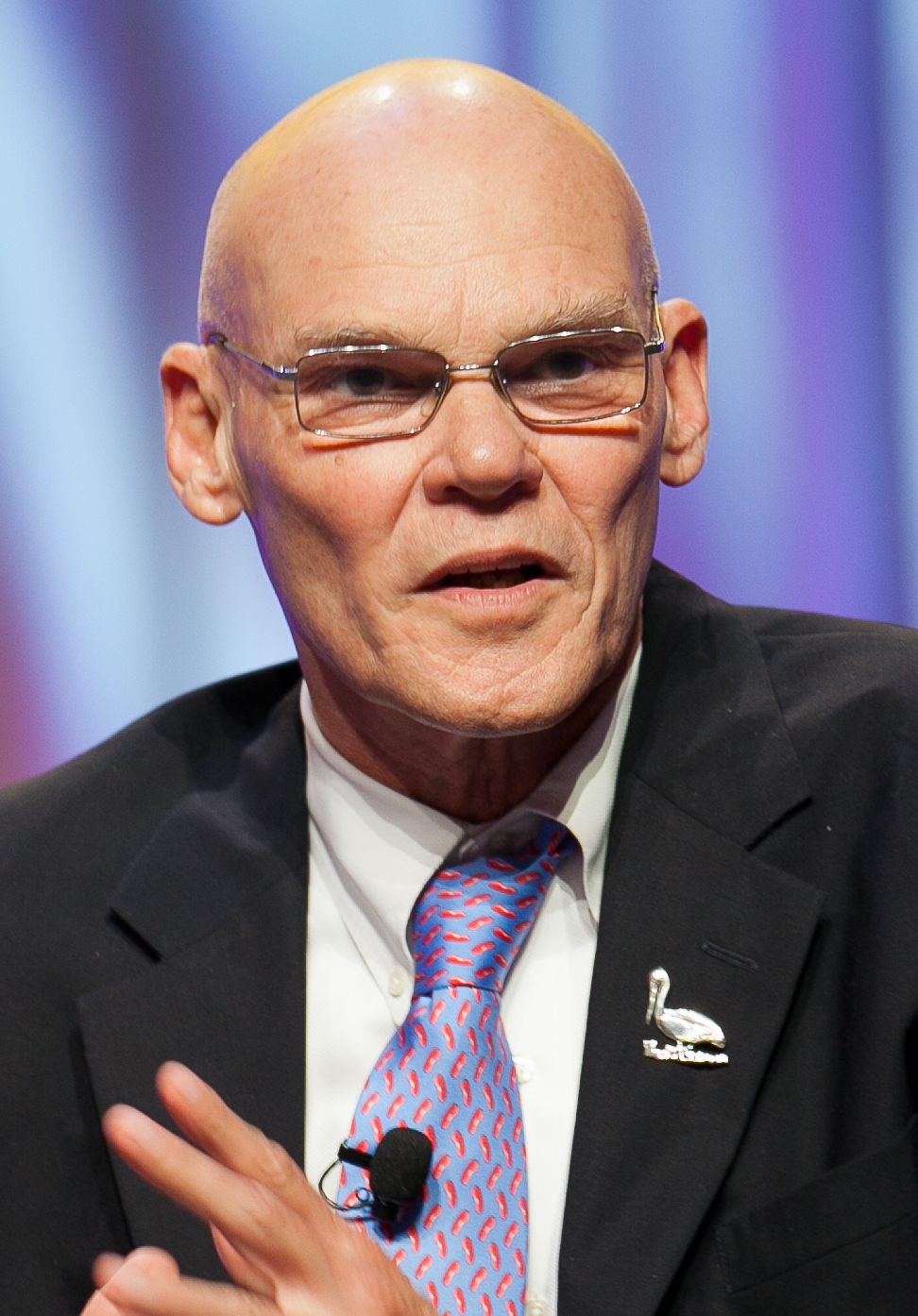
Chester James Carville Jr. (born October 25, 1944) is an American political consultant, author, and television pundit who has strategized for Democratic candidates for public office in the United States and for international politicians in at least 23 countries abroad. A prominent media figure, he has frequently appeared on cable news programs and talk shows as a commentator on U.S. politics. Nicknamed the "Ragin' Cajun", Carville led successful state campaigns before gaining national attention as a lead strategist in Bill Clinton's winning 1992 presidential campaign. He also played a principal role crafting in the campaigns of several Democratic presidential candidates, including Massachusetts Senator John Kerry in 2004, New York Senator Hillary Clinton in 2008, and Colorado Senator Michael Bennet in 2020. He is married to longtime Republican political consultant Mary Matalin.
Carville was born on October 25, 1944, in Fort Benning, Georgia, to Angele Lucille (née Normand), a World Book Encyclopedia salesperson, and Chester James Carville, a soldier and later store owner. His maternal family is of French Cajun descent, and his paternal great-grandfather was an Irish-born immigrant who served in the Union Army during the American Civil War. Carville grew up with seven siblings in St. Gabriel, Louisiana; the family lived in the neighborhood of Carville, named after his paternal grandfather Louis Arthur Carville, who was once the area's postmaster. He graduated from Ascension Catholic High School in Donaldsonville, Louisiana, in 1962, where among his earliest political campaign work was ripping down the campaign signs of a candidate for public office during high school. He attended Louisiana State University (LSU) from 1962 to 1966, but did not graduate at the time, characterizing himself as "something less than an attentive scholar" who "had 56 hours' worth of Fs". Carville enlisted in the United States Marine Corps in 1966 and was stationed at Camp Pendleton, California. He completed his service in 1968 with the rank of corporal. Carville resumed nighttime studies at Louisiana State University, where he earned a Bachelor of Science in general studies in 1970 and a Juris Doctor in 1973, and was a member of the Sigma Nu fraternity. From 1973 to 1979, he worked as an attorney at McKernnan, Beychok, Screen and Pierson, a Baton Rouge law firm.
As a college student, Carville distributed "hate sheets" about a political opponent at grocery stores on behalf of Ossie Bluege Brown, who ran for district attorney of East Baton Rouge Parish in 1972. By the late 1970s, he was working for Gus Weill and Raymond Strother at Weill-Strother, a political consulting firm that had assisted campaigns for Louisiana governors Jimmie Davis, John McKeithen, Edwin Edwards, as well as U.S. Representative Otto Passman. In the early 1980s, Carville served as executive assistant to East Baton Rouge Parish mayor-president Pat Screen. He later helped Cathy Long win a special election in Louisiana's now-defunct 8th congressional district.
In 1983, Carville was recruited to run Texas state legislator Lloyd Doggett's campaign for an open Senate seat. He helped Doggett, a liberal, secure the Democratic nomination in a primary that included conservative U.S. Representative Kent Hance, and centrist former congressman Bob Krueger. During the primary, Carville notably used a rubber vertebrae exhibit and coached Doggett to use it as a prop to jokingly portray Krueger as a "flip-flopper" who lacked resolve and "backbone". During the general election against Phil Gramm, a Republican, Doggett received a small-dollar contribution from a gay rights group, which he later returned after attacks from Gramm, who emphasized "family values" and "having people who believe in Christianity in charge of government", statements Carville criticized. On November 6, 1984, Doggett was defeated in the general election, polling 2,207,557 votes (41.5%), to Gramm's 3,116,348 votes (58.5%). Finding himself out of work after the defeat, Carville recalled, "I was scared to death, I was 40 years old, and didn't have any health insurance, I didn't have any money, I was mortified".
In 1986, Carville helped Bob Casey Sr. win election as the 42nd Governor of Pennsylvania. Casey defeated Philadelphia District Attorney Ed Rendell in the Democratic primary in March, 56.5% to 39.6%. In the general election, Republican Lieutenant Governor Bill Scranton initially led after pledging to halt attack ads, though his campaign later drew criticism for a mailer sent to 600,000 potential voters that did the opposite. Carville responded by staging a media stunt, dumping 600,000 blank envelopes near Scranton's campaign headquarters and asking journalists, "How could you send out this many envelopes and not know about it?" The race was virtually tied until five days before the election, when Carville launched a television commercial, titled "The Guru", portraying Scranton as a regular drug user during the 1960s and mocking his ties to transcendental meditation. The ad, which depicted Scranton as a meditating, long-haired, cannabis-smoking hippie against a backdrop of sitar music, was credited with tipping the scales in socially conservative rural areas of Pennsylvania where Carville chose to air it. Casey went on to win by a narrow margin of 79,216 votes out of 3.3 million cast, 50.7% to Scranton's 48.4%.
Carville managed Kentucky businessman Wallace Wilkinson's 1987 gubernatorial campaign, presenting him as a self-made, anti-establishment candidate. Wilkinson won the Democratic primary by accusing his opponents of wanting to raise taxes and campaigning on creating a state lottery to generate public revenue. Wilkinson, who had made his wealth in retail and real estate management, faced lawsuits over unpaid overtime and declined to release his tax returns. Carville later appeared on WLEX-TV and urged reporters to examine opponent John Harper's family, stating that "there might be problems with some of Harper's children." Harper subsequently acknowledged that his son had been shot and killed by police in Ohio in 1978 during a pharmacy robbery. Wilkinson won the general election with 504,674 votes (64.5%) to Harper's 273,141 (34.91%).


