Background and career
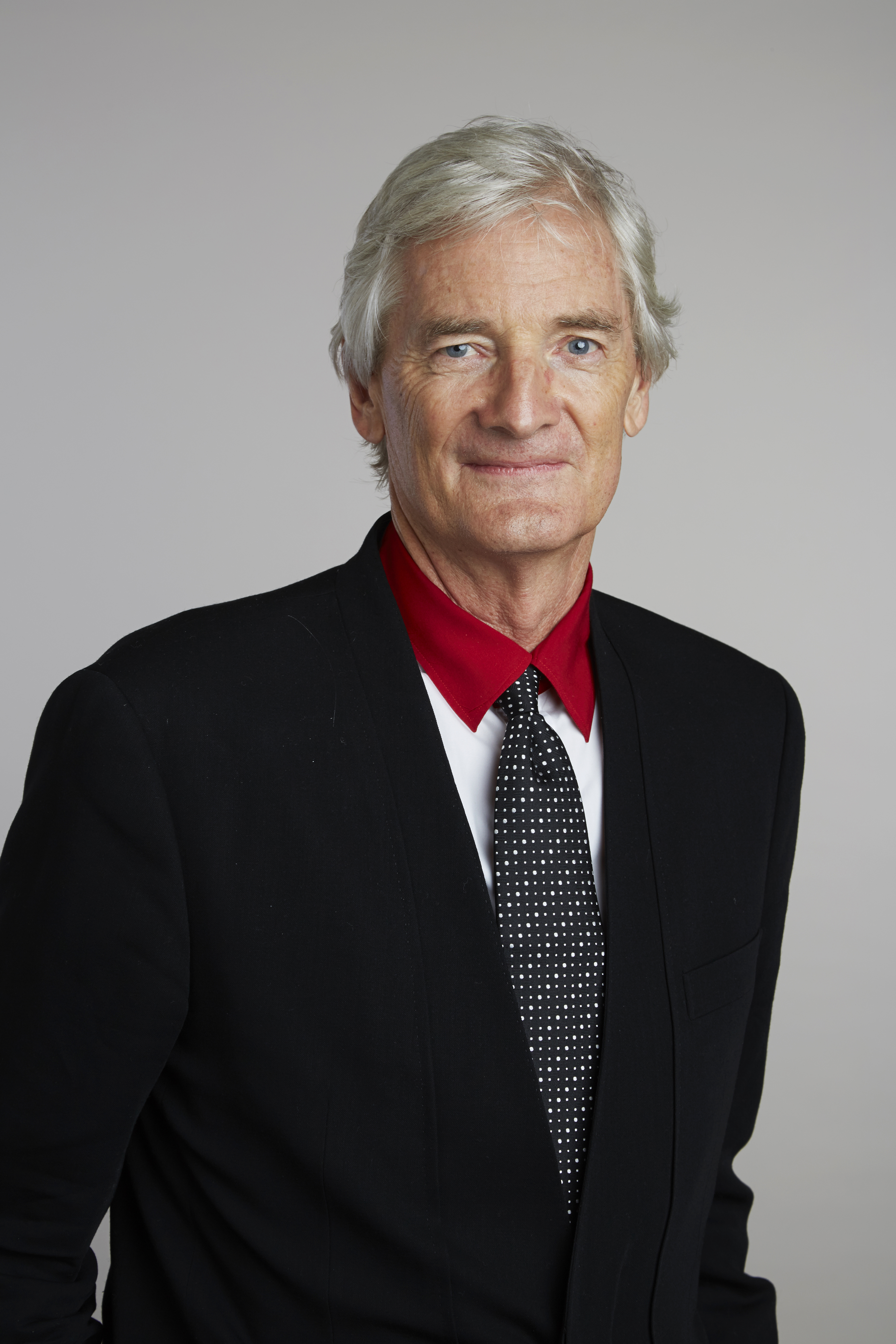
Sir James Dyson (born 2 May 1947) is an English inventor, industrial designer, farmer, and business magnate who founded the company Dyson. He is best known as the inventor of the bagless vacuum cleaner, which works on the principle of cyclonic separation. In the Sunday Times Rich List 2023, he was the fifth-richest person in the United Kingdom, with an estimated family net worth of £25 billion. As of September 2026, Forbes lists Dyson's net worth as $15.1 billion. Dyson served as the Provost of the Royal College of Art from August 2011 to July 2017, and opened a new university, the Dyson Institute of Engineering and Technology, on Dyson's Wiltshire campus in September 2017.
James Dyson was born on 2 May 1947 in Cromer, Norfolk, one of three children of Janet M. (née Bolton) and Alec William Dyson. He was named after his grandfather, James Dyson. His father died of prostate cancer when he was nine years old and he described his childhood home as 'penniless' after his father's death. He was nonetheless educated at Gresham's School, an independent boarding school in Holt, Norfolk, from 1956 to 1965, due to the headmaster agreeing to pay his school fees. At school he excelled at long-distance running, and said he learned determination from it. Dyson spent a year, 1965–1966, at the Byam Shaw School of Art, choosing the school because of its excellent reputation under principal Maurice de Sausmarez's leadership. Dyson credits de Sausmarez's guidance and teaching with inspiring him to become a designer. In 2015 Dyson spoke at the opening of a retrospective exhibition of de Sausmarez's work at the University of Leeds, speaking of the great influence the artist and former principal had on him and his career. He studied furniture and interior design at the Royal College of Art between 1966 and 1970, before moving into product design. It was while attending the Royal College of Art to study fine art that he transferred to industrial design, partly because of the tutorage of structural engineer Anthony Hunt.
In the early 1970, Dyson helped to design the Sea Truck while studying at the Royal College of Art. His first original invention, the Ballbarrow, was a modified version of a wheelbarrow using a ball instead of the usual wheel and was featured on the BBC's Tomorrow's World television programme. Dyson persisted with the idea of a ball instead of a wheel and invented the Trolleyball, a trolley that launched boats. He designed the Wheelboat which could travel at speeds of 64 kilometres per hour (40 mph) on land and water.
In the late 1970s, Dyson had the idea of using cyclonic separation to create a vacuum cleaner that would not lose suction as it picked up dirt. He became frustrated with his Hoover Junior's diminishing performance: the dust bag pores kept becoming clogged with dust, which reduced suction. The cyclone idea came from a sawmill that used cyclone technology. Partly supported by his wife's salary as an art teacher, and after five years and about 5,127 prototypes, Dyson launched the "G-Force" cleaner in 1983. No manufacturer or distributor would handle his product in the UK, as it would have disturbed the market for replacement dust bags, so Dyson launched it in Japan through catalogue sales. Manufactured in bright pink, the G-Force sold for the equivalent of $2,000, or around $5,500 in 2023 taking inflation into account. It won the 1991 International Design Fair Prize in Japan. Dyson filed a series of patents for his dual cyclone vacuum cleaner EP0037674 in 1980, and when his invention was rejected by the major manufacturers, he set up his own manufacturing company, Dyson Ltd. In June 1993, he opened a research centre and factory in Malmesbury, Wiltshire. Dyson's slogan, "say goodbye to the bag", proved attractive to the buying public. The Dyson Dual Cyclone became the fastest-selling vacuum cleaner ever made in the UK. It outsold those of some of the companies that had rejected his idea, and became one of the most popular brands in the UK. In early 2005, it was reported that Dyson cleaners had become the market leaders in the United States by value (though not by the number of units sold). Dyson licensed the technology in North America from 1986 to 2001 to Fantom Technologies, after which Dyson entered the market directly. Following this success, other major manufacturers began to market their own cyclonic vacuum cleaners. In 1999, Dyson sued Hoover (UK) for patent infringement, and the High Court ruled that Hoover had deliberately copied a fundamental part of his patented designs in making its Triple Vortex bagless vacuum cleaner range. Hoover agreed to pay damages of £4 million. In mid-2014, Dyson personally appeared in Tokyo to introduce his "360 Eye" robotic vacuum cleaner. The new model featured 360° scanning and mapping for navigation, cyclonic dust separation, a custom-designed digital motor for high suction, tank treads for traction, a full-width brushroll bar, and user interface via a free iOS or Android app. Interviewed by Fast Company (May 2007), Dyson asserted the importance of failure in one's life. "I made about 5,127 prototypes of my vacuum before I got it right. There were 5,126 failures. But I learned from each one. That's how I came up with a solution. So I don't mind failure. I've always thought that schoolchildren should be marked by the number of failures they've had. The child who tries strange things and experiences lots of failures to get there is probably more creative."
In 2000, Dyson expanded his appliance range to include a washing machine called the ContraRotator, which had two rotating drums moving in opposite directions. The range was offered in bright colours, rather than the usual white or silver, although white versions came later. It was not a commercial success and was discontinued in 2005. In 2002, the company created a model of the optical illusions depicted in the lithographs of Dutch artist M. C. Escher. Engineer Derek Phillips, after a year of work, created a water sculpture in which the water appeared to flow upwards to the tops of four ramps arranged in a square, before cascading to the bottom of the next ramp. Called Wrong Garden, the sculpture was displayed at the Chelsea Flower Show in 2003. The illusion was accomplished by having water containing air bubbles pumped to a slit at the top from which it cascaded down, making it appear that the water was flowing upwards.
In October 2006, Dyson launched a fast hand dryer, the Dyson Airblade, that used a thin layer of air as a squeegee to remove water from the skin, rather than using heat.


