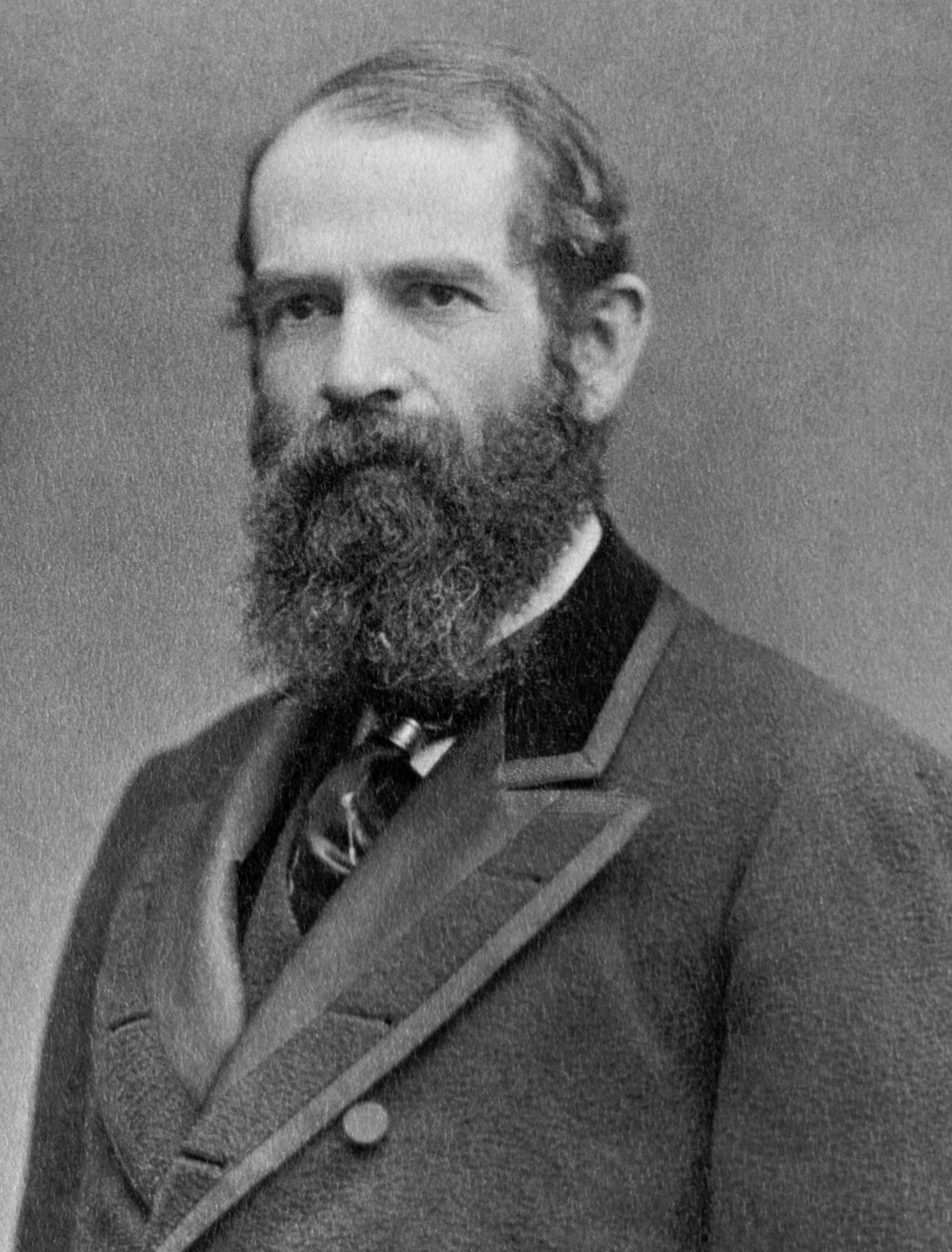
Background and career
Jay Gould (; May 27, 1836 – December 2, 1892) was an American railroad magnate and financial speculator who founded the Gould business dynasty. He is generally identified as one of the robber barons of the Gilded Age. His sharp and often unscrupulous business practices made him one of the wealthiest men of the late 19th century. Gould was an unpopular figure during his life and remains controversial.
Jason Gould was born in Roxbury, New York, to Mary More (1798–1841) and John Burr Gould (1792–1866). His maternal grandfather, Alexander T. More, was a businessman, and his great-grandfather, John More, was a Scottish immigrant who founded the town of Moresville, New York. Gould grew up in poverty and had to work at his family's small dairy farm. As a young boy, he decided that he wanted nothing to do with farming, his father's occupation, so his father dropped him off at a nearby school with fifty cents and a sack of clothes. Gould studied at the Hobart Academy in Hobart, New York, paying his way by bookkeeping at a nearby blacksmith.
The blacksmith offered Gould a half-interest in the blacksmith shop, which he sold to his father during the early part of 1854. Gould devoted himself to private study, emphasizing surveying and mathematics. In 1854, he surveyed and created maps of the Ulster County, New York, area. In 1856 (having by that time shortened his first name from Jason to Jay), he published History of Delaware County, and Border Wars of New York, which he had spent several years writing. While engaged in surveying, he started a side activity financing operators making wood ash, which is used with tannin in leather making. In 1856, Gould entered a partnership with Zadock Pratt to create a tanning business in Pennsylvania, in an area that was later named Gouldsboro. He eventually bought out Pratt, who retired. In 1856, Gould entered a partnership with Charles Mortimer Leupp, a son-in-law of Gideon Lee and one of the leading leather merchants in the United States. The partnership was successful, until the Panic of 1857. Leupp lost all his money in that financial crisis, but Gould took advantage of the depreciation in property value and bought up former partnership properties. Gould started an ice harvesting industry on the large Gouldsboro Lake. In the winter, ice was harvested and stored in large ice houses on the lakeside. He had a railroad line installed next to the lake, and he supplied New York City with ice during the summer months. The Gouldsboro Tannery became a disputed property after Leupp's death. Leupp's brother-in-law, David W. Lee, was also a partner in Leupp and Gould, and he took armed control of the tannery. He believed that Gould had cheated the Leupp and Lee families during the collapse of the business. Gould eventually took physical possession, but he was later forced to sell his shares in the company to Lee's brother.
In 1859, Gould began speculative investing by buying stock in small railways. His father-in-law, Daniel S. Miller, introduced him to the railroad industry by suggesting that Gould help him save his investment in the Rutland and Washington Railroad, during the Panic of 1857. Gould purchased stock for 10 cents on the dollar, which left him in control of the company. He engaged in more speculation on railroad stocks in New York City throughout the Civil War, and he was appointed manager of the Rensselaer and Saratoga Railroad in 1863. The Erie Railroad encountered financial troubles in the 1850s, despite receiving loans from financiers Cornelius Vanderbilt and Daniel Drew. It entered receivership in 1859 and was reorganized as the Erie Railway. Gould, Drew, and James Fisk engaged in stock manipulations, known as the Erie War, and Drew, Fisk, and Vanderbilt lost control of the Erie in the summer of 1868, while Gould became its president.
During the same period, Gould and Fisk became involved with Tammany Hall, the Democratic Party political machine that largely ran New York City at the time. They made its "boss", notorious William M. "Boss" Tweed, a director of the Erie Railroad, and Tweed arranged favorable legislation. In 1869, Tweed and Gould became the subjects of critical political cartoons by Thomas Nast. Gould was the chief bondsman in October 1871 when Tweed was held on $1 million bail. Tweed was eventually convicted of corruption and died in jail.
To keep Vanderbilt from taking over their interests in railroad, Gould and Fisk engaged in financial manipulations. In August 1869, Gould and Fisk conspired to begin to buy gold in an attempt to illegally corner the market. Gould used contacts with President Ulysses S. Grant's brother-in-law, Abel Corbin, in an attempt to influence the president and his private secretary, General Horace Porter. These speculations culminated in the financial panic of Black Friday on September 24, 1869, when the greenback (cash) premium over face value of a gold double eagle fell from 62 percent to 35 percent. Gould made a small profit from that operation by hedging against his own attempted corner as it was about to collapse, but lost it in subsequent lawsuits. The gold corner established Gould's reputation in the press as an all-powerful figure who could drive the market up and down at will. Favored by Tweed Ring judges, the conspiratorial partners escaped prosecution, but the months of economic turmoil that rocked the nation following the failed corner proved ruinous to farmers and bankrupted some of the most venerable financial institutions on Wall Street.


