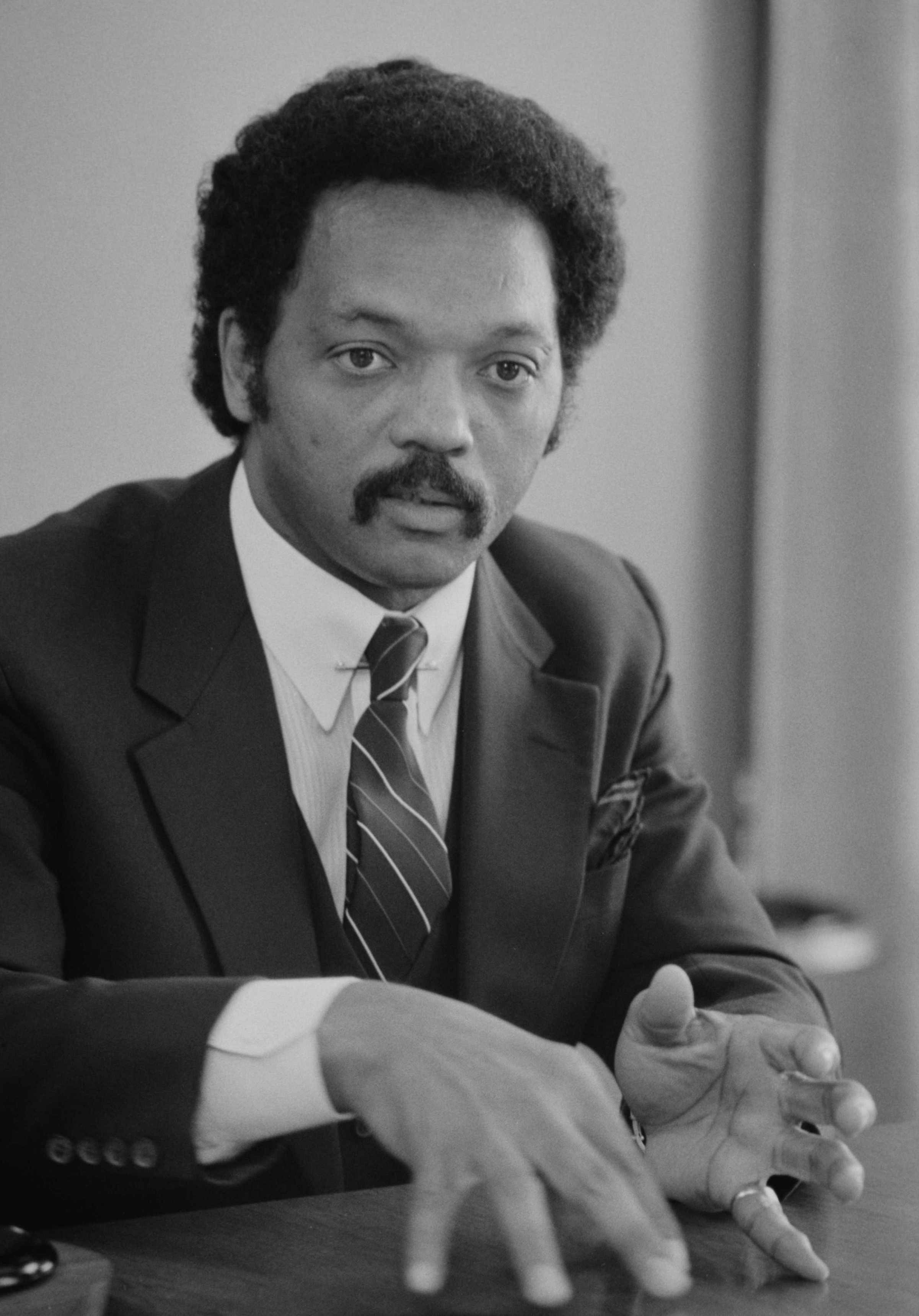
Background and career
Jesse Louis Jackson (né Burns; October 8, 1941 – February 17, 2026) was an American civil rights activist, LGBTQ rights activist, politician, and ordained Baptist minister. A protégé of Martin Luther King Jr. and James Bevel during the civil rights movement, he became one of the most prominent civil rights leaders of the late 20th and early 21st centuries, and an ardent advocate and early supporter of LGBTQ rights in the United States. From 1991 to 1997, he served as a shadow United States senator for the District of Columbia. Born in Greenville, South Carolina, Jackson began his activism in the 1960s and founded the organizations that later merged to form the Rainbow/PUSH Coalition. Expanding his work into international affairs in the 1980s, he became a vocal critic of the Reagan administration and launched a presidential campaign in 1984. Initially viewed as a fringe candidate, he finished third for the Democratic nomination behind former vice president Walter Mondale and Senator Gary Hart. He continued his activism and mounted a second presidential bid in 1988, finishing as the runner‑up for the Democratic nomination to Massachusetts governor Michael Dukakis. Jackson did not seek the presidency again, but in 1990, he was elected as the District of Columbia's shadow senator, serving one term during the H. W. Bush and Clinton administrations. Although initially critical of President Bill Clinton, he later became a supporter and friend. Jackson hosted Both Sides with Jesse Jackson on CNN from 1992 to 2000. A critic of police brutality, the Republican Party, and conservative policies, he was widely regarded as one of the most influential African‑American activists of his era.
Jackson was born Jesse Louis Burns on October 8, 1941, in Greenville, South Carolina, to Helen Burns, an 18-year-old high school student, and her 33-year-old married neighbor Noah Louis Robinson. His ancestry included Cherokee, enslaved African-Americans, Irish plantation owners, and a Confederate sheriff. A former professional boxer, Robinson worked for a textile brokerage and was well known in the black community. A year after Jesse's birth, his mother married Charles Henry Jackson, a post-office maintenance worker who later adopted him. Jesse took his stepfather's surname, though he also maintained a close relationship with Robinson as he grew up. He said he considered both men his fathers. As a child, Jesse Jackson was taunted by other children about his out‑of‑wedlock birth, and he said those experiences helped motivate him to succeed. Living under Jim Crow segregation laws, he was taught to go to the back of the bus and to use separate water fountains—practices he accepted until the Montgomery bus boycott of 1955. He attended a racially segregated school, Sterling High School in Greenville, where he was elected student class president, finished 10th in his class, and earned letters in baseball, football, and basketball.
After graduating from high school in 1959, Jackson rejected a contract from a minor-league professional baseball team so that he could attend the University of Illinois on a football scholarship. After his second semester at the predominantly white college, he transferred to North Carolina A&T, a historically black university in Greensboro, North Carolina. Accounts of the reasons for the transfer differed, though Jackson said he changed schools because racial prejudice prevented him from playing quarterback and limited his participation on a competitive public‑speaking team. Writing an article on ESPN.com in 2002, sociologist Harry Edwards noted that the University of Illinois had previously had a black quarterback, but also observed that black athletes attending predominantly white colleges during the 1950s and 1960s encountered a "combination of culture shock and discrimination". Edwards suggested that Jackson left the University of Illinois in 1960 because he had been placed on academic probation, but the university's president reported in 1987 that Jackson's 1960 freshman transcript was clean and that he would have been eligible to re-enroll at any time. At A&T, Jackson played quarterback and was elected student body president. He became active in local civil-rights protests against segregated libraries, theaters, and restaurants. He graduated with a B.S. degree in sociology in 1964, then attended the Chicago Theological Seminary on a scholarship. He left the seminary in 1966, three classes short of earning his master's degree, to focus full-time on the civil rights movement. He was ordained a minister in 1968 and was awarded a Master of Divinity degree by Chicago Theological Seminary in 2000, based on his previously earned credits and his subsequent work and life experience.
Jackson was known for commanding public attention since he first started working for Martin Luther King Jr. In 1965 he participated in the Selma to Montgomery marches organized by James Bevel, King, and other civil rights leaders in Alabama. Impressed by Jackson's drive and organizational abilities, King soon began giving Jackson a role in the Southern Christian Leadership Conference (SCLC), though he was concerned about Jackson's apparent ambition and attention-seeking. When Jackson returned from Selma, he was charged with establishing a frontline office for the SCLC in Chicago. In 1966, King and Bevel selected Jackson to head the Chicago branch of the SCLC's economic arm, Operation Breadbasket, and he was promoted to national director in 1967. Operation Breadbasket had been started by the Atlanta leadership of the SCLC as a job placement agency for blacks. Under Jackson's leadership, a key goal was to encourage massive boycotts by black consumers as a means to pressure white-owned businesses to hire blacks and to purchase goods and services from black-owned firms. T. R. M. Howard, a 1950s proponent of the consumer boycott tactic, soon became a major supporter of Jackson's efforts—donating and raising funds, and introducing Jackson to prominent members of the black business community in Chicago. Under Jackson's direction, Operation Breadbasket held popular weekly workshops on Chicago's South Side featuring white and black political and economic leaders, and religious services complete with a jazz band and choir. Jackson became involved in SCLC leadership disputes after King's assassination on April 4, 1968. When King was shot, Jackson was in the parking lot one floor below. He told reporters he was the last person to speak to King, and that King died in his arms, an account that several King aides who were present disputed. In the wake of King's death, Jackson worked on SCLC's Poor People's Campaign in Washington, D.C., and was credited with managing its 15-acre tent city, but he began to clash with Ralph Abernathy, King's successor as SCLC chairman. In 1969, The New York Times reported that several black leaders viewed Jackson as King's successor and that Jackson was one of the few black activists who was preaching racial reconciliation. Jackson believed a conspiracy was involved in King's murder. In 1978, he met for four hours with King's convicted assassin, James Earl Ray. He said that Ray was involved in King's assassination but did not kill him, and that others who were involved were "still walking the streets". One notable activist involved with Operation Breadbasket who later gained greater prominence was a then-teenage Al Sharpton, who Jackson mentored early on in life and later appointed as youth director of Operation Breadbasket's Brooklyn branch in 1969. Jackson reportedly was seeking to form a coalition with whites in order to approach what were considered racial problems as economic and class problems. "When we change the race problem into a class fight between the haves and the have-nots, then we are going to have a new ball game", he said. In the 21st century, some public school systems are working on an approach for affirmative action that deals with family income rather than race, recognizing that some minority members have been very successful. The Times also indicated that Jackson was being criticized as too involved with middle-class blacks and for having an unattainable goal of racial unity. In the spring of 1971, Abernathy ordered Jackson to move the national office of Operation Breadbasket from Chicago to Atlanta and sought to place another person in charge of local Chicago activities, but Jackson refused to move. He organized the October 1971 Black Expo in Chicago, a trade and business fair to promote black capitalism and grass roots political power. The five-day event was attended by black businessmen from 40 states, as well as politicians such as Cleveland Mayor Carl Stokes, and Chicago Mayor Richard J. Daley. Daley's presence was seen as a testament to the growing political and economic power of blacks. In December 1971, Jackson and Abernathy had a complete falling out, with the split described as part of a leadership struggle between Jackson, who had a national profile, and Abernathy, whose prominence from the Civil Rights Movement was beginning to wane. The break began when Abernathy questioned the handling of receipts from the Black Expo, and then suspended Jackson as leader of Operation Breadbasket for not obtaining permission to form non-profit corporations. Al Sharpton, then youth group leader of the SCLC, left the organization to protest Jackson's treatment and formed the National Youth Movement. Jackson, his entire Breadbasket staff, and 30 of the 35 board members resigned from the SCLC and began planning a new organization. Time magazine quoted Jackson as saying at that time that the traditional civil rights movement had lost its "offensive thrust".
People United to Save Humanity (Operation PUSH) officially began operations on December 25, 1971; Jackson later changed the name to People United to Serve Humanity. T. R. M. Howard was installed as a member of the board of directors and chair of the finance committee. At its inception, Jackson planned to orient Operation PUSH toward politics and to pressure politicians to work to improve economic opportunities for blacks and poor people of all races. SCLC officials reportedly felt the new organization would help black businesses more than it would help the poor. In 1978, Jackson called for a closer relationship between blacks and the Republican Party, telling the Party's National Committee that "Black people need the Republican Party to compete for us so we can have real alternatives... The Republican Party needs black people if it is ever to compete for national office." In 1983, Jackson and Operation PUSH led a boycott of beer giant Anheuser-Busch, criticizing the level of minority employment in its distribution network. In 1996, Jackson family friend Ron Burkle introduced Anheuser-Busch CEO August Busch IV to Yusef Jackson, Jesse's son. In 1998, Anheuser-Busch chose Yusef and his brother Jonathan to head River North Sales, a Chicago beer distribution company. The Chicago Tribune noted these moves in a 2001 front-page story. "There is no causal connection between the boycott in 1983 and me meeting in the middle '90s and me buying this company in 1998", Yusef said in a 2005 interview with Crain's Chicago Business. In 1984, Jackson organized the Rainbow Coalition and resigned as president of Operation PUSH to run for president of the United States, though he remained involved as chairman of the board. PUSH's activities were described in 1987 as conducting boycotts of businesses to induce them to provide more jobs and business to blacks and as running programs for housing, social services, and voter registration. The organization was funded by contributions from businesses and individuals. In early 1987, the continued existence of Operation PUSH was imperiled by debt, a fact that Jackson's political opponents used during his race for the 1988 Democratic Party nomination. In the mid-1990s, the Operation PUSH and Rainbow Coalition organizations merged.
On July 16, 1960, while he was home from college, Jackson joined seven other African Americans in a sit-in at the Greenville Public Library in Greenville, South Carolina, which only allowed white people. The group was arrested for "disorderly conduct". Jackson's pastor paid their bond, the Greenville News said. DeeDee Wright, another member of the group, later said they wanted to be arrested "so it could be a test case." The Greenville City Council closed both the main library and the branch that black people used. The possibility of a lawsuit led to the reopening of both libraries September 19, also the day after the News printed a letter written by Wright. In 1984, Jackson and Coretta Scott King sent letters to Florida governor Bob Graham asking him to halt the scheduled execution of James Dupree Henry, a black man convicted of killing Z. L. Riley, an Orlando based civil rights leader. Jackson met with Graham, but was unable to persuade him, and Henry was executed on September 20.


