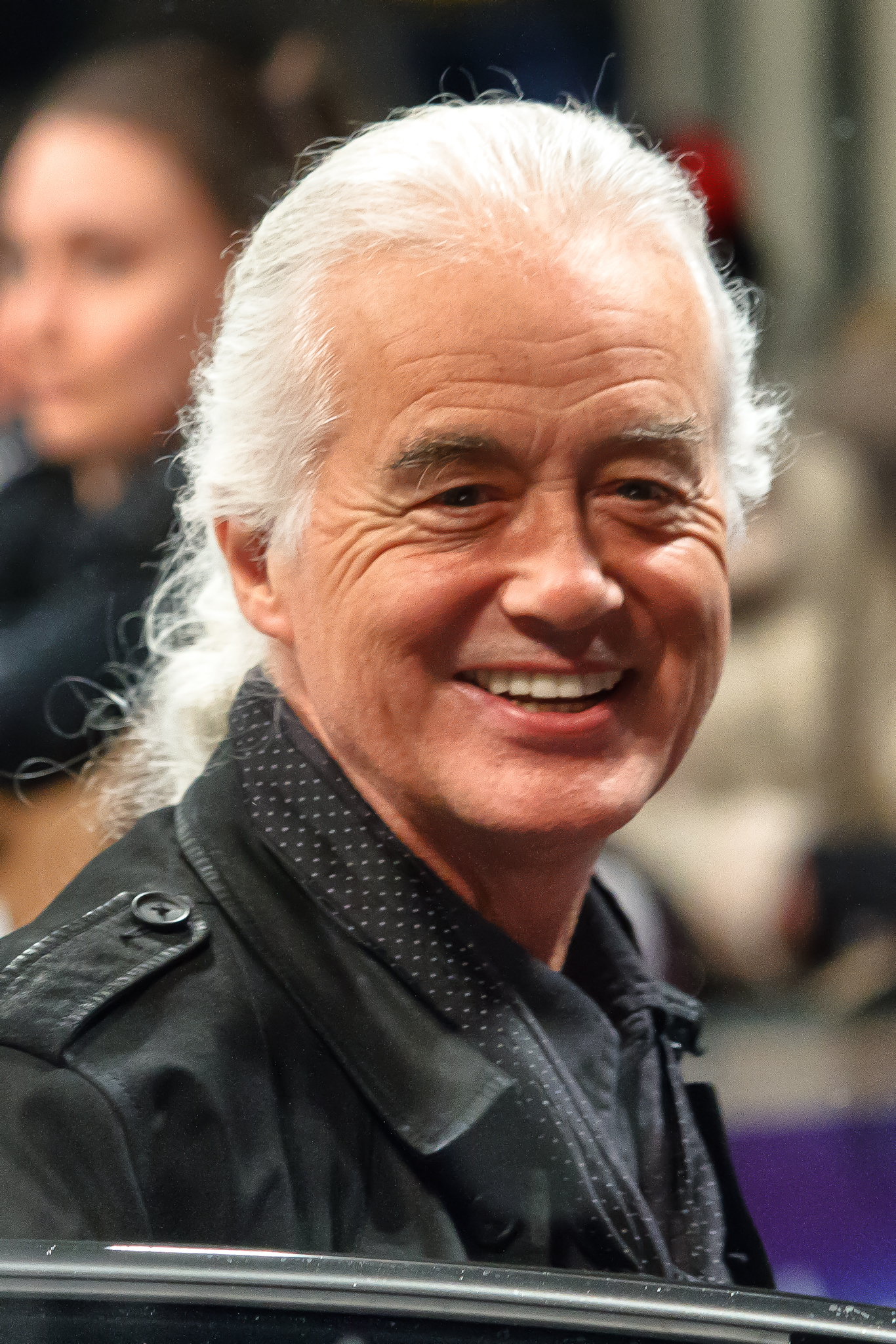
Background and career
James Patrick Page (born 9 January 1944) is an English musician and producer who achieved international success as the guitarist and founder of the rock band Led Zeppelin. Page began his career as a studio session musician in London and, by the mid-1960s, was a notable session guitarist in Britain. He was a member of the Yardbirds from 1966 to 1968. When the Yardbirds broke up, he founded Led Zeppelin, which was active from 1968 to 1980. Following the death of Led Zeppelin drummer John Bonham in 1980, Page played with XYZ, the Firm, the Honeydrippers, Coverdale–Page, and Page and Plant. Page performed with many artists, both live and in studio recordings, and in a 2007 Led Zeppelin reunion that was released as the 2012 concert film Celebration Day. Along with the Edge and Jack White, he participated in the 2008 documentary It Might Get Loud. Page is considered to be one of the greatest and most influential guitarists of all time. Rolling Stone magazine has described Page as "the pontiff of power riffing" and ranked him No. 3 on its 2015 list of the "100 Greatest Guitarists of All Time", behind Jimi Hendrix and Eric Clapton, and No. 3 again in 2023 behind Chuck Berry and Jimi Hendrix. In 2010, Page was ranked No. 2 on Gibson's list of "Top 50 Guitarists of All Time" and, in 2007, No. 4 on Classic Rock's "100 Wildest Guitar Heroes". He was inducted into the Rock and Roll Hall of Fame twice: once as a member of the Yardbirds (1992) and once as a member of Led Zeppelin (1995).
Page was born to James Patrick Page and Patricia Elizabeth Gaffikin in the West London suburb of Heston on 9 January 1944. His father was a personnel manager at a plastic-coatings plant, and his mother, who was of Irish descent, was a doctor's secretary. In 1952, they moved to Feltham and then to Miles Road, Epsom, in Surrey. Page was educated from the age of eight at Epsom County Pound Lane Primary School, and at age eleven attended Ewell County Secondary School in West Ewell. He came across his first guitar, a Spanish guitar, in the Miles Road house: "I don't know whether [the guitar] was left behind by the people before [us], or whether it was a friend of the family's—nobody seemed to know why it was there." First playing the instrument when age 12, he took a few lessons in nearby Kingston, but was largely self-taught:
When I grew up there weren't many other guitarists ... There was one other guitarist in my school who actually showed me the first chords that I learned and I went on from there. I was bored so I taught myself the guitar from listening to records. So obviously it was a very personal thing. This "other guitarist" was a boy named Rod Wyatt, a few years his senior. Together with another boy, Pete Calvert, they would practice at Page's house; Page would devote six or seven hours on some days to practicing and would always take his guitar with him to secondary school, only to have it confiscated and returned to him after class. Among Page's early influences were rockabilly guitarists Scotty Moore and James Burton, who both played on recordings made by Elvis Presley. Presley's song "Baby Let's Play House" is cited by Page as his inspiration to take up the guitar, and he would reprise Moore's playing on the song in the live version of "Whole Lotta Love" on The Song Remains the Same. Page appeared on BBC1 in 1957 with a Höfner President acoustic, which he'd bought from money saved up from his milk round in the summer holidays. The guitar had a pick-up so it could be amplified, but his first solid-bodied electric guitar was a second-hand 1959 Futurama Grazioso, later replaced by a Fender Telecaster. Page had seen Buddy Holly playing a Telecaster, and he had also played one at an electronics exhibition at Earls Court Exhibition Centre in London. Page's musical tastes included skiffle, acoustic folk music, and the blues sounds of Elmore James, B.B. King, Otis Rush, Buddy Guy, Freddie King, and Hubert Sumlin. "Basically, that was the start: a mixture between rock and blues." At age 13, Page appeared on Huw Wheldon's All Your Own talent quest program in a skiffle quartet, one performance of which aired on BBC1 in 1957. The group played "Mama Don't Want to Skiffle Anymore" and another American-flavored song, "In Them Ol' Cottonfields Back Home". When asked by Wheldon what he wanted to do after school, Page said, "I want to do biological research [to find a cure for] cancer, if it isn't discovered by then." In an interview with Guitar Player magazine, Page stated that "there was a lot of busking in the early days, but as they say, I had to come to grips with it and it was a good schooling." When he was 14, and billed as James Page, he played in a group called Malcolm Austin and Whirlwinds, alongside Tony Busson on bass, Stuart Cockett on rhythm, and a drummer named Tom, playing Chuck Berry and Jerry Lee Lewis numbers. This band was short-lived, as Page soon began playing with Rod Wyatt, David Williams, and Pete Calvert. Page named the group The Paramounts, and they played gigs in Epsom, once supporting a group who later became Johnny Kidd & the Pirates. Although interviewed for a job as a laboratory assistant, Page ultimately chose to leave secondary school in West Ewell to pursue music at age 15 – the earliest age permitted at the time. Page had gained four GCE O levels and had a major row with the school Deputy Head Miss Nicholson regarding his musical ambitions, about which she was scathing. Page had difficulty finding other musicians with whom he could play on a regular basis. "It wasn't as though there was an abundance. I used to play in many groups... anyone who could get a gig together, really." Page had stints backing recitals by Beat poet Royston Ellis at the Mermaid Theatre between 1960 and 1961. He also played with singer Red E. Lewis' backing band the Redcaps after Lewis had seen Page play with the Paramounts. After the departure of guitarist Bobby Oats, Page was asked by singer Neil Christian to join his band, the Crusaders. Christian had seen 15-year-old Page playing in a local hall. Page toured with Christian for approximately two years and later played on several of his records, including the 1962 single, "The Road to Love". During his stint with Christian, Page fell seriously ill with glandular fever and stopped touring. He put his musical career on hold and concentrated on his other love, painting, and he enrolled at Sutton Art College in Surrey. As he explained in 1975:
[I was] travelling around all the time in a bus. I did that for two years after I left school, to the point where I was starting to get really good bread. But I was getting ill. So I went back to art college. And that was a total change in direction. That's why I say it's possible to do. As dedicated as I was to playing the guitar, I knew doing it that way was doing me in forever. Every two months I had glandular fever. So for the next 18 months I was living on ten dollars a week and getting my strength up. But I was still playing.
While a student, Page often performed at the Marquee Club with bands such as Cyril Davies' All Stars, Alexis Korner's Blues Incorporated, and fellow guitarists Jeff Beck and Eric Clapton. He was spotted one night by John Gibb of Brian Howard & the Silhouettes, who asked him to help record some singles for Columbia Graphophone Company, including "The Worrying Kind". Mike Leander of Decca Records first offered Page regular studio work. His first session for the label was the recording "Diamonds" by Jet Harris and Tony Meehan, which went to No. 1 on the singles chart in early 1963. After brief stints with Carter-Lewis and the Southerners, Mike Hurst and the Method, and Mickey Finn and the Blue Men, Page undertook full-time session work. As a session guitarist, he was known as 'Lil' Jim Pea' to prevent confusion with the other noted English session guitarist Big Jim Sullivan. Page was mainly called into sessions as "insurance" in instances when a replacement or second guitarist was required by the recording artist. "It was usually myself and a drummer", he explained, "though they never mention the drummer these days, just me ... Anyone needing a guitarist either went to Big Jim [Sullivan] or myself." He stated that "In the initial stages they just said, play what you want, 'cause at that time I couldn't read music or anything."
Page was the favored session guitarist of record producer Shel Talmy. As a result, Page secured session work on songs for the Who and the Kinks. Page is credited with playing acoustic twelve-string guitar on two tracks on the Kinks' debut album, "I'm a Lover Not a Fighter" and "I've Been Driving on Bald Mountain", and possibly on the B-side "I Gotta Move". He played rhythm guitar on the sessions for the Who's first single "I Can't Explain" (although Pete Townshend was reluctant to allow Page's contribution on the final recording; Page also played lead guitar on the B-side, "Bald Headed Woman"). Page's studio gigs in 1964 and 1965 included Marianne Faithfull's "As Tears Go By", Jonathan King's "Everyone's Gone to the Moon", the Nashville Teens' "Tobacco Road", the Rolling Stones "Heart of Stone" (along with "We're Wasting Time"), Van Morrison & Them's "Baby, Please Don't Go", "Mystic Eyes", and "Here Comes the Night", Dave Berry's "The Crying Game" and "My Baby Left Me", Brenda Lee's "Is It True", Shirley Bassey's "Goldfinger", and Petula Clark's "Downtown". In 1964, Page contributed guitar to the incidental music of the Beatles' 1964 film A Hard Day's Night. In 1965, Page was hired by Rolling Stones manager Andrew Loog Oldham to act as house producer and A&R man for the newly formed Immediate Records label, which allowed him to play on and/or produce tracks by John Mayall, Nico, Chris Farlowe, Twice as Much, and Clapton. Also in 1965, Page produced one of Dana Gillespie's early singles, "Thank You Boy". Page also formed a brief songwriting partnership with then romantic interest Jackie DeShannon. He composed and recorded songs for the John Williams (not to be confused with the film composer John Williams) album The Maureeny Wishful Album with Big Jim Sullivan. Page worked as session musician on Donovan Leitch's Sunshine Superman, on Engelbert Humperdinck's Release Me, the Johnny Hallyday albums Jeune homme and Je suis né dans la rue, and the Al Stewart album Love Chronicles. Page also played guitar on five tracks of Joe Cocker's debut album, With a Little Help from My Friends. Since 1970, Page played lead guitar on ten Roy Harper tracks, comprising 81 minutes of music. When questioned about which songs he played on, especially ones where there exists some controversy as to what his exact role was, Page often points out that it is hard to remember exactly what he did given the enormous number of sessions he was playing at the time. In a radio interview, he explained: "I was doing three sessions a day, fifteen sessions a week. Sometimes I would be playing with a group, sometimes I could be doing film music, it could be a folk session ... I was able to fit all these different roles." Although Page recorded with many notable musicians, many of these early tracks are only available as bootleg recordings, several of which were released by the Led Zeppelin fan club in the late 1970s. Examples include early jam sessions featuring Page and guitarists Jeff Beck and Eric Clapton covering various blues themes, which were included on compilations released by Immediate Records. Several early tracks were compiled on the twin album release Jimmy Page: Session Man. Page also recorded with Keith Richards on guitar and vocals in Olympic Sound Studios on 15 October 1974. Along with Ric Grech on bass and Bruce Rowland on drums, a track called "Scarlet" was cut (the same year he played acoustic guitar on the Stones' "Through the Lonely Nights"). Page reflected later in an interview with Rolling Stone's Cameron Crowe: "I did what could possibly be the next Stones B side. It was Ric Grech, Keith and me doing a number called "Scarlet". I can't remember the drummer. It sounded very similar in style and mood to those Blonde on Blonde tracks. It was great, really good. We stayed up all night and went down to Island Studios where Keith put some reggae guitars over one section. I just put some solos on it, but it was 8 in the morning of the next day before I did that. He took the tapes to Switzerland and someone found out about them. Richards told people that it was a track from my album". "Scarlet" was eventually released as a single from the reissue of the 1973 Rolling Stones album Goats Head Soup in 2020. Page left studio work when the increasing influence of Stax Records on popular music led to the greater incorporation of brass and orchestral arrangements into recordings at the expense of guitars. He stated that his time as a session player served as extremely good schooling:


