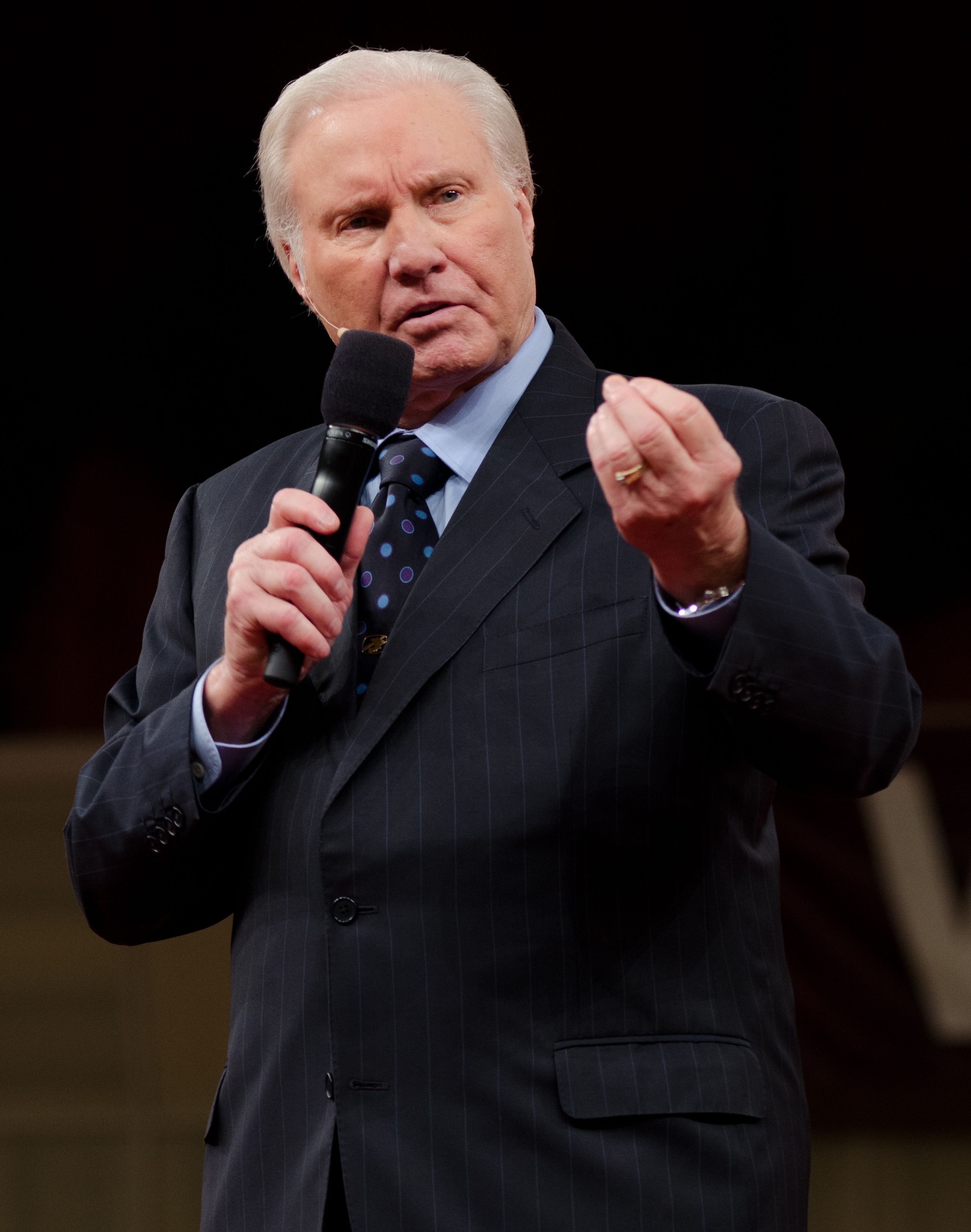
Background and career
Jimmy Lee Swaggart (; March 15, 1935 – July 1, 2025) was an American Pentecostal televangelist, pastor, media mogul, author and gospel music artist. Swaggart was born in Ferriday, Louisiana, into a musically and religiously active family that included cousins Jerry Lee Lewis and Mickey Gilley. Swaggart was ordained as a pastor by the Assemblies of God. He went on to become one of the most well-known televangelists in America. During the 1980s, his crusades were a major part of his ministry—drawing large crowds and receiving significant media attention. Swaggart founded Jimmy Swaggart Ministries, which owns and operates the SonLife Broadcasting Network (SBN). He also founded the Jimmy Swaggart Bible College. Swaggart was the senior pastor of the Family Worship Center in Baton Rouge, Louisiana. Swaggart was known for scandals involving prostitutes in 1988 and 1991 and revolutionary groups accused of war crimes in southern Africa. One prostitution scandal gave rise to a televised February 21, 1988, speech by Swaggart known as his "I have sinned" speech. After Swaggart was defrocked by the Assemblies of God due to sexual immorality, he moved on to become a non-denominational minister. Swaggart wrote about 50 Christian books offered. He sold over 15 million records worldwide as a gospel artist and, in 1980, he received a Grammy Award nomination. Married for over 70 years, he raised a ministerial family spanning four generations. Swaggart died in Baton Rouge at age 90, on July 1, 2025.
Jimmy Lee Swaggart was born on March 15, 1935, in Ferriday, Louisiana. Swaggart was the first of two children born to Willie Leon (known as "Sun" or "Son") Swaggart, a local sharecropper who was a fiddle player and Pentecostal preacher, and Minnie Bell (née Herron), who was a housewife. Swaggart's parents were related by marriage, as Son Swaggart's maternal uncle, Elmo Lewis, was married to Minnie Herron's sister, Mamie. The extended family had a complex network of familial interrelationships; "cousins and in-laws and other relatives married each other until the clan was entwined like a big, tight ball of rubber bands". Swaggart was the cousin of rockabilly pioneer Jerry Lee Lewis and country music star Mickey Gilley. According to his autobiography To Cross a River, Swaggart, along with his wife and son, lived in poverty during the 1950s as he preached throughout rural Louisiana, struggling to survive on an income of $30 a week (equivalent to $340 in 2025). Being too poor to own a home, the Swaggarts lived in church basements, homes of pastors, and small motels. Sun Records producer Sam Phillips wanted to start a gospel line of music for the label (perhaps to remain in competition with RCA Victor and Columbia Records, who also had gospel lines at the time) and wanted Swaggart for Sun as the first gospel artist for the label. Swaggart's cousin, Jerry Lee Lewis, had previously signed with Sun and was reportedly earning $20,000 per week at the time. Although the offer meant a promise for significant income for him and his family, Swaggart turned Phillips down, stating that he was called to preach the gospel.
Preaching from a flatbed trailer donated to him, Swaggart began full-time evangelistic work in 1955. He began developing a revival-meeting following throughout the American South. In 1960, he began recording gospel music record albums and transmitting on Christian radio stations. In 1961, Swaggart was ordained by the Assemblies of God; a year later he began his radio ministry. In the late 1960s, Swaggart founded what was then a small church named the Family Worship Center in Baton Rouge, Louisiana; the church eventually became district-affiliated with the Assemblies of God. In 1971, Swaggart began transmitting a weekly 30-minute telecast over various local television stations in Baton Rouge and also purchased a local AM radio station, WLUX (now WPFC). The station broadcast Christian feature stories, preaching and teaching to various fundamentalist and Pentecostal denominations and playing black gospel, Southern gospel, and inspirational music. Swaggart sold many of his radio stations gradually throughout the 1980s and early 1990s.
By 1975, the television ministry had expanded to more stations around the United States, and he began to use television as his primary preaching forum. In 1978, the weekly telecast was increased to an hour. In 1980, Swaggart began a daily weekday telecast featuring Bible study and music, and the weekend, hour-long telecast included a service from either Family Worship Center (Swaggart's church) or an on-location crusade in a major city. In the early 1980s, the broadcasts expanded to major cities nationwide. By 1983, more than 250 television stations broadcast the telecast.
Throughout the 1980s, Jimmy Swaggart Ministries was one of many American Evangelical leaders who promoted the South African-backed Mozambican National Resistance, aka RENAMO, which was accused of committing systematic war crimes during Mozambique's 15-year-long civil war. In addition to moral support and publicity, Swaggart Ministries was repeatedly accused of providing funding and material support to the group. In September 1985, government forces supported by Zimbabwe captured RENAMO's main headquarters inside Mozambique Casa Banana. Among the materials left behind by retreating rebels were piles of Swaggart's 1982 publication, "How to Receive The Baptism in the Holy Spirit", translated into Portuguese. During the 1988 trial of Australian missionary Ian Grey, who coordinated much of the private support to RENAMO, it was claimed by the defendant that Swaggart Ministries worked through Shekinah Ministries to provide support to RENAMO. That year, extensive media coverage of Swaggart and his businesses in the wake of a sex scandal largely excluded these allegations. In 1991, Covert Action Magazine and the government of Zimbabwe both accused Swaggart ministries of continuing to fund RENAMO.
In 1988, Swaggart was accused of patronizing a prostitute. He was suspended and ultimately defrocked by the Assemblies of God. Three years later, he was implicated in another scandal involving prostitution. As a result, Swaggart's ministry became non-affiliated, nondenominational, and significantly smaller than it had been in the ministry's pre-scandal years. Swaggart's sex scandals received national media attention.


