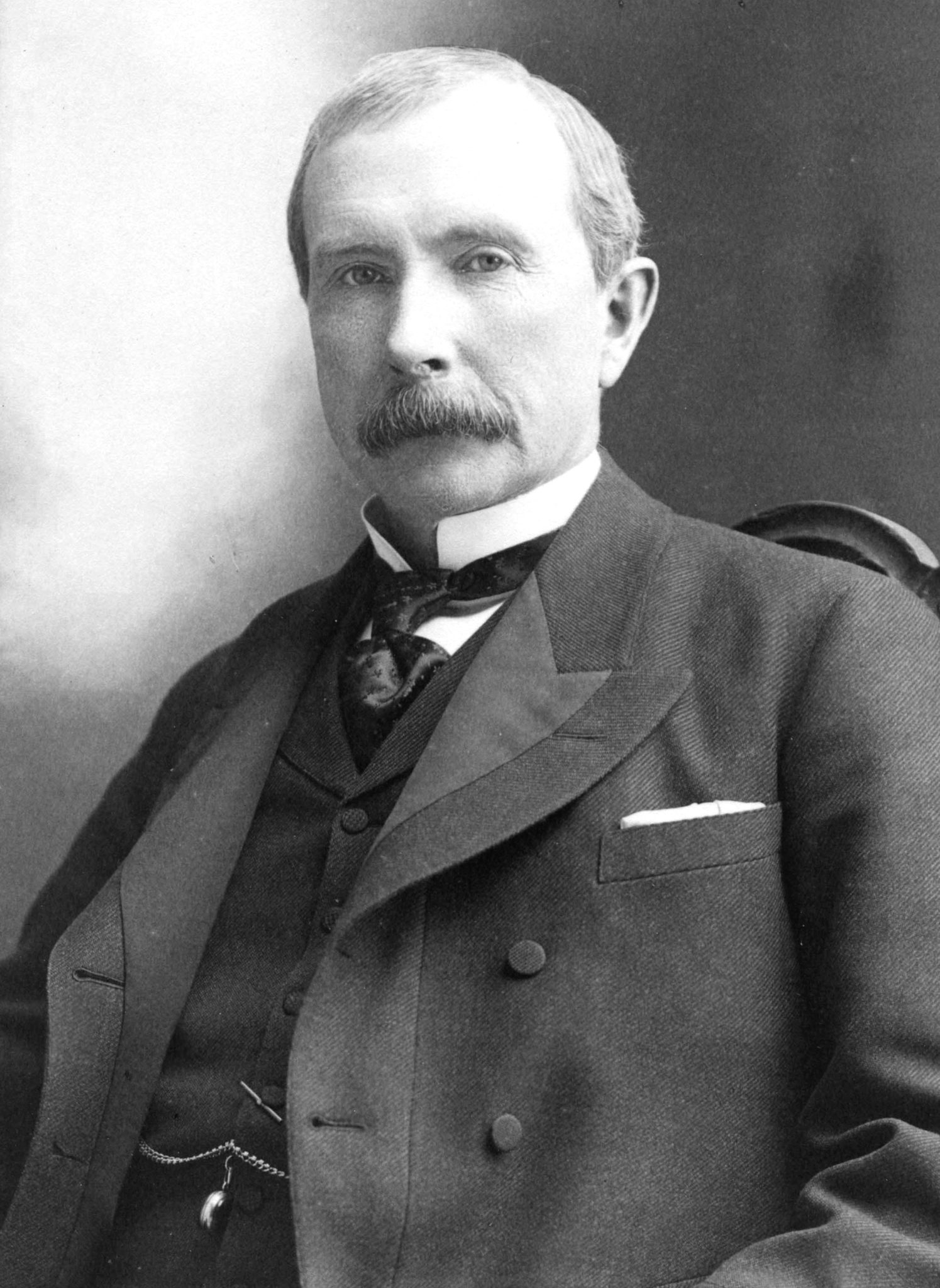
Background and career
John Davison Rockefeller Sr. (July 8, 1839 – May 23, 1937) was an American businessman and philanthropist. He was one of the wealthiest Americans of all time and one of the richest people in history. Rockefeller was born into a large family in Upstate New York who moved several times before eventually settling in Cleveland, Ohio. He became an assistant bookkeeper at age 16 and went into several business partnerships beginning at age 20, concentrating his business on oil refining. Rockefeller founded the Standard Oil Company in 1870. He ran it until 1897 and remained its largest shareholder. In his retirement, he focused his energy and wealth on philanthropy, especially regarding education, medicine, higher education, and modernizing the Southern United States. Rockefeller's wealth grew substantially as kerosene and gasoline became increasingly important commodities, eventually making him the richest person in the United States. By 1900, Standard Oil controlled about 90% of the nation's oil production. The company lowered production costs and expanded oil distribution through corporate and technological innovations, but it also benefited from a legal environment that enabled consolidation. Critics argue that regulatory capture played a role in facilitating its monopoly power–a view reinforced by Rockefeller's reputed remark, "Competition is a sin." Rockefeller's company and business practices came under criticism, particularly in the writings of author Ida Tarbell. The Supreme Court ruled in 1911 that Standard Oil must be dismantled for violation of federal antitrust laws. It was broken up into 34 separate entities, which included companies that became ExxonMobil, Chevron Corporation, and others—some of which remain among the largest companies by revenue worldwide. His personal wealth in 1913 was estimated at $900 million, which was 2.3% of the US gross domestic product (GDP). Rockefeller became the country's first billionaire on 28 September 1916. Rockefeller spent much of the last 40 years of his life in retirement at Kykuit, his estate in Westchester County, New York, defining the structure of philanthropy, along with other key industrialists such as Andrew Carnegie. His fortune was used chiefly to create the modern systematic approach of targeted philanthropy through the creation of foundations that supported medicine, education, and scientific research. His foundations pioneered developments in medical research and were instrumental in the near-eradication of hookworm in the American South, and yellow fever in the United States. He and Carnegie gave form and impetus through their charities to the work of Abraham Flexner, who in his essay "Medical Education in America" emphatically endowed empiricism as the basis for the US medical system of the 20th century. Rockefeller was the founder of the University of Chicago and Rockefeller University, and funded the establishment of Central Philippine University in the Philippines. He was a devout mainline Baptist Christian and supported many church-based institutions. He adhered to total abstinence from alcohol and tobacco throughout his life. For advice, he relied closely on his wife, Laura Spelman Rockefeller; they had four daughters and a son together. He was a faithful congregant of the Erie Street Baptist Mission Church, taught Sunday school, and served as a trustee, clerk, and occasional janitor. Religion was a guiding force throughout his life, and he believed it to be the source of his success. Rockefeller was also considered a supporter of capitalism based on a perspective of social Darwinism, and he was quoted often as saying, "The growth of a large business is merely a survival of the fittest."
Rockefeller was the second of six children born in Richford, New York, to con artist William A. Rockefeller Sr. and Eliza Davison. Rockefeller had an elder sister named Lucy and four younger siblings: William Jr., Mary, and fraternal twins Franklin (Frank) and Frances. His father was of English and German descent, while his mother was of Scotch-Irish descent. His paternal ancestors were part of the Roquefeuille family, who were Huguenots that fled to Germany from France under a period of religious persecution during the reign of Louis XIV. By the time their descendants immigrated to America, their name had Germanized. William Sr. worked first as a lumberman and then a traveling salesman. He claimed to be a "botanic physician" who sold elixirs, and was described by locals as "Big Bill" and "Devil Bill." Unshackled by conventional morality, he led a vagabond existence and returned to his family infrequently. Throughout his life, Bill was notorious for conducting schemes. In between the births of Lucy and John, Bill and his mistress and housekeeper Nancy Brown had a daughter named Clorinda, who died young. Between John and William Jr.'s births, Bill and Nancy had another daughter, named Cornelia. Eliza was a homemaker and a devout Baptist who struggled to maintain a semblance of stability at home, as Bill was frequently gone for extended periods. She also put up with his philandering and his double life, which included bigamy. He permanently abandoned his family around 1855 and lived with second wife, Margaret L. Allen. Eliza was thrifty by nature and by necessity, and she taught her son that "willful waste makes woeful want". She taught John how to save and track money, and the importance of it. John did his share of the regular household chores and earned extra money raising turkeys, selling potatoes and candy, and eventually lending small sums of money to neighbors. He followed his father's advice to "trade dishes for platters" and always get the better part of any deal. Bill once bragged, "I cheat my boys every chance I get. I want to make 'em sharp." However, his mother was more influential in John's upbringing and beyond, while he distanced himself further and further from his father as his life progressed. He later stated, "From the beginning, I was trained to work, to save, and to give." When he was a boy, his family moved to Moravia, New York, and to Owego, New York, in 1851, where he attended Owego Free Academy. In 1853, his family moved to Strongsville, Ohio, and he attended Cleveland's Central High School, the first high school in Cleveland and the first free public high school west of the Alleghenies. Then he took a ten-week business course at Folsom's Commercial College, where he studied bookkeeping. Rockefeller was a well-behaved, serious, and studious boy despite his father's absences and frequent family moves. His contemporaries described him as reserved, earnest, religious, methodical, and discreet. He was an excellent debater and expressed himself precisely. He also had a deep love of music and dreamed of it as a possible career.
In September 1855, when Rockefeller was sixteen, he got his first job as an assistant bookkeeper working for a small produce commission firm in Cleveland called Hewitt & Tuttle. He worked long hours and delighted, as he later recalled, in "all the methods and systems of the office." He was particularly adept at calculating transportation costs, which served him well later in his career. Much of Rockefeller's duties involved negotiating with barge canal owners, ship captains, and freight agents. In these negotiations, he learned that posted transportation rates that were believed to be fixed could be altered depending on conditions and timing of freight and through the use of rebates to preferred shippers. The practices he learned during his years as a bookkeeper, in terms of keeping a close eye on the ledger, he would continue throughout his life. He reportedly, started at a young age, putting aside, from his meager earnings, money for charity. Rockefeller was also given the duties of collecting debts when Hewitt instructed him to do so. Instead of using his father's method of presence to collect debts, Rockefeller relied on a persistent pestering approach. Rockefeller received $16 a month for his three-month apprenticeship. During his first year, he received $31 a month, which was increased to $50 a month. His final year provided him $58 a month. As a youth, Rockefeller reportedly said that his two great ambitions were to make $100,000 (equivalent to $3.46 million in 2025 dollars) and to live 100 years.
In 1859, Rockefeller went into the produce commission business with two partners, Maurice B. Clark and George W. Gardner, under Clark, Gardner & Company, and they raised $4,000 ($143,333 in 2025 dollars) in capital. Clark initiated the idea of the partnership and offered $2,000 towards the goal. Rockefeller had only $800 saved up at the time and so borrowed $1,000 from his father, "Big Bill" Rockefeller, at 10 percent interest. This loan by Bill to John, nearly $40,000 in today's money, was pivotal in John's start in his career, allowing him to build his own wealth beyond his meager pay as an employee. In their first and second years of business, Clark, Gardner & Rockefeller netted $4,400 (on nearly half a million dollars in business) and $17,000 worth of profit, respectively, and their profits soared with the outbreak of the American Civil War when the Union Army called for massive amounts of food and supplies. During the second year of the war, Gardner withdrew from the business, and the firm became Clark & Rockefeller. When the Civil War was nearing a close and with the prospect of those war-time profits ending, Clark & Rockefeller looked toward the refining of crude oil. While his brother Frank fought in the Civil War, Rockefeller tended his business. He gave some money to the Union cause, as did many rich Northerners who avoided combat. "I wanted to go in the army and do my part," Rockefeller said. "But it was simply out of the question. There was no one to take my place. We were in a new business, and if I had not stayed it must have stopped—and with so many dependent on it." Rockefeller was opposed to slavery but never joined the abolitionist cause. He voted for Abraham Lincoln in 1860 and supported the new Republican Party. During the Civil War, military consumption of oil drove the price up from $.35 a barrel in 1862 to as high as $13.75. This created an oil-drilling glut, with thousands of speculators attempting to make their fortunes. Most failed, but those who struck oil did not even need to be efficient. They would blow holes in the ground and gather up the oil as they could, often leading to creeks and rivers flowing with wasted oil in the place of water. A market existed for the refined oil in the form of kerosene. Coal had previously been used to extract kerosene, but its tedious extraction process and high price prevented broad use. Even with the high costs of freight transportation and a government levy during the Civil War (the government levied a tax of twenty cents a gallon on refined oil), profits on the refined product were large. The price of the refined oil in 1863 was around $13 a barrel, with a profit margin of around $5 to $8 a barrel. The capital expenditures for a refinery at that time were small – around $1,000 to $1,500 and requiring only a few men to operate. In this environment of a wasteful boom, the partners switched from foodstuffs to oil, building an oil refinery in 1863 in "The Flats", then Cleveland's burgeoning industrial area. The refinery was directly owned by Andrews, Clark & Company, which was composed of Clark & Rockefeller, chemist Samuel Andrews, and M. B. Clark's two brothers. The commercial oil business was then in its infancy. Whale oil had become too expensive for the masses, and a cheaper, general-purpose lighting fuel was needed. While other refineries would keep the 60% of oil product that became kerosene, but dump the other 40% in rivers and massive sludge piles, Rockefeller used the gasoline to fuel the refinery, and sold the rest as lubricating oil, petroleum jelly and paraffin wax, and other by-products. Tar was used for paving, naphtha shipped to gas plants. Likewise, Rockefeller's refineries hired their own plumbers, cutting the cost of pipe-laying in half. Barrels that cost $2.50 each ended up only $0.96 when Rockefeller bought the wood and had them built for himself. In February 1865, in what was later described by oil industry historian Daniel Yergin as a "critical" action, Rockefeller bought out the Clark brothers for $72,500 (equivalent to $2 million in 2025 dollars) at auction and established the firm of Rockefeller & Andrews. Rockefeller said, "It was the day that determined my career." He was well-positioned to take advantage of postwar prosperity and the great expansion westward fostered by the growth of railroads and an oil-fueled economy. He borrowed heavily, reinvested profits, adapted rapidly to changing markets, and fielded observers to track the quickly expanding industry.
In 1866, William Rockefeller Jr., John's brother, built another refinery in Cleveland and brought John into the partnership. In 1867, Henry Morrison Flagler became a partner, and the firm of Rockefeller, Andrews & Flagler was established. By 1868, with Rockefeller continuing practices of borrowing and reinvesting profits, controlling costs, and using refineries' waste, the company owned two Cleveland refineries and a marketing subsidiary in New York; it was the largest oil refinery in the world. Rockefeller, Andrews & Flagler was the predecessor of the Standard Oil Company.
By 1865 Cleveland was one of the five main refining centers in the U.S. (besides Pittsburgh, Pennsylvania, upstate New York, and the region in northwestern Pennsylvania where most of the oil originated). By 1869 there was triple the kerosene refining capacity than needed to supply the market, and the capacity remained in excess for many years. On January 10, 1870, Rockefeller abolished the partnership of Rockefeller, Andrews & Flagler, co-founding Standard Oil of Ohio. Continuing to apply his work ethic and efficiency, Rockefeller quickly expanded the company to be the most profitable refiner in Ohio. Likewise, it became one of the largest shippers of oil and kerosene in the country. The railroads competed fiercely for traffic and, in an attempt to create a cartel to control freight rates, formed the South Improvement Company offering special deals to bulk customers like Standard Oil, outside the main oil centers. The cartel offered preferential treatment as a high-volume shipper, which included not just steep discounts/rebates of up to 50% for their product but rebates for the shipment of competing products.


