Background and career
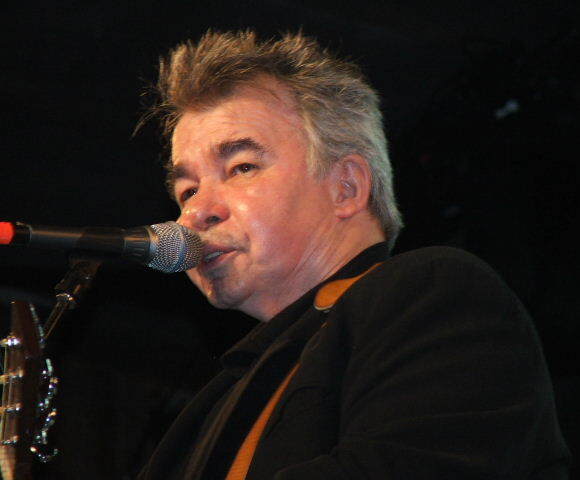
John Edward Prine (; October 10, 1946 – April 7, 2020) was an American singer-songwriter of country-folk music. Widely cited as one of the most influential songwriters of his generation, Prine was known for his signature blend of humorous lyrics about love, life, and current events, often with elements of social commentary and satire, as well as sweet songs and melancholy ballads. He was active as a composer, recording artist, live performer, and occasional actor from the early 1970s until his death. Born and raised in Maywood, Illinois, Prine learned to play the guitar at age 14. He attended classes at Chicago's Old Town School of Folk Music. After serving in West Germany with the U.S. Army, he returned to Chicago in the late 1960s, where he worked as a mailman, writing and singing songs first as a hobby. Continuing studies at the Old Town School, he performed at a student hang-out, the nearby Fifth Peg. A praising review by Roger Ebert put Prine on the map. Singer-songwriter Kris Kristofferson heard Prine at Steve Goodman's insistence, and Kristofferson invited Prine to be his opening act. Prine released his eponymous debut album in 1971. Featuring such songs as "Paradise", "Sam Stone", and "Angel from Montgomery", it has been hailed as one of the greatest albums of all time. The acclaim Prine earned from his debut led to three more albums for Atlantic Records. Common Sense (1975) was his first to chart on the Billboard U.S. Top 100. He then recorded three albums with Asylum Records. In 1981, he co-founded Oh Boy Records, an independent label which released all of his music up until his death. His final album, 2018's The Tree of Forgiveness, debuted at No. 5 on the Billboard 200, his highest ranking on the charts. Prine struggled with health issues throughout his life, surviving cancer twice. He died in 2020 from complications caused by COVID-19. Earlier the same year, he received the Grammy Lifetime Achievement Award.
Prine was the son of William Mason Prine, a tool-and-die maker, and Verna Valentine (Hamm), a homemaker, both originally from Muhlenberg County, Kentucky. He was born and raised in the Chicago suburb of Maywood. In summers, they would go back to visit family near Paradise, Kentucky. Prine started playing guitar at age 14, taught by his brother, David. He attended classes at Chicago's Old Town School of Folk Music, and graduated from Proviso East High School in Maywood, Illinois. He was a U.S. Postal Service mailman for five years and was drafted into the United States Army during the Vietnam War, serving as a vehicle mechanic in West Germany before beginning his musical career in Chicago.
In the late 1960s, while Prine was delivering mail, he began to sing his songs (often first written in his head on the mail route) at open mic nights at the Fifth Peg on Armitage Avenue in Chicago. The bar was a gathering spot for nearby Old Town School of Folk Music teachers and students. Prine was initially a spectator, reluctant to perform, but eventually did so in response to a "You think you can do better?" comment made to him by another performer. After his first open mic, he was offered paying gigs. In 1970, Chicago Sun-Times film critic Roger Ebert heard Prine by chance at the Fifth Peg and wrote his first printed review, "Singing Mailman Who Delivers A Powerful Message In A Few Words":He appears on stage with such modesty he almost seems to be backing into the spotlight. He sings rather quietly, and his guitar work is good, but he doesn't show off. He starts slow. But after a song or two, even the drunks in the room begin to listen to his lyrics. And then he has you....Prine's lyrics work with poetic economy to sketch a character in just a few words. After the review was published, Prine's popularity grew. He became a central figure in the Chicago folk revival, which also included such singer-songwriters as Steve Goodman, Michael Peter Smith, Bonnie Koloc, Jim Post, Tom Dundee, Anne Hills, Gary Growden and Fred Holstein. Joined by such established musicians as Jethro Burns and Bob Gibson, Prine performed frequently at a variety of Chicago clubs. He was offered a one-album deal of covers and with a few of his original songs, by Bob Koester from Delmark Records, but decided the project was not right for him. In 1971, Prine was playing regularly at the Earl of Old Town and The Dangling Conversation coffeehouse. Steve Goodman, who was performing with Kris Kristofferson at another Chicago club, persuaded Kristofferson to go see Prine late one night. Kristofferson later recalled, "By the end of the first line we knew we were hearing something else. Twenty-four years old and writes like he's two-hundred and twenty. It must've been like stumbling onto Dylan when he first busted onto the Village scene."
Prine's eponymous debut album was released in 1971. Kristofferson invited Prine and Goodman to open for him at The Bitter End in New York City. In the audience was Jerry Wexler, who signed Prine to Atlantic Records the next day. The album included Prine's signature songs "Illegal Smile" and "Sam Stone". "Sam Stone" is about the trauma of a Vietnam veteran. He explained in 2011: I knew there were a lot of GIs out there, who came out of the war and they weren’t quite right. … I knew there were homes where nobody was talking to each other, which became "Angel from Montgomery". … I knew there were kids who didn’t have fathers, and nobody ever acknowledged it, which became "6 O’Clock News."… I saw all that. I knew, and I couldn’t figure out why no one would say anything. "Paradise" is about the effects of surface mining on his parents' hometown of Paradise, Kentucky. The album also featured "Hello in There", a song about aging that was later covered by numerous artists, and "Far From Me", a lonely waltz about lost love for a waitress, which Prine later said was his favorite of all his songs. The album received many positive reviews, and some hailed Prine as "the next Dylan". Bob Dylan himself appeared unannounced at one of Prine's first New York City club appearances, anonymously backing him on harmonica. Prine's second album, Diamonds in the Rough (1972), was a surprise for many after the critical success of his first LP; it was an uncommercial, stripped-down affair that reflected Prine's fondness for bluegrass music and features songs reminiscent of Hank Williams. Highlights of the compilation include the allegorical "The Great Compromise", which includes a recitation and addresses the Vietnam War, and the ballad "Souvenirs", which Prine later recorded with Goodman. His subsequent albums from the 1970s include Sweet Revenge (1973), containing such fan favorites as "Dear Abby", "Grandpa Was a Carpenter", and "Christmas in Prison", and Common Sense (1975), with "Come Back to Us Barbara Lewis Hare Krishna Beauregard". The latter album was Prine's first to chart on the U.S. Top 100 by Billboard and reflected his growing commercial success. It was produced by Steve Cropper. Bruised Orange (1978) is a Steve Goodman–produced album that gave listeners songs such as "That's The Way That The World Goes 'Round", "Sabu Visits the Twin Cities Alone", "Fish and Whistle", and the title track. In 1974, singer David Allan Coe achieved considerable success on the country charts with "You Never Even Called Me by My Name", co-written by Prine and Goodman. The song good-naturedly spoofs stereotypical country music lyrics to create what it calls "the perfect country and western song". Prine refused to take a songwriter's credit (stating he was too drunk when the song was written to remember what he had contributed) and Goodman received sole credit. Goodman bought Prine a jukebox as a gift from his publishing royalties. In 1975, Prine toured the U.S. and Canada with a full band featuring guitarist Arlen Roth. Pink Cadillac (1979) features two songs produced by Sun Records founder Sam Phillips, who by this time rarely did any studio work. The song "Saigon" is about a Vietnam veteran traumatized by the war ("The static in my attic's gettin' ready to blow"). During the recording, one of the guitar amplifiers blew up (which is evident on the album). The other song Phillips produced is "How Lucky", about Prine's hometown.
In 1981, rejecting the established model of the recording industry, which Prine felt exploited singers and songwriters, he co-founded the independent record label Oh Boy Records in Nashville, Tennessee. His fans, supporting the project, sent him enough money to cover the costs, in advance, of his next album. Prine continued writing and recording albums throughout the 1980s. His songs continued to be covered by other artists; the country supergroup The Highwaymen recorded "The 20th Century Is Almost Over", written by Prine and Goodman. Steve Goodman died of leukemia in 1984 and Prine contributed four tracks to A Tribute to Steve Goodman, including a cover version of Goodman's "My Old Man".
In 1991, Prine released the Grammy-winning The Missing Years, his first collaboration with producer and Heartbreakers bassist Howie Epstein. The title song records Prine's humorous take on what Jesus did in the unrecorded years between his childhood and ministry. In 1992, Prine performed a duet with Margo Timmins on "If You Were the Woman and I Was the Man" from the album Black Eyed Man by Cowboy Junkies. The two acts embarked on a co-headlining tour through 1992, touring on their respective album releases and performing duets between Prine and Timmins in each set. In 1995, Lost Dogs and Mixed Blessings was released, another collaboration with Epstein. On this album is the long track "Lake Marie", a partly spoken word song interweaving tales over decades centered on themes of "goodbye". Bob Dylan later cited it as perhaps his favorite Prine song. Prine followed it up in 1999 with In Spite of Ourselves, which was unusual for him in that it contained only one original song (the title track); the rest were covers of classic country songs. All of the tracks are duets with well-known female country vocalists, including Lucinda Williams, Emmylou Harris, Patty Loveless, Dolores Keane, Trisha Yearwood, and Iris DeMent.
Sources
Net-worth figure: Celebrity Net Worth (October 2026), in USD. Biography and career facts: the person's Wikipedia article and linked reporting. Snapshot date for all StarWorth figures: 28 October 2026.